No. 102 — Is it a go?
It’s March 20, 2025, and you’re reading the newsletter from Médianes.
Hello, everyone,
Book clubs are no longer limited to libraries or elite literary circles. More and more media outlets, journalists, and creators are using them to build their communities. Want to give it a try? Here are three media outlets and formats to draw inspiration from when starting your own book club.
In this issue, you’ll also find the very first FAQ section of our newsletter, “Les 10 liens.” Every two weeks, my colleague Owen Huchon shares his readings and discoveries on media news, the world of the web, and innovative formats. I’m sure you’ll have far more than ten questions to ask him.
Finally, in our roundup: a return to sensory experiences, an indie publishing festival, management practices that strike fear, a cultural media outlet on YouTube, and job listings, of course.
Enjoy the read,
— MARINE SLAVITCH, JOURNALIST AT MÉDIANES
Why not?
IDEAS FOR YOUR MEDIA
It can be very easy to set up; it’s a deeply political—and therefore engaging—identity marker; it’s useful, and you can make it a lot of fun. Why not start a book club for your media outlet? The best part: the format can be tailored to your audience, your resources, and your stage of development—whether you’re looking to build your first community, build audience loyalty, or increase brand awareness.
To start with
Did you know? The letter-based publication *La Disparition* launched with a newsletter featuring cultural recommendations. Intended as a way to generate interest in their print project, the newsletter attracted 1,600 subscribers in four months—even though not a single letter had been sent out yet. What was meant to be just a launchpad ended up continuing as a complementary offering to the print publication, turning the recommendations into a media outlet in its own right. It’s a way to bring their values to life and establish a strong editorial line.
⟶ To learn more, read our interview with François de Monès, co-founder of La Disparition.
To generate new revenue
The newspaper El País realized that a book club could be a way to strengthen its subscribers’ engagement. By limiting access to a private Facebook group to paying readers only, it creates an exclusive discussion space where members can interact with journalists and authors. The result: subscribers feel valued and remain more loyal to the publication. A great idea for monetizing your audience: why not offer a book club exclusively for premium subscribers, featuring exclusive meetups and private discussions on Discord or Slack?
To create interactivity
Streamer Maxime Biaggi has reinvented the book club by making it interactive. With two weeks to read a book, followed by a Twitch session to discuss it, he turns reading into an opportunity to connect and engage with his community. What makes this format so effective? The group dynamic, instant engagement, and the spontaneity of live streaming. Could this idea be adapted for other platforms like Instagram Live or YouTube, by hosting discussions with authors or researchers?
★ We, the book club, imagine it in a “Real” format on Instagram. This lets us bring it to life and introduce you to lots of awesome magazines. Have any ideas for how to improve it? Want to collaborate? Reply to this email.
Over in Médianes
PROJECT SPOTLIGHT
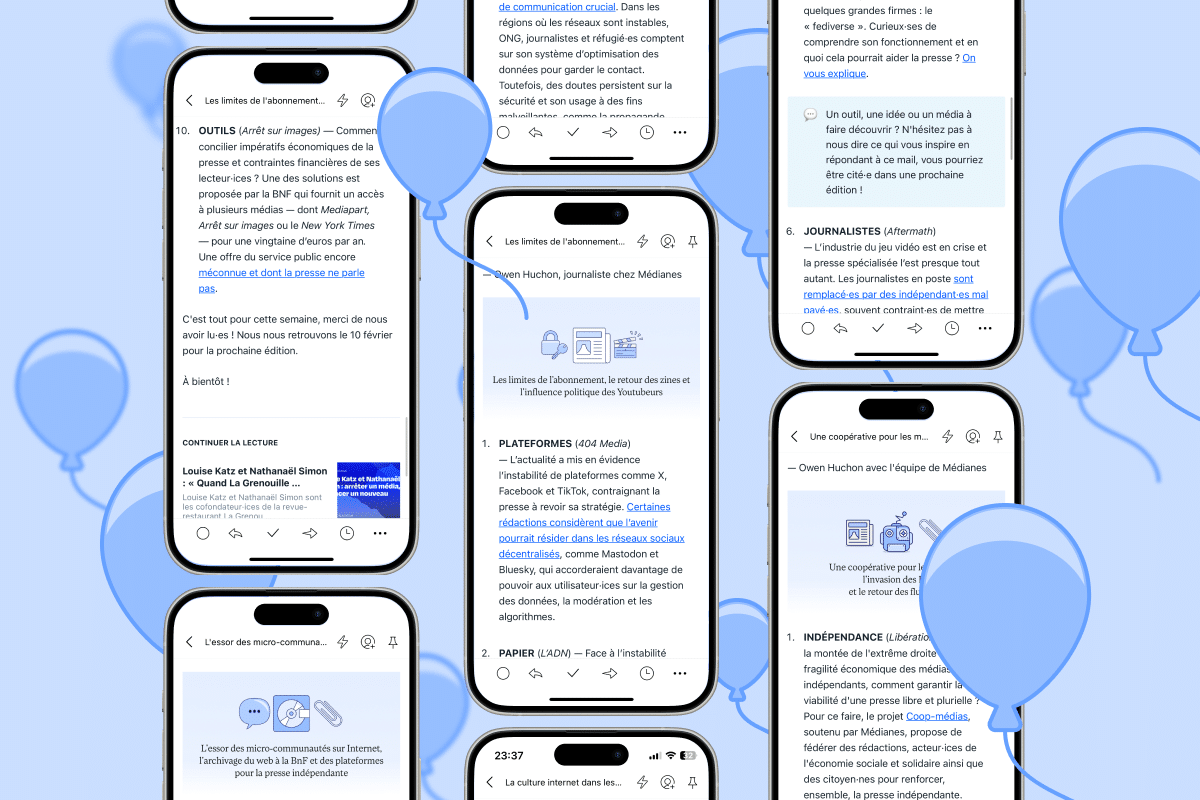
Exactly one year ago, we launched our third newsletter, “Les 10 liens,” with a promise: to provide you with a regular selection of analyses, perspectives, and tools to help you understand the media ecosystem, identify best practices, and anticipate future challenges in the industry.
These 10 links now embody the ambition that will guide the evolution of our editorial offerings: to guide founders and executives in their strategic decisions and to provide those who believe in the importance of a free and independent press with food for thought as they grapple with major challenges.
After more than twenty issues and hundreds of shared links, we wanted to take the time to give you a behind-the-scenes look at this format by answering the questions you regularly ask us about our editorial choices, methods, and tools. Do you have any other comments, questions, or suggestions? Feel free to write to us!
On Our Radar
OUR MARKET RESEARCH TO SUPPORT YOUR PROJECTS
I love, I love your sensory experience
AMANDA MULL / BLOOMBERG
The more storage our phones have, the more we document… and the less we remember. Conversely, physical objects (such as concert tickets or movie tickets) remain emotional anchors and tangible reminders of our past. Bringing back physical elements—limited editions, posters, and the like—could strengthen engagement and emotional connection with your audience, and even bolster your business model.
So blurry
BRICE LAEMLE / LE MONDE
Finding “the right balance between friend, father, and boss” is like taking a penalty kick: we dream about it (though, personally, not so much), but in reality we often miss the mark. While the success of So Press (Society, So Foot, Tsugi…) leaves little room for doubt, its management model—somewhere between cronyism and vague authority—raises questions. In the media, management is all too often the blind spot—an oversight that can weigh heavily on the well-being and stability of teams. Here are a few concrete ideas to try to do better.
Over at medianes.org
IT'S HOMEMADE
How Der Spiegel replaced its comments section with a debate platform
HANAA’ TAMEEZ / NIEMAN LAB — TRANSLATED BY OWEN HUCHON
The German news outlet Der Spiegel has replaced its comment sections with “Debate,” a platform where subscribers discuss current events selected by the editorial staff. This system improves the quality of discussions, facilitates moderation, and provides a better understanding of readers’ opinions, while fostering positive and constructive interactions.
Advertisements
SPONSORED OR PARTNERED CONTENT
- The Sphera team looks forward to seeing youMédianes on April 10 in Perugia for a festive evening that will provide an opportunity to meet other independent media professionals from across Europe.
- Christelle Perrin, artistic director of Médianes, is in Nantes today for the Media Design Lab’s third anniversary. She’s participating in a panel discussion on design tools for the media. If by any chance you happen to be in the area, let us know!
Book your ad here.
Whether it’s a job posting, a media launch, or a new service, you can reach our community of over 5,000 media executives and journalists for €150 per newsletter, while supporting our editorial content.
In Brief
THAT WAY, YOU'LL KNOW
• Mediapart, Forbidden Stories, Booska-P…: These media outlets are hiring. Check out their job openings.
• Isn’t publishing a form of media? The first Independent and Political Book Festival will take place on May 17 and 18 in Marseille.
• What if we partnered our media outlets on an international scale to expand their reach? The Sister Libraries initiative could serve as an inspiration.
• CFJ students are taking Instagram by storm with these interviews with media personalities. It’s an accessible format that drives engagement and sparks lively discussions in the comments section.
• Should people interviewed in documentaries be paid? Director Elodie Font invites us to engage in a collective ethical discussion.
• Editor’s Pick: Illegally Blondes, a new YouTube channel that analyzes cultural and media discourse. Well-researched, highly inclusive, and very clever.
See you on April 3!
Thank you for your messages, which have helped us enrich this newsletter. We’d also like to take this opportunity to welcome the teams from the CNRS, *Le Monde*, *Imagine Magazine*, and everyone else who has recently joined us.
See you on April 3. Until then, take care of yourselves and your social media.
— THIS NEWSLETTER WAS PREPARED BY MARINE SLAVITCH IN COLLABORATION WITH THE MÉDIANES TEAM.
MEDIANES.ORG — MEDIANES.STUDIO
Médianes is on Instagram, Bluesky, and LinkedIn.