The start of the school year always has that bittersweet feeling—sweet and bitter at the same time. Sweet because it smells of fall, fresh paper, and good resolutions. Bitter, because we already know those resolutions will shatter against the reality of our busy lives, and that we’ll spend more time staring at our screens than flipping through the latest gems from our bookstores.
This year, this ambivalence has never been stronger around me, and I’m also aware that I’m now even more sensitive to it. After an apocalyptic summer, international news that remains as grim as ever, and a digital addiction that seems more toxic than ever, the words are the same: “This start to the school year is intense,” “I’m already swamped,” “I didn’t even have time to recharge or disconnect.” And yet, we’re very good at telling others to do what we never apply to ourselves: disconnect regularly, cut back on screen time, stop letting productivity dictate every free hour… in short, reduce the hold that technology and capitalism have on our lives!
Running a media outlet or an organization with a social mission often means having your hands full—and I experience this myself every day, torn between the desire to do a good job, having no time for anything else, and even less time to rest and reflect. Eventually, you manage to catch your breath just to ask yourself how to (cross out as appropriate): make up for lost revenue, make sure your team is doing well, avoid getting sick, launch the project that will ensure the growth of your media outlet without destroying the planet, try to sleep, exercise, and eat healthily without blowing your budget, and continue to find meaning in a world that seems to be heading a little closer to disaster every day. That’s really the crux of it for anyone who leads or is part of an impact-driven project: how to contribute through their work to a more just, inclusive, and sustainable society—without forgetting, in the meantime, to breathe and make time for life.
✅ Looking for (very) practical advice? Further down in this column, you’ll find two handy lists: our management principles and a few more personal tips we’ve tested at [company name] toMédianes really make time for ourselves.
Choosing to Lead Differently
Personally, this is the seventh school year I’ve ledMédianes, and I can tell that I’m experiencing this one differently—with more perspective and a desire to strike a better balance in my work, both for myself and for the teams I support. I don’t think this is simply the result of experience—both lived and observed—of turning thirty (though…) or of having lost that initial spark (quite the opposite, in fact). I think it’s the result of a multitude of reasons, both personal and professional. These are fueled by witnessing the difficulties of many projects that have been launched—wonderful in theory, but causing so much suffering in reality, for their leaders, their teams, and our ecosystem.
But I had a radical epiphany: this spring, by trying so hard to juggle everything and putting my needs after those of others, I felt like I was burning out. Beyond just not feeling well, I wasn’t sending the right message internally, and I ended up fueling the very system I was criticizing. It must be said that there’s been no shortage of challenges here overMédianes the past two years: a team that doubled in size, the integration of a new organization (Sphera), financial difficulties that brought us face-to-face with the end, the arrival of our first three babies (including one in management), accidents, loved ones to support, and news that never ceases to be terrifying.
What helped me get through that? First of all, amazing partners and loved ones, who helped me take a break, recharge, and slow down. We don’t talk enough about how important your support network is when you’re starting a project! On a more structural level, we were able to draw on the skills we’d learned in our management training, adapt our roles, and apply to our leadership what we’d already been implementing at the team level: work can’t come at the expense of our well-being. In fact, it’s the very condition for its success.
So how can we—individually and collectively—give ourselves the means to slow down so we can lead (and live) differently?
If we wear ourselves out, who will be left to change the world?
Before we go any further, we should make it clear that here at [name]Médianes, we don’t claim to be experts in our own field or to be the media’s oracle. We simply seek, in our own way, to share practices that we believe are effective in order to develop more viable and sustainable models. And we believe that seeking to radically change our organizations and our society does not require a quest for perfection, nor a form of militant purity that would cause us to lose, along the way, both time and our humanity.
This is, in fact, what drives us to promote—both within our own organization and in the media outlets and organizations we support—a different approach to management, particularly in those where the “left-wing boss” syndrome is most pronounced. All too often, there is a disconnect between the editorial line and the values publicly championed by the organization, on the one hand, and the internal practices that undermine employees and expose them to very real psychosocial risks, on the other. Yet you cannot build a sustainable organization—or a transformation initiative that stands the test of time—by exhausting the very people who drive it.
Just as media entrepreneurship is not a sprint but a marathon, organizational well-being is essential to the very existence of the mission itself and is indispensable to the development of an independent media outlet.
? At Médianes, we view management as a necessary condition for the successful development of a media outlet, as explained by the leaders of organizations such as Contexte and Mediapart on our podcast *Chemins*.
Cut Off the Internet to Be Truly Innovative
When the school year starts, everyone has their own little rituals to get back on track, both in the short and long term. As for me, to remind myself of the importance of not just spending my life working and being constantly connected, I read or reread the utopian and devilishly political works of Hadrien Klent, the pen name of writer and journalist Raphaël Meltz, co-founder and former editor-in-chief of the now-defunct magazine *Le Tigre*.
In his latest science fiction novel, *Le Jour Zéro*, published by Éditions du Tripode, an unprecedented solar storm has fried every electronic device on the planet: “From the local level to the highest echelons of government, the same question keeps coming up: what if this were an unexpected opportunity to reinvent ourselves?” In the two-part series *Paresse pour tous* (2021) and *La Vie est à nous* (2023), we had already followed the journey of a left-wing economist who became president of the Republic, reducing the daily workweek to three hours—allowing everyone to discover the joy of living differently and enabling France to launch a new model of society.
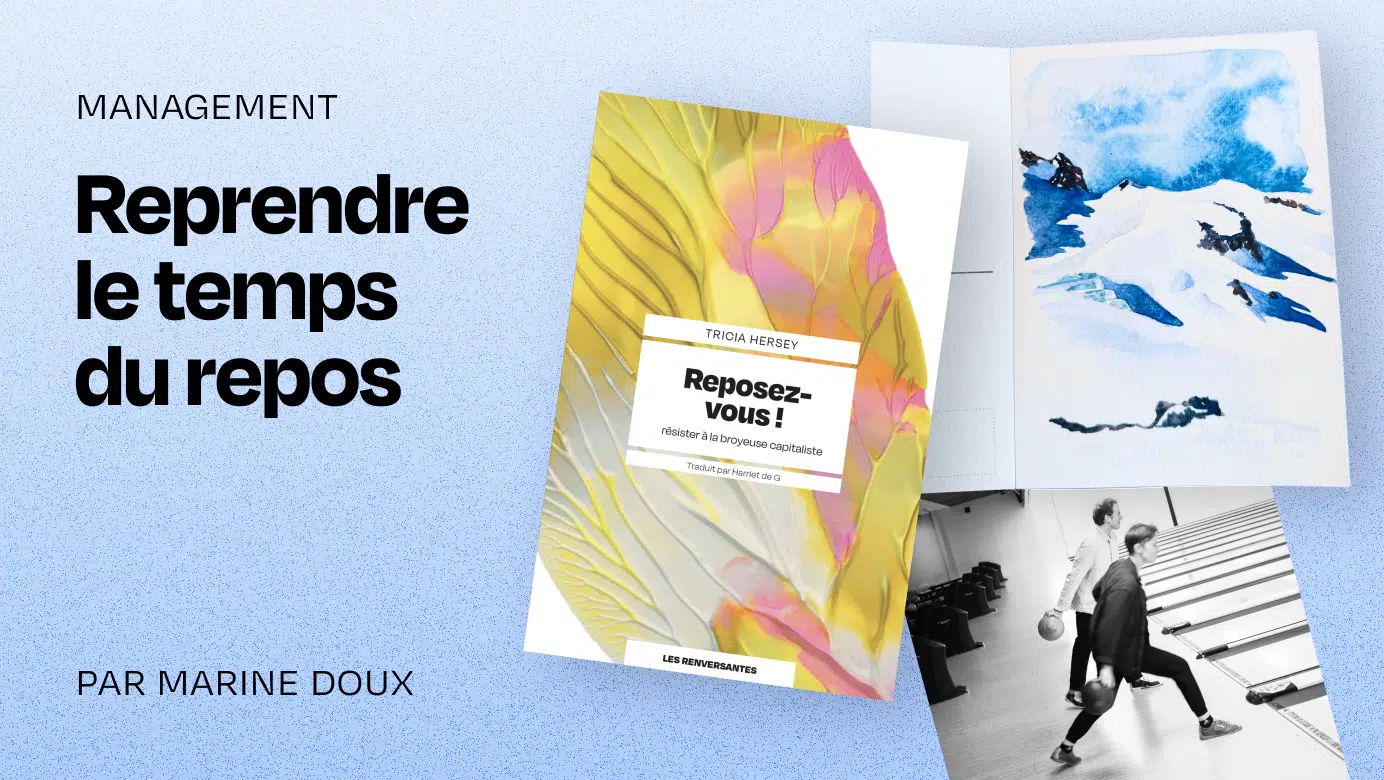
Victoire Tuaillon, who co-edits the *Les Renversantes* series at Leduc Publishing with Karine Lanini, made a similar point when she cited *Reposez-vous!* Resisting the Capitalist Grinder by Tricia Hersey, which aired on France Inter this summer: in the face of the climate emergency, solutions aren’t found by constantly picking up the pace, but rather by giving ourselves the right to slow down.
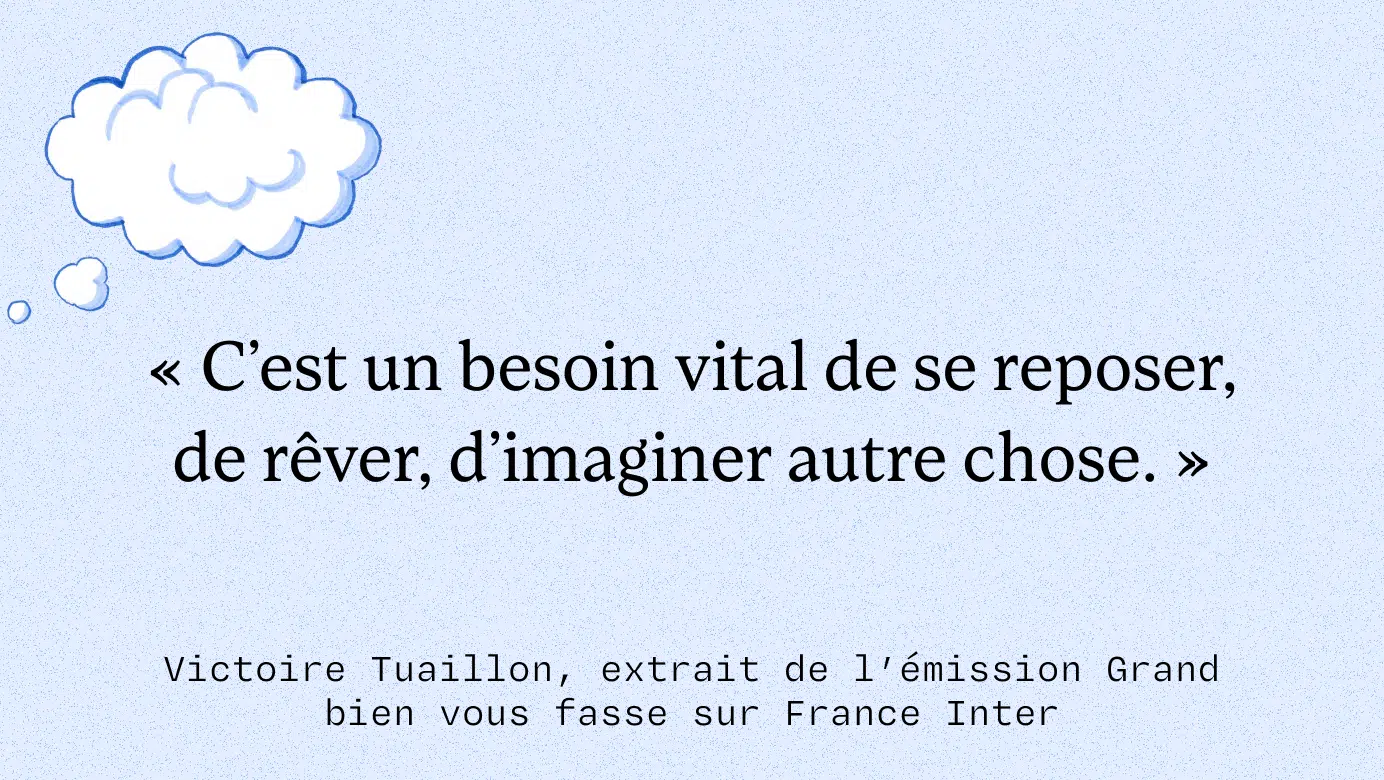
Quoting this manifesto—which is both combative and tender—Tuaillon explains that, to cope with the capitalist grind, “the author imposes Shabbats on herself, this concept from Jewish culture of radical breaks that can last for months, weeks, or at least once a week […] total disconnections from the Internet, from contacts, and from social media to have time to rest. This involves doing something that isn’t productive.”
My colleague Christelle Perrin, co-founder of andMédianes design director, explores this same idea from a different angle—that of her creative practice and her relationship to work—in her column “Slowing Down: A Design Practice That Goes Against the AI Trend.” In it, she recounts her three-week artistic retreat this spring and the three reasons that led her to embark on this adventure: “(1) to rest, (2) to get away from screens, (3) to paint and draw. I needed to see what I was capable of, while allowing myself the freedom to fail and not produce anything useful.” Taking time away to reclaim time, without necessarily producing anything commercially viable.
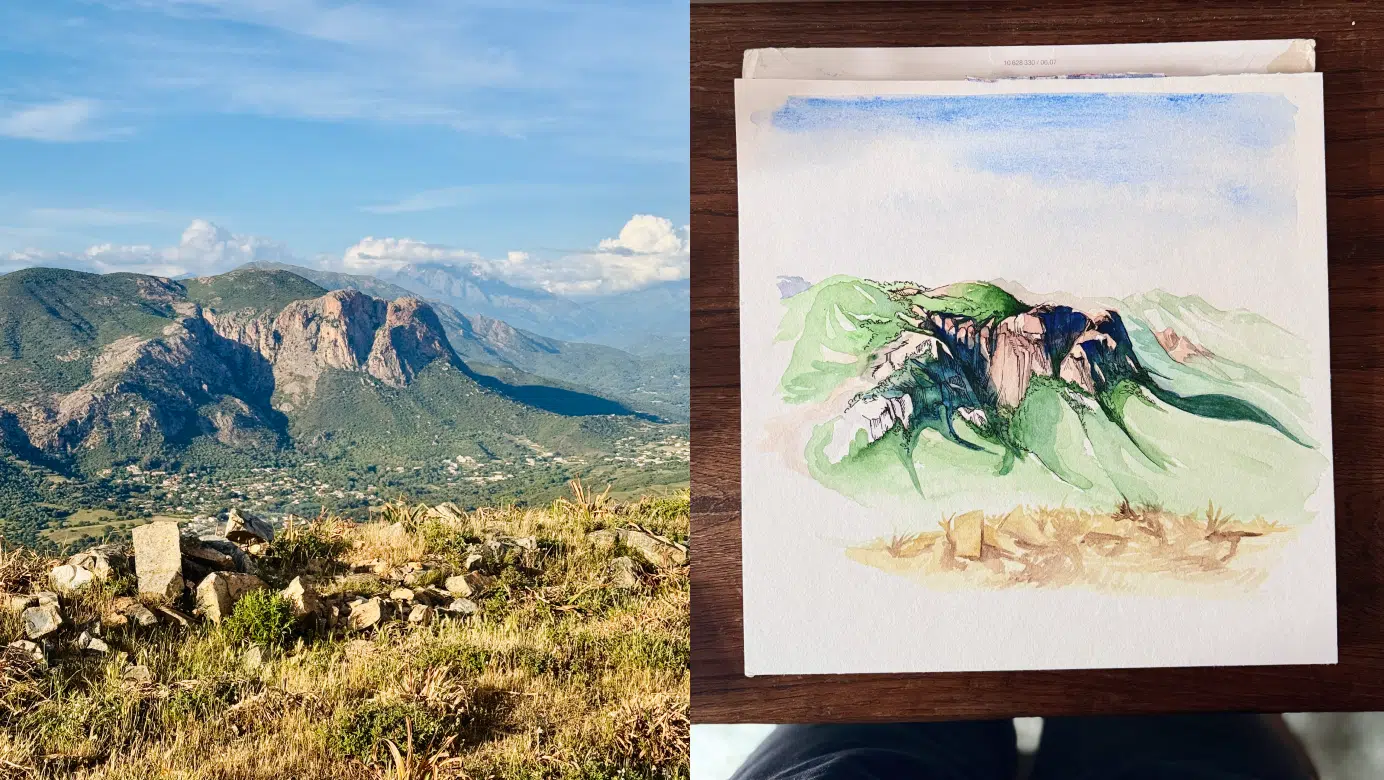

Taking this time—in a small organization and right in the middle of a busy period—is no easy feat, but it’s a choice that pays off in the medium term, not immediately: it’s a way to explore new creative horizons and foster productive individual practices within the company that enrich the collective (even the artistic direction teamMédianes has been embracing handmade work again since this summer!). In this specific case, we planned for this break from a managerial and financial standpoint to ensure it could take place under the right conditions—by working with her to organize her projects in advance and bringing in an experienced designer to take over during her absence— and then, for the long term, by establishing a weekly meeting to discuss current and future priorities with our two department heads (studio and media/network).More generally, the ability to plan ahead and communicate effectively is key to ensuring a smooth transition into vacation: not burning out beforehand and not being disturbed while on vacation.

Like the Labrosse sisters, the co-founders of Trouble Publishing, I like to think that the struggle begins in the imagination. And if that imagination is whittled down to almost nothing, how can we find ways to take action to defend independent journalism?
Setting aside time for yourself isn't the same as doing nothing
As the leader of a young organization committed to cultural independence, with about twenty members spread across several cities, I’m often asked if I’m able to “unplug.” I always answer that I do, but it’s no miracle. It’s the result of both individual and collective organization that makes this disconnect possible. Ten years after the El Khomri law, Le Monde noted last May that the right to disconnect remains, for many employees, a theoretical right.
A few years ago, at the launch of Médianes, I shared my concern with a media founder that I might be consumed by my work—that mix of passion, commitment, and work that ends up taking over everything, coupled with an inability to set boundaries. At the time, he replied that I’d just have to get used to it: the next ten years would be like that, and that was really the only way a dedicated organization could function. (Spoiler alert: Five years later, this media outlet isn’t doing well, and due to high turnover, it’s struggling to recruit.) Once I got past the fear of not being in the right place—of not fitting into the only model I’d been told was possible—we decided, together with the management at [name]Médianes, that this project shouldn’t come at the expense of our values or, ultimately, our well-being and that of our team. In short, leading by example. At [company name]Médianes, this is the conviction we strive to uphold: best practices, tools, and training aren’t achieved overnight—they require ongoing maintenance—but we believe they are crucial. It is this conviction that led us to document these principles in greater detail in a series titled “Transparency, Trust, and Rigor: Everything You Need to Know About Our Management Practices.”
In practical terms, this plays out on two levels: the level of the principles we collectively uphold, and the level of the more personal choices that each of us can make on our own, but which are key when leading an organization. These lists are, of course, not exhaustive; the idea is to share practices that might work for you.
Here are a few management principles we've implemented at :Médianes
- to trust everyone;
- establish clear and shared project management practices, document and share our technical and interpersonal skills, and question the value of certain meetings;
- Whether working remotely or in person, remind employees of the importance of taking breaks and offer informal, optional opportunities to socialize;
- Establish monthly one-on-one meetings with the manager (template available at this link);
- adopt a work structure that better suits our needs: being able, when possible, to work remotely for both short and longer periods, and to be flexible regarding both remote work and work schedules (not everyone is—or can be—a morning person);
- introduce appropriate types of leave, such as menstrual leave;
- Turn off visual and audio notifications on both your cell phone and computer to help you stay focused;
- make our availability visible in our calendars, with clear time slots for the whole team…and take this opportunity to add our workout sessions to our calendars;
- Set aside half-days or full days without meetings, or even designate one day a week to work differently (Fridays!): no client or partner meetings, more time for yourself, or internal brainstorming sessions… or oil painting or writing sessions, depending on the line of work! ;
- use dedicated work tools for communication (no, WhatsApp isn't one!);
- Plan ahead and work together to organize the workload so that we can adjust our schedules and go on vacation without any extra stress.
A few more personal tips for leaders:
- Talking to those around you about your journey is always easier when you have people around you who support you in taking care of yourself and with whom you can share your thoughts;
- learn about yourself and how to take care of yourself and your mental health—if possible, seeing a psychologist can be very helpful, either through the free government program or through occupational health services;
- Try meditation and/or cardiac coherence (some members of our team use the Headspace or RespiRelax apps)—it helps clear your mind and improves your ability to concentrate as well;
- (re)connecting with an artistic, creative, or athletic activity, without any focus on performance;
- turn your smartphone into a “dumbphone” by limiting or even removing social media from it, and remember that there are plenty of things you can do without it;
- walking in nature, hiking, swimming: anything that takes you far away and gets you away from screens;
- read, read, read (and not always books related to one's work or political essays);
- to have clearly defined work periods (so no work during those times, yes!).
Of course, this list isn’t a magic formula for actions that work every time: you have to experiment to find the approaches that work for you. And finally, these actions are no substitute for a broader political and economic movement that would transform our relationship to work in society.
Reaching New Heights, Together
In practical terms, this also involves spending time together as a team. At [Company Name]Médianes, we’ve been operating in a hybrid format since 2020: half of our team works from Paris, while the rest works remotely from various cities in France and across Europe (Toulouse, several cities in Brittany, Marseille, Florence). And because remote work and its flexibility are part of our corporate culture, this also means there are times when we all get together.
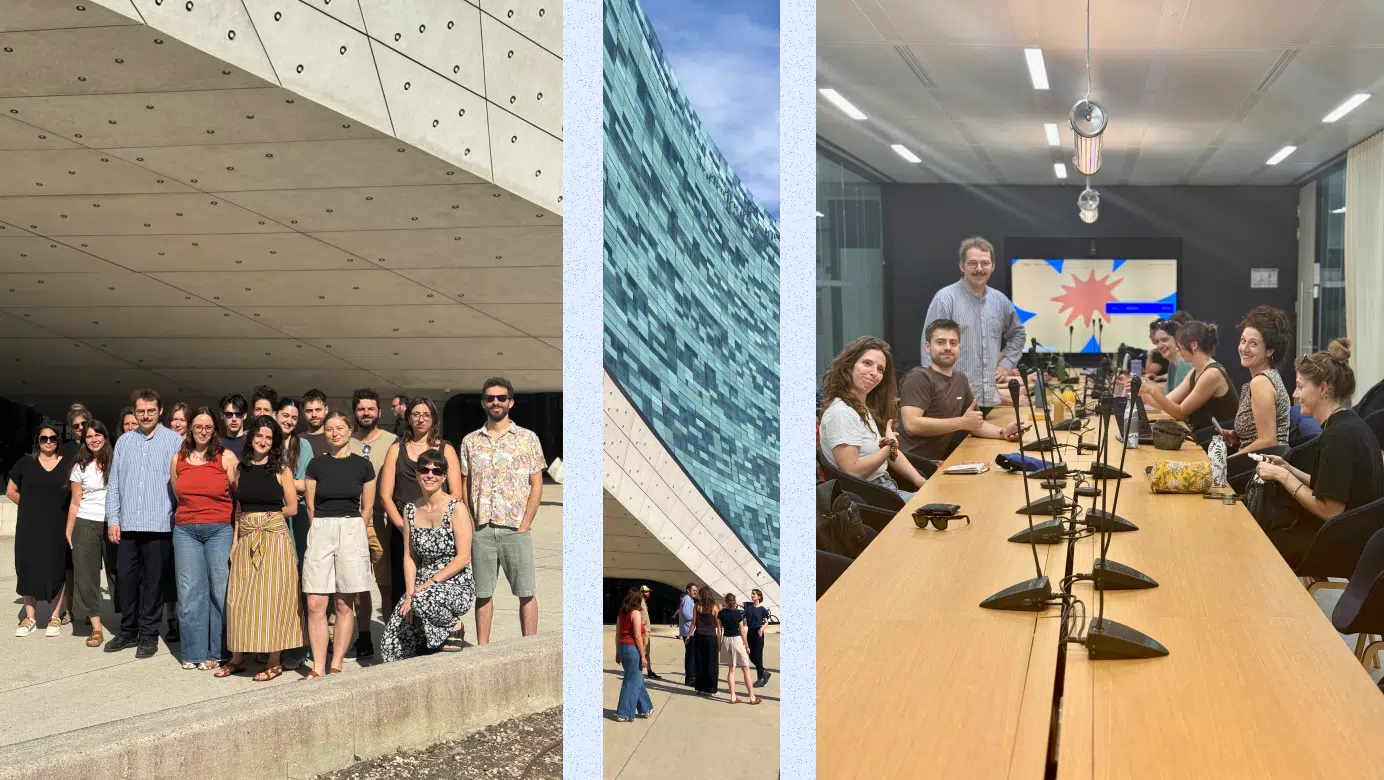
Twice a year, before the end of each half-year, we hold a team seminar to take stock, assess our progress, and set the roadmap for the coming period. It’s a way to review our progress, reflect on both our successes and challenges, assess our progress, define the roadmap for the year, and discuss our goals and projects for the coming months. Above all, these are moments for us to step away from our daily routines, allowing us to gain perspective, break out of our silos, create new dynamics… and enjoy some informal (non-mandatory!) time together playing a game of mölkky.
? At our studioMédianes, we apply this method to serve our media clients, from Harmonie Santé to Les Jours, Vert, and Disclose. Learn more about our expertise in management and executive coaching.
Setting aside time for oneself, therefore, can be neither a luxury nor an optional extra that we allow ourselves only after urgent matters have been dealt with. It is a discipline—both individual and collective—that is built over time: a day off every now and then, a right to disconnect that is taken seriously, thoughtfully designed workshops, and intentional breaks from meetings. Above all, as Hersey and Klent each remind us in their own way, it is the prerequisite for continuing to imagine another world rather than simply surviving in this one. The struggle begins in the imagination—but we must still set aside the time for it.