
Bringing journalists on stage to discuss their investigations: this practice is emerging as a major trend in an industry seeking solutions and a connection with its community. A survey conducted by the European Journalism Center identifies some 30 live journalism initiatives across Europe, and figures from the Reuters Institute, published in January 2026, confirm a gradual increase in interest in this format: 54% of media executives surveyed rank events—both online and in-person—among the revenue drivers to focus on this year, and building community through events is among the priorities identified in the face of competition from AI.
Like many strategies devised by newsrooms in recent months, the origins of this movement owe much to the emergence of new technologies that are disrupting the industry and to social media platforms that have become too unpredictable. The same Reuters Institute report also lists the figures reported by the media outlets surveyed: a 43% drop in referral traffic from Facebook and a 46% drop from X over the past three years, and an expected decline of more than 40% in search traffic within the next three years due to generative AI. Newsrooms fear losing touch with their audience and, as a result, see this as a threat to their revenue.
In search of alternatives on a web that seems dominated by GAFAM, media outlets are looking for ways to do without them by taking matters into their own hands. By organizing events and taking the stage to share their journalism, they free themselves from intermediaries with opaque methods. No more algorithms, SEO, or GEO—just a special moment to deliver information on their own terms and at their own pace. Through live streaming, media outlets hope to break through a wall that seems to be growing ever thicker between them and their audience. But which audience?
An audience that's much the same
“We’re not going to beat around the bush,” replies Nathanaël Simon, co-founder of Les 3 Ours, when asked about his audience’s profile. “The people who come to a show are, first and foremost, people who are already informed—or even very well informed.” ” Since 2025, the media outlet—based primarily in Rennes—has presented more than a dozen different shows, bringing journalist Cindy Hubert to the stage to recount the Mazan rape trial, photographer Louis Witter to recount his reporting in Mayotte, and Jonathan Dagher, head of the Middle East bureau for Reporters Without Borders, to describe their work protecting journalists in Gaza since October 7, 2023, and the death toll. After each performance, the media outlet distributes a questionnaire to audience members to create a demographic profile: “intermediate professions” and “managers and professionals” together account for just over half of the audience, says Nathanaël Simon, with a notable presence of teachers, professionals in the sociocultural sector, and journalists. Average annual income: between 20,000 and 40,000 euros.

The same was true on the other side of the country, at Mediavivant, which staged its own investigative productions for three seasons, primarily in Marseille, before closing its doors for good in early 2026 due to an unsustainable financial situation. According to Alix de Crécy, co-founder of Mediavivant, the format also attracted an audience that was already well-informed. “This was somewhat at odds with our initial positioning, since we originally wanted to use the event as a way to reach out to those who were less informed,” she explains. Over the years, the media outlet had built up a sort of core audience (30% of attendees returning at least three times per season) that Alix de Crécy describes as people between the ages of 35 and 45 who live downtown: “That was me, actually—people like us, like those working in the media.”
To make its events more accessible, Mediavivant had, in particular, adopted a pay-what-you-can pricing strategy. “The more you pay, the more you enable those who can’t afford it to attend this type of event,” explains Alix de Crécy, while noting that price isn’t everything. “I’m not sure that everyone feels they have the right—even if it’s free—to enter the Théâtre du Châtelet (located in downtown Paris, Ed.), for example,” she speculates, noting that choosing small venues rather than large theaters for Mediavivant’s performances has helped limit this sense of social and cultural illegitimacy. As suggested by a Finnish study on live journalism published in 2021, price and location are not the only filters. Formats in which a journalist recounts, in the first person, their reflections and introspections regarding a work-related topic “would likely attract primarily middle-class audiences already well-versed in self-reflection and personal development,” write researchers Juho Ruotsalainen and Mikko Villi.
Les 3 Ours have also refined their pricing policy, offering, for example, a reduced rate of 6 euros exclusively for residents of Rennes. Nathanaël Simon himself puts this strategy into perspective, noting that it sometimes attracts people with significant informational and cultural background, but who may find themselves in more precarious situations—such as unemployment—rather than being out of touch with current events. Despite its limitations, this strategy remains a way to set themselves apart from other models. “When you have a show in Paris that costs 30 or 40 euros—or even up to 60 euros—you know very clearly what kind of audience you’re reaching, and you know you’re creating a barrier to entry,” he says.
Ways to expand the audience
For these media outlets, much of what defines their audience profile also hinges on the choice of topic itself. At Mediavivant, each investigation attracted a different audience, reflecting its theme. An event on Ukrainian refugees brought together historians and students; an investigation co-produced with Mediapart on homophobic traps attracted a predominantly LGBTQIA+ audience; and an event on pollution in Fos-sur-Mer drew a crowd of environmental activists. For the media outlet, the strength of the format also lay in its commitment to bringing not only journalists but also sources, witnesses, and those directly affected by the stories onto the stage. After each presentation, the speakers would leave the stage to join the audience for an open discussion. During an event dedicated to drug consumption rooms in Marseille, “there were many users who came to hear the investigation,” recalls Alix de Crécy. “These were people who couldn’t afford the admission fee. We welcomed them all.”
The situation is similar for Les 3 Ours: according to their own figures, more than 65% of audience members cite the theme as their primary reason for attending. The Rennes-based theater company then adapts its formats to suit its target audiences. A play about incest, currently in production, is designed to be sold and performed in medium-sized cities, through municipal theaters or local sociocultural organizations. The goal is to bring a topic—one that people in urban centers are becoming increasingly aware of—to audiences outside those geographic areas. To reinforce this strategy of reaching new audiences, the team is developing more streamlined formats: for 2027, Les 3 Ours plan to launch “news stand-up” shows, designed to minimize logistical and material requirements—and thus costs—so they can more easily travel to schools, libraries, or businesses. The topics covered will focus more on media literacy—such as how the press covers news stories—in a deliberately more playful format designed to stand the test of time: unlike a show tied to a specific news story, it “goes out of date” less quickly. In addition to its theater performances, Les 3 Ours also organizes press reviews at media libraries, sold to institutions for between 550 and 600 euros and offered free of charge to the public: “Since we operate on a sharing model—which is what we also offer to local media libraries— is that once a press review has already been created […] if others want to purchase it, they’ll pay 250 euros,” in order to encourage wider distribution, he explains.
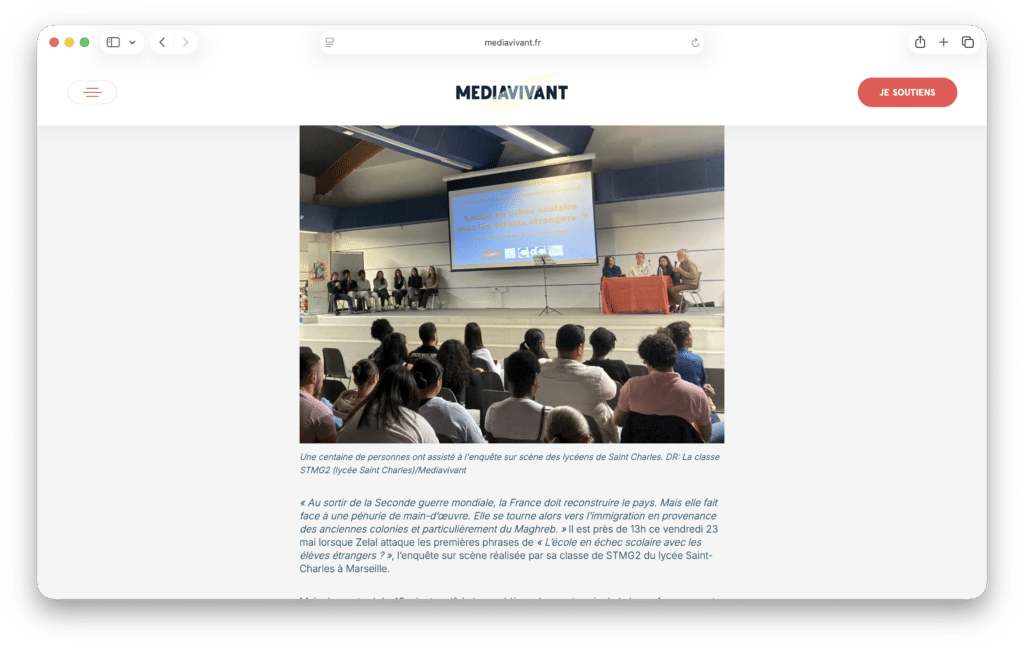
Another key factor: the school system. For each of its productions, the Rennes-based theater company includes a performance for students—free of charge when the organization that purchased the show has covered the cost for everyone, or paid for by the middle school or high school, but never by the student. This is a key advantage, Nathanaël Simon points out, allowing a school to bring in an entire grade level—“an entire age group”—regardless of individual interest or financial means. Mediavivant has done the same through a program promoting media literacy among the general public. In 2025, for example, STMG2 students from Saint-Charles High School in Marseille presented on stage the results of a six-month investigation conducted alongside Mediavivant: “Is the School System Failing Foreign Students?”
Is it more or less as exclusive as the Internet?
That leaves a more thorny issue: that of recording. Filming a performance is, in theory, the simplest way to reach a wider audience without being constrained by cost or borders. The German media outlet Correctiv has made this a central pillar of its theater strategy. As part of its major investigation into a far-right network meeting secretly in Potsdam, the editorial team simultaneously prepared a theatrical adaptation of their work, which was performed seven days after the investigation was published. The event was streamed live for free and watched by 19,000 people simultaneously, in addition to the 700 people in the live audience. But the media outlet also made the script freely downloadable and royalty-free, allowing any theater to stage it without paying a penny in royalties. The result, according to David Schraven, co-founder of Correctiv, who spoke about it at a roundtable in Perugia this year, was more than a hundred performances across the country, at no additional cost to the media outlet.
But filming isn’t an obvious solution for every story. Les 3 Ours categorically refuse to film. “Filming isn’t interesting,” declares Nathanaël Simon, who points to the weight of the topics covered by the media—often serious and sometimes sensitive for the people sharing their stories. Without recording, the participants gain greater freedom of expression; for the co-founder, the absence of recording becomes an integral part of the format itself rather than a limitation to be overcome. Mediavivant had made the opposite choice, systematically recording its performances: its on-stage investigations are made available in full on YouTube and as podcasts. For Alix de Crécy, the result is undeniably different: “What we’re selling when we present a media production on stage is the live experience, which is pretty wild.” According to the journalist, recording serves to extend the show’s reach, not to replace it.
This difference in scale raises a broader question that affects the entire industry: What is an audience? The typical reaction is to compare the numbers for an online article to the capacity of a theater and conclude that the web always wins based on the figures detailing clicks and page visitors. But this line of reasoning is based on a confusion between reach and actual consumption, argued Jean Peters, editor-in-chief of Correctiv, at the International Journalism Festival in Perugia, noting that a click does not equal a read: “You write a real investigative piece, you put a tremendous amount of work into it, and it gets 100,000 clicks on your site. Except that we know that out of those 100,000 clicks, there are perhaps 80 people who read the entire text. ” A room filled with several hundred people listening for an hour—in silence and without distractions—may generate less “reach” in the statistical sense, but it guarantees that the information is consumed in its entirety and with full attention… An impact that is much harder to measure using statistical tools.
Live performances also allow for geographic targeting, something the web, by its very nature, cannot do. This is partly why Mediavivant has deliberately chosen to stage its shows in small venues rather than large institutional theaters, focusing part of its outreach on distributing flyers and posters on the street ahead of each performance to build a local, targeted audience. For Alix de Crécy, this method had a real impact on attendance: “I think that if we had tried not distributing flyers and just putting up posters around Marseille, I’m not sure the events would have been as sold out.”