While it might seem that live journalism often goes hand in hand with a carefully produced spectacle, there are other ways for media outlets to do live coverage—and plenty of good reasons to give it a try. Whether it’s to offer a different editorial experience, create a highlight for your audiences, showcase your content, or foster a sense of community with your followers, for example.
In this case study, “live” refers to an interaction between a media team and its audience: a scheduled event, set in advance, experienced simultaneously by both parties, with no restrictions on format or number of participants, whether in person or via videoconference. This definition is intentionally broader than that of “live journalism,” which the European Journalism Center describes as a practice that involves bringing a (verified) news report to the stage to turn it into a shared experience.
Live journalism is often—and rightly so—associated with a performance centered on journalists performing in front of an audience; some media outlets devote themselves exclusively to this format (such as Live Magazine, a French initiative that produces “live newspapers” on stage), while others organize it on an ad hoc basis for specific occasions (such as the Falter Arena, performances by the Viennese weekly Falter).
But this is just one form among many: the formats, topics, themes, participants, venues, and pacing vary from one project to another. Live programming can thus be adapted to different models and stages of development for any media outlet—including yours.
1. Does this apply to me?
Live events aren’t just for news organizations that can rent a large performance venue. They’re accessible to media outlets of all sizes, regardless of their budget, editorial focus, or geographic location. A partner café, a bookstore, a media library, or even your own offices are all that’s needed to organize a meet-and-greet with your audience, without the costs and logistics of a performance venue.
This can serve several different (and sometimes complementary) objectives. For example: strengthening the bond with its audience, for media outlets seeking to break free from their dependence on digital platforms or diversify their revenue streams, in a context where the media economy is often under strain. This can help mark a key moment for the newsroom, to highlight a topic, a new product, an anniversary… By allowing you to go against the imposed logic of social media (algorithmic constraints, immediacy, etc.) and finally take control of the pace, as well as the conditions under which information is disseminated and received—without having to satisfy any algorithms.
If any of these examples sound familiar to you, this applies to you!
2. Why do this?
2.a Building connections with audiences and your team (or just having a good time)
Launch parties, live podcast recordings, or other more informal gatherings that step away from journalism itself—these “in-person” moments (as we’ve been saying since the pandemic) are opportunities to see each other, talk, and share something together. And that’s already a lot! It’s a valuable opportunity not only to have a good time but also to meet your audience, understand their needs and expectations, and more. These moments of interaction provide an opportunity to engage directly with your audience through various audience engagement tools: surveys shared via QR codes, a show of hands, an applause meter… or simply by asking questions in person!
A great idea: Les 3 Ours invite the audience to submit questions via a WhatsApp number, which the team answers at the end of the show. This helps make the exchange more efficient (one person can handle receiving, sorting, and compiling multiple questions while someone else answers them) and encourages audience members who are less comfortable speaking in public to participate.
These highlights also provide an opportunity to showcase other team members beyond journalists, offer a behind-the-scenes look at the media outlet, announce upcoming initiatives, and, above all, spark discussion. These are all ways to build audience engagement and loyalty… and to help transform your audience into a community. This approach is particularly useful for projects whose business model relies on audience engagement (donations, subscriptions, etc.) to ensure the sustainability and strength of their model.
2.b Share information in a different way to make a lasting impression
For print or web editorial teams, offering a live experience means providing their audience with a different way of engaging, a different way of experiencing—or, to put it less elegantly, “consuming”—information. It’s more active, more engaging, and more immersive. Live content engages more senses than reading an article or watching a video alone. It offers a unique sensory intensity, specific to live events, where meaning is also created by and with the audience in attendance. For a newsroom, it’s a way to reaffirm its dynamic, human dimension and diversify its formats beyond the written word. For the viewer, it’s a way to develop a more sensory and intimate relationship with information.
2.c Highlight a key editorial moment; showcase its content
Live coverage also provides an opportunity to highlight a key moment related to a topic on which the editorial team wishes to take a stance.A media outlet may occasionally host an event to highlight a report, a series, or an investigation, as L’Heure du Monde—a podcast by the newspaper Le Monde—did during the preview of the podcast “The Spanish Civil War: The Echo of Silence.” The live broadcast, co-organized with the Cervantes Institute (dedicated to promoting the Spanish language and culture), was followed by a panel discussion. This format also provides an opportunity to forge partnerships with organizations that share common themes or values—which can also lighten the organizational burden by providing valuable resources (venues, visibility, expertise, etc.). When its book was released, the French media outlet StreetPress organized a bookstore tour to meet its audience. It was also an opportunity to highlight its editorial offerings.
2.d Diversify Your Business Model
Live events can also serve as a source of supplemental revenue through ticket sales or event-related partnerships. This is an avenue that news organizations looking to diversify their business models should not overlook!
Several French-language magazines have taken up the topic by occasionally organizing events designed for a live experience, with a corresponding ticketing system. The Belgian media outlet Imagine occasionally organizes live events featuring its journalists on stage. Philosophie Magazine, a monthly philosophy journal, is launching the first edition of PhiloLive in 2026—a ticketed philosophy festival that brings together the thinkers who regularly contribute to its pages. Usbek & Rica is organizing “Futur” for the second consecutive year, a festival supported by numerous partners. In all three cases, the logic is the same: to offer its audience a different kind of experience, in line with its editorial focus, while generating an additional source of revenue through ticket sales.
2.e Reaching New Audiences
Reaching out to audiences who don’t naturally engage with your content by leveraging venues or formats they’re familiar with is another good reason to get started with live streaming. But how do you go about it? If you focus all your promotional efforts on social media to promote the event, you run the risk of reaching the same audience—one that’s already accustomed to consuming your digital content.
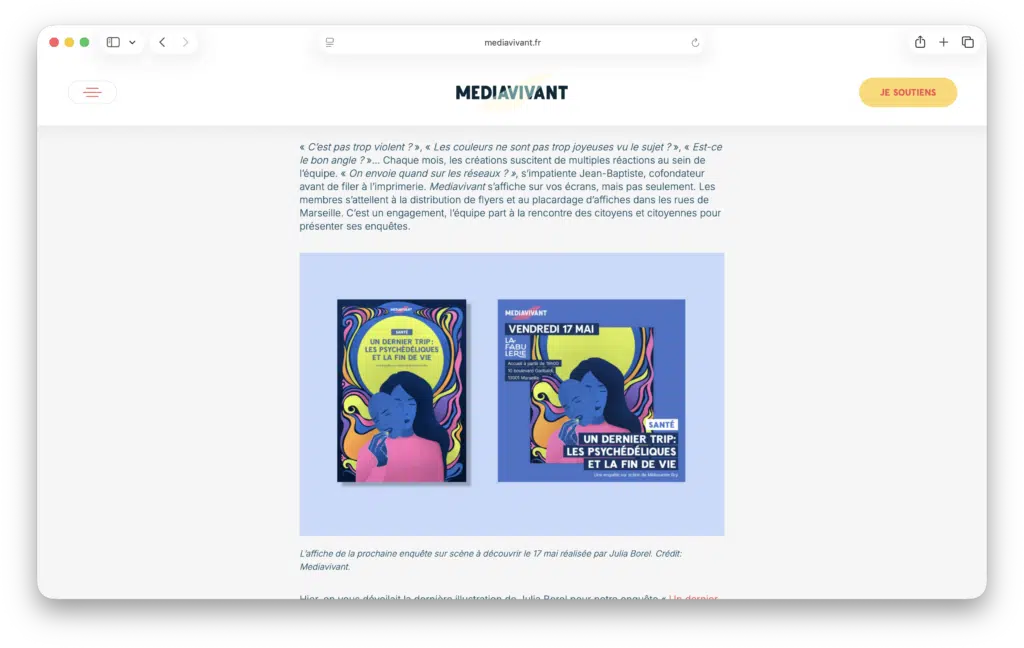
A great idea: the French media outlet Mediavivant, which ceased operations in 2026, distributed flyers and put up posters on the street ahead of its shows in an effort to reach a new, local audience.
So what does that mean in practice? Reaching new audiences is a priority for many newsrooms. But there’s often an underestimated gap—in terms of resources, preparation, and strategy—between the temptation to expand the audience and the actual ability to do so. Here are three questions to ask yourself before getting started.
2.f Thank your supporters and donors
To thank your donors or readers, organizing a meetup can help foster a sense of belonging and make the impact of their financial contributions more tangible. If you want to make this a key part of your fundraising strategy, you don’t have to organize a large-scale event—especially if you plan to hold them regularly. Virtual meetups can be a great way to acknowledge their support and strengthen their long-term commitment. They require neither a venue nor travel, and offer a special opportunity—unlimited by geography—reserved for those who support the media outlet. It’s a simple format that’s easy to repeat. For example, the media outlet *Le 1 hebdo* offers its donors a remote discussion forum, by participating in the monthly “Petite conférence de rédaction” (Small Editorial Meeting), attended by the editor-in-chief and experts, to discuss current events and “test (…) story ideas.”
A Great Idea: Tenoua, a French online media outlet dedicated to Jewish thought, hosts a quarterly video discussion between a team member and a guest to discuss a project, explore an issue, introduce a notable figure and their journey, or offer a behind-the-scenes look at the media outlet. This regular event is reserved for donors, serving both to thank them and to strengthen the bond with them.
While this format offers several advantages, it’s important to keep certain limitations in mind and anticipate any difficulties you might encounter. Live events come with uncertainties—and thus a loss of control compared to written or pre-recorded content: a speaker who cancels at the last minute, a technical issue, or a smaller-than-expected audience. This is also what makes them valuable, but you need to accept these risks up front. Also consider security concerns: going out to meet your audience can expose your editorial team to interactions that may be more or less challenging. Be sure to discuss these risks with your team and consider appropriate responses in case of a problem. It’s also not always easy to diversify your audience through live streaming. A paid performance in the city center and a live stream on social media do not reach the same audience at all. There’s a real risk of always reaching the same people—often urban dwellers in higher socioeconomic brackets—rather than broadening your audience.
3. Where to start?
Once you've identified your motivation, the idea is to choose a format (and how often it takes place) that aligns with your ambitions, your goals, and the size of your team. In other words: be realistic.
3.a. Be realistic
Not every editorial team has the capacity to put on a show—and it isn’t always necessary. The first step is to identify what’s feasible given the resources at hand (available time, in-house skills, budget), but also what truly meets your audience’s expectations. It’s about distinguishing between what sounds appealing and what’s actually feasible, rather than jumping into an overly ambitious format just because it’s trendy. A “live” event doesn’t necessarily have to be an in-person gathering: a live social media broadcast or a video conference with the editorial team can just as effectively serve the purpose of humanizing the brand, building a connection with the audience, or hosting a Q&A session—all for a fraction of the cost and preparation time required for an in-person event.
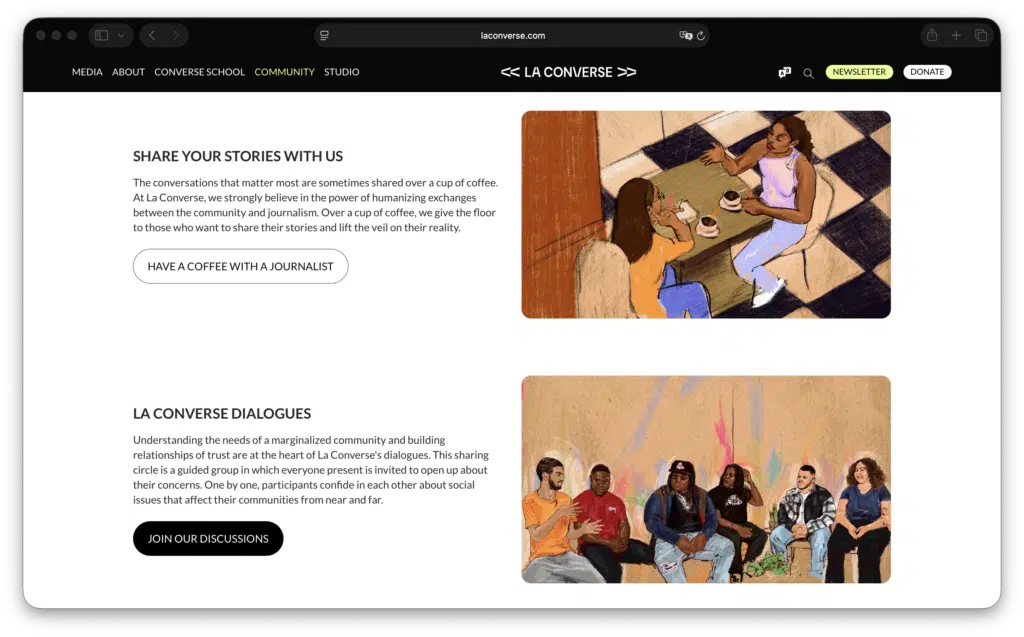
Live events can be low-key or more artisanal, like the “guided walking tour” organized by the Marseille-based techno-critical collective *Le Nuage était sous nos pieds* to explain what’s happening around data centers. The Quebec-based media outlet La Converse, for its part, invites its audience to “book” a coffee date with the editorial team to give “a free platform to people who wish to speak out and shed light on their reality.” It’s a way to come together and learn, without having to rent a venue or deal with overly complex logistics.
3.b. Knowing What to Say
The choice of format also depends on what the editorial team wants to highlight: a specific investigation, an anniversary, a major current events issue, or, more broadly, its approach to work. A story that lends itself well to dramatic presentation (a field investigation rich in anecdotes, plot twists, and characters) does not call for the same format as a discussion segment focused more on the inner workings of the newsroom or on major issues in the news.
3.c. Gauge public interest
How can you ensure that this audience will show up? A few simple steps can help minimize this risk: promote the event in advance through your channels (word of mouth, audience research, opening pre-registration) to gauge the level of interest.
A Great Idea: The Paris-based media outlet Arrêt sur images wanted to organize its first event outside the capital. The team, hoping to launch a series of events outside Paris, held a vote among its audience to choose the first city on the tour, and Toulouse won. For the occasion, the team recorded a live broadcast there focused on media coverage of the recent municipal election campaign, inviting one of the candidates and a local journalist. By grounding the topic in local rather than national news, the event became more relevant to its audience. The result: a nearly full 450-seat venue.
3.d. Choose the format/frequency
Once the audience and the narrative have been defined, the next step is to choose the format that best suits them—and, above all, its frequency. A one-time event (such as a special evening to launch an investigation) does not require the same level of organization as a recurring event. Both have their advantages. A one-time event creates a sense of exclusivity and generates enthusiasm among the team and the audience; a recurring event establishes a routine and can eventually become a recognizable, go-to format.
Both approaches come at a cost: the one-time approach requires remobilizing everything each time—preparation, communication, logistics—without benefiting from the momentum created by recurrence; conversely, recurring initiatives require sustaining the effort over the long term, even when current events are less conducive or the team’s resources are limited.
It’s therefore better to start with a one-time event—even if that means making it a permanent feature once the format has proven successful—rather than committing right away to a recurring event that you won’t be able to sustain over the long term.
The Good Idea: The German media outlet Correctiv is seeking to develop a replicable format rather than one-off productions. Their major investigation into far-right and Nazi networks in Potsdam has been adapted for the theater, and the script can be freely reused by theaters across the country. At the International Journalism Festival in Perugia, David Schraven, the outlet’s co-founder, mentioned dozens of different performances… without it costing them a penny more.
3.e Considering Resources and the Business Model
A live event comes with costs—both direct (venue rental, technical equipment, marketing) and indirect (preparation time, involvement of multiple team members). These costs must be anticipated from the outset, depending on the scope of the chosen format: a picnic or a video conference doesn’t require the same level of funding as a live performance. Unsurprisingly, funding remains the main obstacle to developing this type of format. It’s up to you to weigh the ratio between the necessary investment (time, money, and the team’s energy) and the expected benefit—whether that translates into community engagement, direct revenue, or simply visibility for your media outlet.
Also note that the benefits may not be immediate. The goal isn’t necessarily to generate direct revenue, but to boost the media outlet’s visibility, strengthen reader loyalty, or simply boost team morale. These are all benefits that are difficult to quantify, but very real indeed!
4. What's next?
Now that the event is over, there are several questions to consider in order to get the most out of it. This is also a good time to assess whether it was a success—keeping in mind that this concept is defined first and foremost by your initial goals. Since this type of event may be quite different from what you’re used to organizing, the criteria for success may also differ from those you typically use—and may be less straightforward to quantify precisely. Here are a few suggestions.
4.a Shall we do it again? Should
this event become a recurring feature—or even a signature format for your media outlet? The question of whether to make it a permanent feature often arises after a successful first attempt. That is, provided—as mentioned above—you have the resources to sustain it over the long term.
A Good Idea: What if you partnered with other newsrooms to pool your resources and cut costs in the process? After all, live coverage can also be seen as a tool for collaboration among media outlets, rather than a standalone format. The Scottish Beacon, a Scottish network of local and independent newsrooms, organized “The Power Shift Live,” a one-day event in Glasgow that brought together journalists, researchers, activists, and community voices to discuss the energy transition in Scotland. The event served as an opportunity to launch both a special print issue and a new network of environmental journalists. This approach strengthens ties between newsrooms and allows for the sharing of resources and costs: by pooling their efforts, small local media outlets can collectively organize a national-scale event that none could have hosted on its own.
4.b Thinking About the Audience Journey
We’re not going to let them leave just like that! The people who attended your event are likely among the most engaged members of your audience: coming requires real effort (setting aside time, sometimes paying, traveling…), which is more meaningful than just clicking on an article. The post-event period is an opportunity to plan your audience’s journey by building on the experience they’ve just had. After such a great time, don’t forget to thank them. Include a tailored call to action to engage your community (a donation appeal, promoting a subscription, signing up for the newsletter…), while using the event to better understand your audience—who came, why, and what their expectations were. The question is how to gather this information without detracting from the event itself: a QR code displayed in the venue that links to a short form; a paper questionnaire handed out at the entrance or exit; or, more informally, a guestbook where everyone leaves a note on their way out. It’s up to you to choose the format that best fits the atmosphere of your event.
4.c Replay or no replay?
Should you share the full recording, a few photos, or clips from the event? It’s up to you, depending on your goals. There’s no rule against it: in fact, some formats benefit from remaining exclusive to cultivate the value of the ephemeral, but also to encourage speakers to let their guard down and express themselves more frankly, which can be particularly beneficial when people who aren’t used to speaking in public are discussing difficult and personal topics.
Conversely, content shared after the event can also be used to engage new people and repurpose the content produced that day. It’s up to you to find the right balance between what to share and what not to share. This will depend on the audience you want to reach, as well as the topic you’ll be covering. Would you prefer the speaker to speak with confidence and freedom in front of a smaller audience, where they’ll have a greater impact? Or, on the contrary, would you rather create a moment that can be viewed later by a larger audience?
4.d Take Stock
Finally, measure your impact. Evaluate the event against the goals set beforehand: number of participants, results in terms of donations, subscriptions, press coverage, or brand awareness, qualitative feedback from your audience… This assessment will allow you to make an informed decision about whether the format is worth repeating. The joy of being together and having a good time can also count as KPIs!
With this type of format, it can be difficult to identify relevant data, since the outcomes differ so much from those typically tracked in your activities. Rather than evaluating the revenue generated or the newsletter’s open rate, it’s better to accept that the impact of an event is often difficult to measure and takes time to become apparent: increased loyalty, a sense of belonging to a community, a better understanding of the information, reduced “news anxiety”…
Be sure to take a step back as well. Even if the event didn’t meet all your expectations, it’s often still a highlight in terms of raising awareness and learning: an opportunity to bring new people on board and to apply the skills and knowledge you gained during the event in other contexts!