
What do Cuba, Iran, China, and France have in common? Before July 2026, they were the last countries where AI Overviews—those short, AI-generated summaries that appear at the top of Google search results—were absent. They arrived in France in the middle of summer, in late July, and concern quickly spread through newsrooms. For the press, the issue goes beyond the simple question of traffic: it’s the role of Google itself that is changing, as Jérémy Dousson, executive director of Alternatives Économiques, explains. “Google is moving up the value chain. Whereas before they indexed content, they’re now starting to produce it and are therefore competing with publishers. ” This competition comes from a company that is on track to invest $200 billion by 2026—particularly in AI—and is far from the only one reshaping the landscape of information distribution on the web.
Because the issue of content hoarding is not unique to Google. Meta recently announced its intention to “scrape” content from Meta Business accounts to train its AI models, before delaying the implementation of this plan in the face of opposition from media outlets. In France, five professional organizations (CPA, FNPS, GESTE, SEPM, and SPIIL) filed a complaint on October 30 with the European Commission, citing competition law. They condemn the rollout of AI Overviews “without consultation” and fear its effects on content visibility, media business models, and traffic. On this last point, recent changes imposed by tech companies also represent a new test of resilience for part of the press. Already accustomed to significant fluctuations on platforms, the press sees the Overviews as an opportunity not only to put its business model to the test but also to accelerate and strengthen direct distribution—bypassing intermediaries—in order to better inform its readership.
A decline in traffic—not necessarily a new phenomenon
On October 8, the Alliance for Press and Media Figures (ACPM) released the first data: approximately −20% for *Le Monde*, *La Dépêche*, and *Le Figaro* compared to September 2025, and as much as −49.7% for *Ici*. It remains to be seen exactly how much of this is attributable to the Overviews, and the newsrooms themselves are crunching the numbers with caution. At Alternatives Économiques, the recent redesign of the website makes interpreting the figures more difficult, but a drop in traffic has indeed been observed. “Based on the latest figures, roughly one-third of our SEO traffic has disappeared since July 22,” explains Jérémy Dousson, who prefers to remain cautious about the extent of the Overviews’ impact: “This should be taken with a grain of salt because a lot of things have changed at the same time.” The publication itself reported on its traffic decline in an interview with Nathalie Sonnac, a professor of information and communication sciences. Vert took a similar approach, reporting that September 2026 saw a 12% decline compared to the same month in 2025, “but more importantly, 44% below the 2026 average,” warns the online media outlet dedicated to climate issues.
At Basta, an independent online media outlet, a decline was also observed: “In September, compared to last year, we saw a drop of about 17% in traffic, and that’s just the decline in search engine traffic […] We’re seeing monthly visit numbers that are at a ten-year low,” notes Nicolas Camier, head of development, who also points out that he doesn’t yet have enough perspective to assess the exact impact of the Overviews. This phenomenon is not new for the independent media outlet, whose reach had already been impacted by Meta’s algorithm changes: “At one point, 40 to 45% of visits came from Facebook during certain periods,” he recalls. In 2024, Press Gazette reported a 58% drop in traffic from the social network over six years. This sense of dependence on social media platforms has helped strengthen the outlet’s resilience in the face of a new upheaval—this time involving search engines. “Our traffic has been steadily declining for seven or eight years, but our revenue has been steadily increasing for seven or eight years,” notes Nicolas Camier, who makes no secret of his surprise at a trend that may seem contradictory at first glance. The journalist, who sees this as a form of recognition and loyalty to the journalism produced by the editorial staff, remains optimistic about the outlet’s future, though cautious: “It can’t keep going down to zero.”
This decoupling between traffic trends and the health of the business model can also be seen at other media outlets, such as The Guardian and The New York Times, which—despite declining traffic—are seeing a steady increase in subscriptions and donations. “For us, the business model isn’t about audience numbers—it’s about subscriptions,” confirms Jérémy Dousson of Alternatives Économiques, “We’ve been following this approach for years now—not chasing audience numbers, but instead building a direct relationship with our readers.” This view is shared by Splann, a Breton investigative news outlet, for which traffic is not a metric that dictates editorial strategy: “It’s not at all a metric that we scrutinize closely or that influences decisions, editorial choices, or anything else. Instead, we look at newsletter subscribers and open rates,” says Sylvain Ernault, who notes that donations are steadily increasing. According to its financial report, published on its website, donations “increased by 86% in 2025 compared to 2024, rising from 175,000 euros to 323,000 euros.” This is a crucial figure for a media outlet that is 82% funded by reader contributions.
Mastering Your Channels
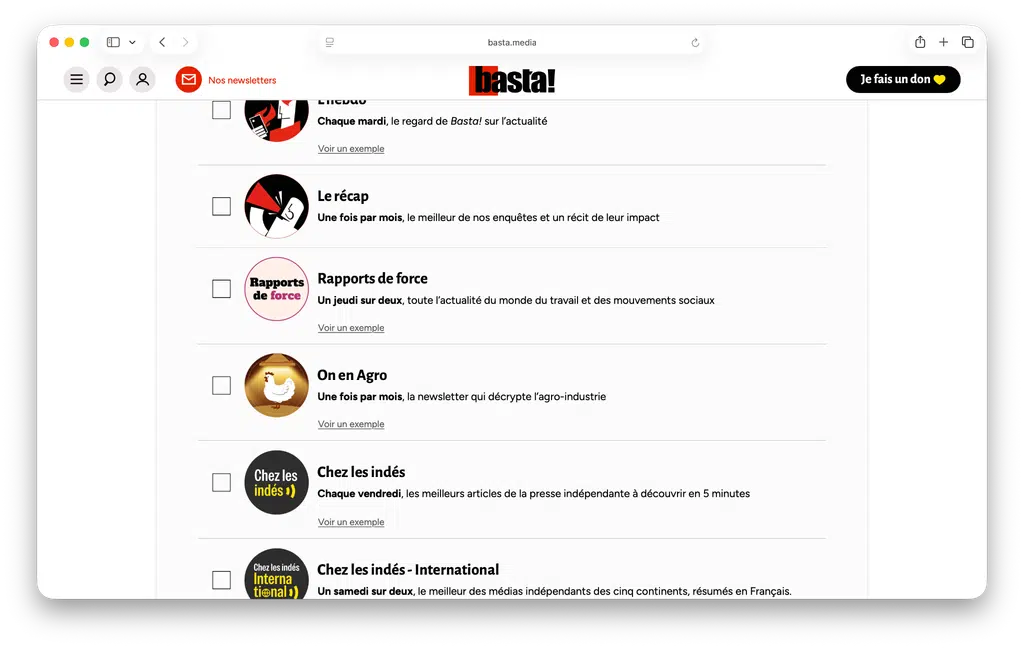
To offset declining traffic, Basta has opted for a strategy aimed at strengthening its community and, above all, building loyalty: “How can we better engage them, better thank them, better communicate with them, tailor our messages…,” lists Nicolas Camier. “We told ourselves: if we want to build their loyalty and engage them over the long term, we can’t be a nuisance […] We don’t ask them to donate when they’ve already done so.” ” The goal: to anticipate potentially lower traffic by strengthening and retaining a smaller but more loyal and engaged audience. This effort also involves an editorial approach that builds on the outlet’s strengths and niche areas, focusing in particular on highlighting its editorial line to clarify the value of subscribing to the media outlet: “ This has largely been achieved through themed newsletters that truly provide highly specific content to an audience that needs it and won’t find this information elsewhere,” explains Nicolas Camier. Considered a prime channel for developing a relationship independent of algorithms, the newsletter plays a key role in the outlet’s strategy. On its website, readers can choose from several newsletters, such as *On en Agro*, dedicated to the agribusiness sector, as well as *Rapport de force*, the result of a merger with the media outlet of the same name in January 2026, which focuses on the world of work and social movements.
A need to build reader loyalty was identified by media outlets long before the advent of Overviews, and this need has notably spurred the development of the “club” concept at certain news organizations, such as Vert, Chut!, and the British cooperative media outlet The Bristol Cable. According to the Reuters Institute, media outlets that already have direct traffic—without intermediaries—and a subscription-based model are far more confident about the future of their business model. Subscriptions and memberships remain the top revenue priority for 76% of the publishers surveyed. For some media outlets, their existing community also represents an attractive and effective way to expand their reach by turning their subscribers into ambassadors for their offerings. In Finland, Uusi Juttu, a media outlet launched with support from the Danish company Zetland, gained 10,000 new subscribers in 21 days thanks to a word-of-mouth campaign. The strategy: providing its existing audience with arguments and links to help them convince their friends and family to subscribe.
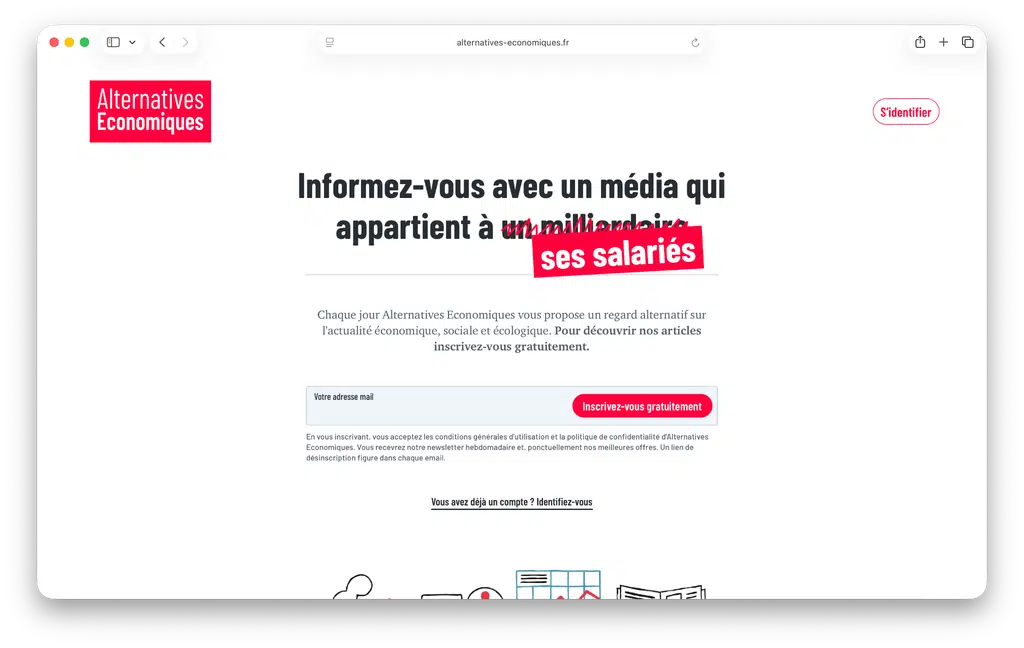
For Alternatives Économiques, the development of this direct relationship is embodied in the recent redesign of their website. For people who don’t yet have an account, the homepage first displays an invitation to sign up, followed by an explanation of the model and the editorial team’s work—more akin to an “About Us” page, or even a manifesto, than to a traditional media outlet’s homepage. “For us, the number one priority is for people to agree to create an account with us, to give us their email address, and for us to no longer be in a relationship mediated by a social network, a search engine, or anything else,” explains Jérémy Dousson.
But how far can this resilience go? Because while these newsrooms plan to rely on subscriptions or newsletters to build audience loyalty, how can they convince new people to subscribe if traffic continues to decline? “What we need to figure out is: are these people who are no longer visiting the site also no longer creating accounts or subscribing? Or, on the contrary, were the people who came through that channel ultimately fairly unqualified leads, in which case it would have less of an impact?” wonders Jérémy Dousson. For the media outlet, which also publishes a monthly print magazine, a diversification strategy in which the website isn’t the main focus is essential: “Today, a media outlet’s website is just one platform among many. We have the app, where usage is on the rise, as are newsletter subscriptions and views of our vertical videos.”
But even newsletters aren’t spared. Google is expanding the use of AI in its email inboxes, and Meta recently launched an assistant, Muse, capable of connecting to its users’ email accounts. “With our limited resources, we’re putting together a newsletter, but ultimately, we’re at the mercy of Gmail’s algorithms, for example. We’re never 100% secure,” admits Sylvain Ernault. To build an audience outside of these platforms, Splann relies heavily on in-person events. “We participate in maybe 40 or 50 events a year—festivals, film screenings followed by discussions […]. We also reach people directly, without going through their screens, and we don’t plan on stopping,” he explains. His media outlet sees this as an advantage: “The idea is really to diversify the ways we reach our readers. And since we’re a regional media outlet, we can more easily afford to be out in the field. […] It might be a trump card, an asset for us.”
The Collective as a Lever for Sovereignty
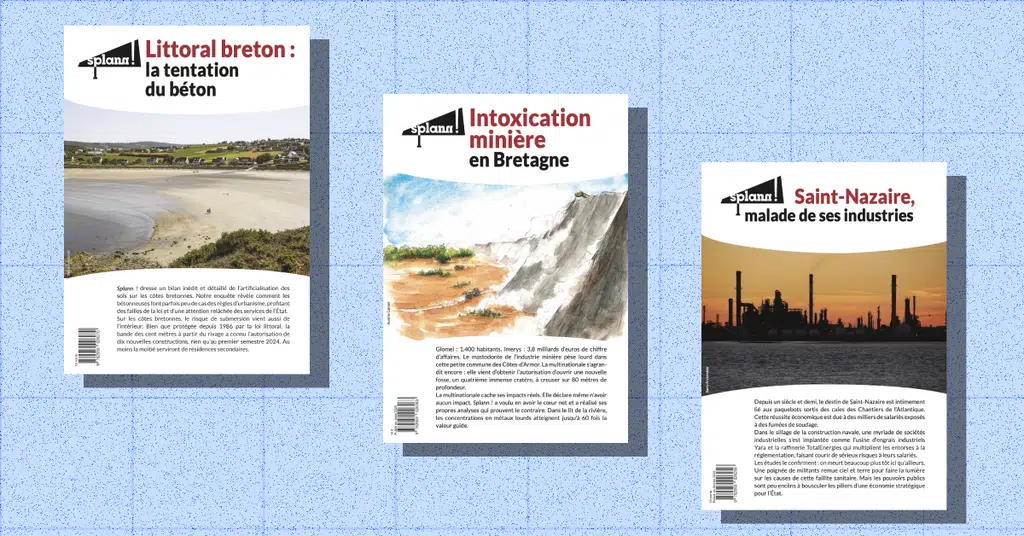
While Splann’s Breton editorial team focuses primarily on event coverage, the team is also developing strategies for content distribution. A few years ago, the outlet launched its booklets—physical editions of its investigative reports—which are sold for 11 euros on its website as well as in bookstores throughout the region it covers, and it also relies on its audience to distribute and give them away. This collaboration also takes the form of co-publication partnerships: “We consistently have distribution partners with larger audiences than Splann. It’s really part of our impact model,” says Sylvain Ernault. In February 2026, their investigation into the far right in Saint-Malo was published on the Mediapart website, and the outlet developed a partnership with France 3 Bretagne, which republishes its investigations on its website and provides them with airtime on the public broadcaster’s channel.
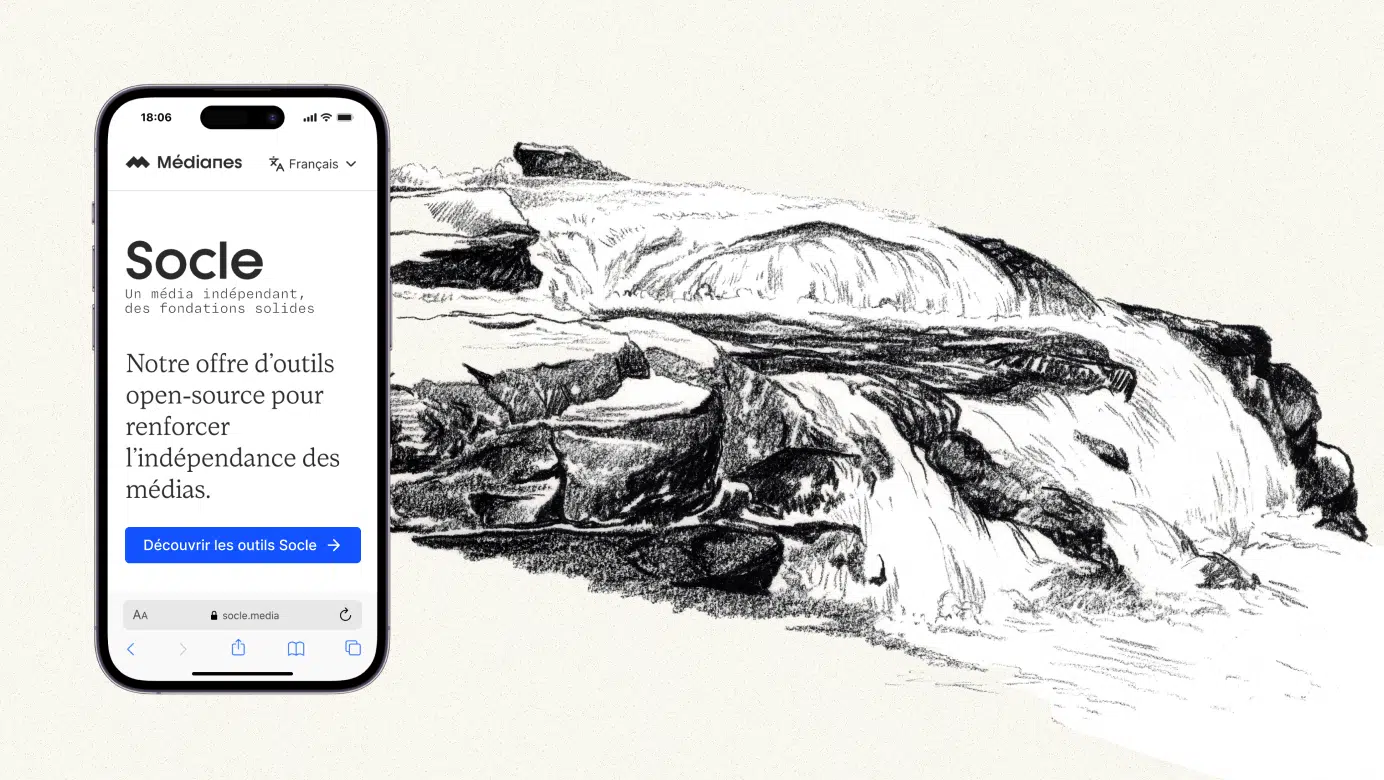
“Together, we represent a large audience. If we all pull in the same direction in certain areas, it clearly has an impact,” says Nicolas Camier, who sees this vulnerability as a collective opportunity. Basta is notably behind the development and management of the Independent Media Portal, a sort of alternative to Google News for the independent press: “It’s a tool that will make a name for itself, that will spread by word of mouth, and that will also grow in other ways—through events, more direct channels, and media recommendations…” This strategy of developing media-owned channels can be seen in Canada, particularly after Canadian newsrooms were banned from Meta’s platforms. In the wake of this, several of them joined forces under Unrigged, a website aggregating content from participating independent media outlets. In Scotland, about twenty local media outlets have also joined forces under the Scottish Beacon to turn their local reporting into national investigations. The collective therefore operates a website and a newsletter to share the work of its partner newsrooms. Scottish Beacon members also share articles from other media outlets on their own website.
In France, this collective momentum also came to fruition on September 17, when 28 independent media outlets published a joint op-ed calling on their readers to defend pluralism in the face of technological changes imposed by major platforms, with Google’s AI-generated snippets specifically in their crosshairs. Among the signatories are Mediapart, Marsactu, Les Jours, Politis, and La Déferlante, which address their audience directly: “Only you, our readers, can prevent us from being rendered permanently invisible. ” The statement was published following the Fête de l’Humanité, during which independent media outlets gathered at the “independent media village” to debate and engage with the public.
Behind the initiative is Jean-Marie Leforestier, general coordinator of La Presse Libre, a platform launched last year that allows users to subscribe to multiple independent media outlets simultaneously, starting at 12 euros per month. The platform’s website recently underwent a redesign, placing greater emphasis on its members’ publications, more clearly adopting a shared distribution model, and creating spaces for consuming news that are owned by the press.
It’s also a way to turn a subscription—even a free one—into a political and civic act, rather than simply a passive means of accessing content. An important educational exercise, according to Sylvain Ernault, which the op-ed embodies: “Raising public awareness is also crucial because it’s never a lost cause. We shouldn’t assume: ‘The public, the citizens, no longer buy newspapers, so they won’t pay for online news either.’ Yes, it is possible. There is at least an active—and growing—minority that can keep independent publications alive.”