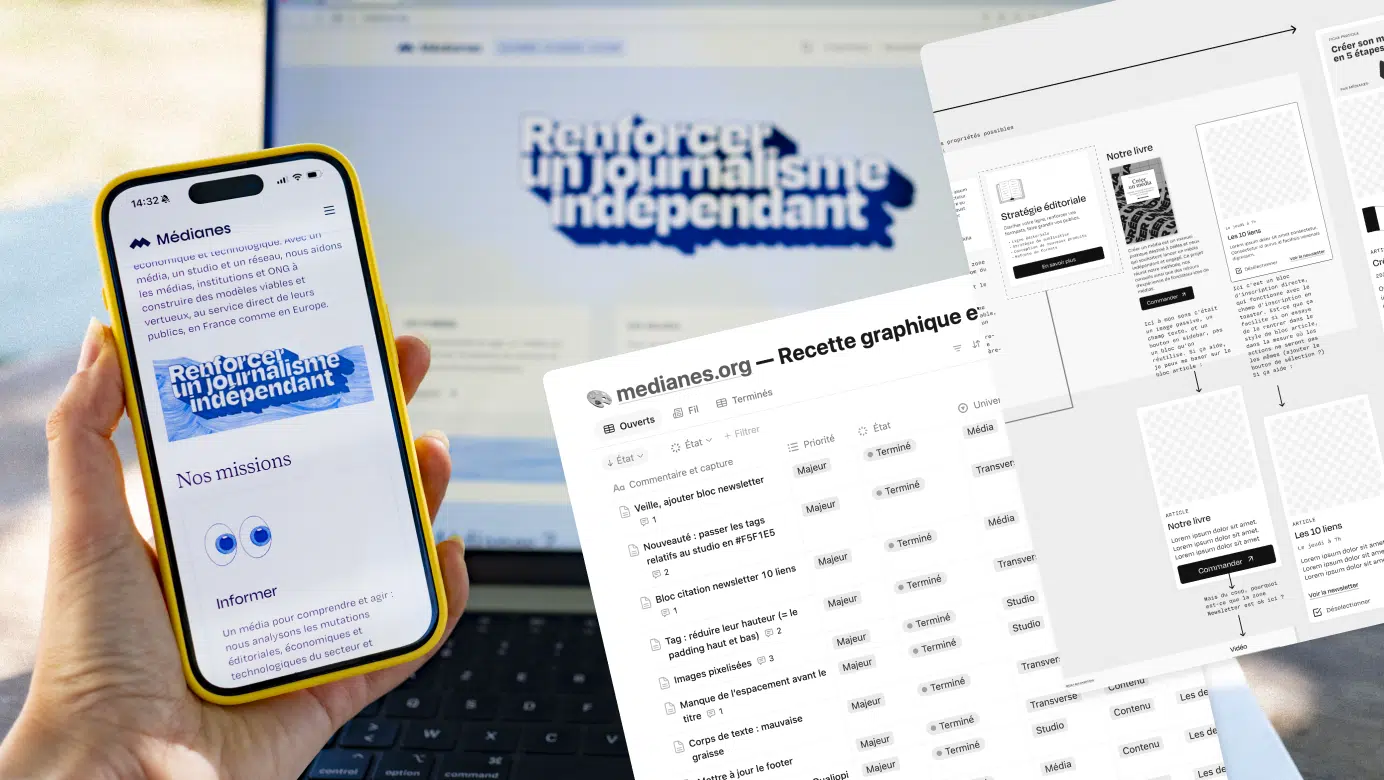

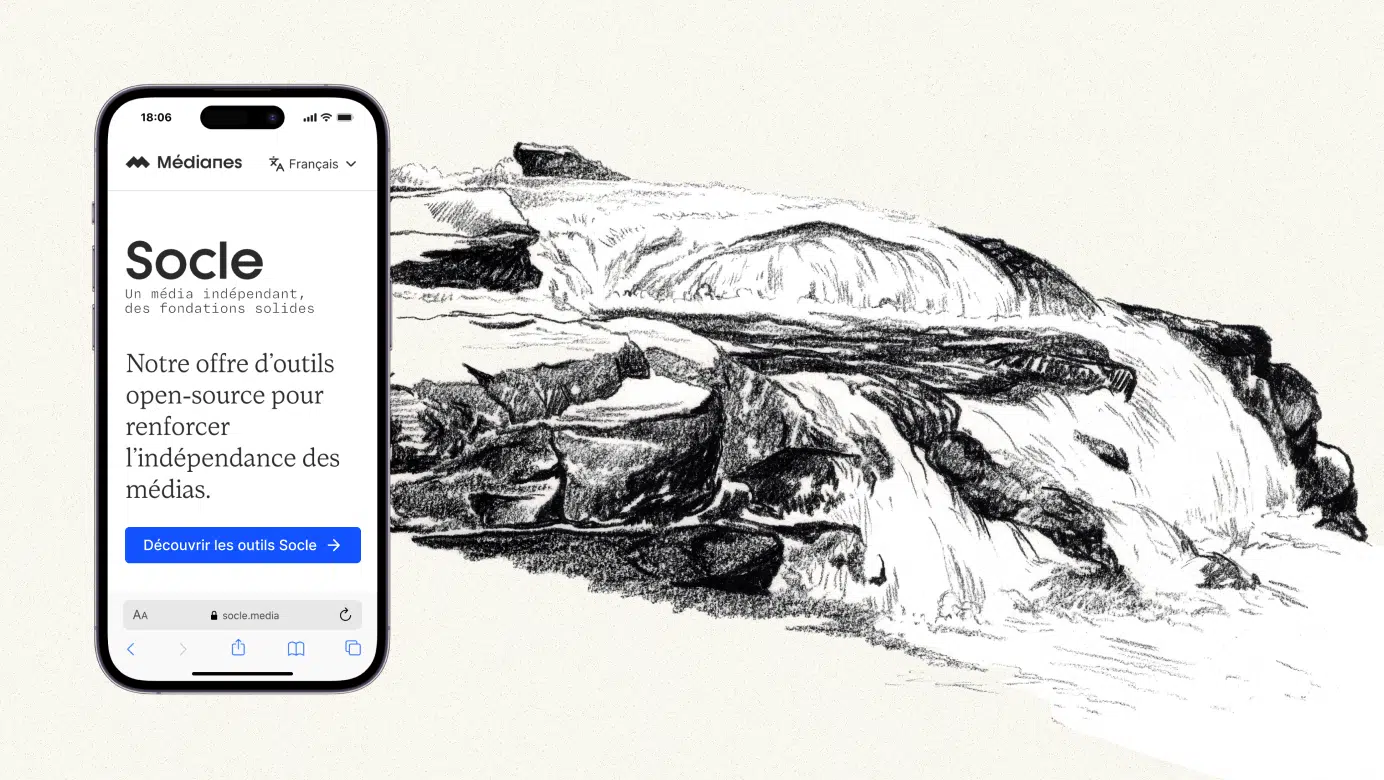
Independent media outlets have learned to defend their editorial stance against shareholders, advertisers, and those in power. But their freedom can also be undermined by technological choices made by default, often without even thinking about it. This is what we’ve observed, project after project, with the media outlets we’ve been supporting since 2020 through Médianes, a media outlet, a studio, and a network designed to strengthen media independence.
Technological independence is one of the media’s major blind spots. A media outlet can fiercely defend its editorial stance while entrusting its distribution, revenue, archives, and reader data to entities whose operations it does not control and whose objectives conflict with its own. Yet the issue of technology strikes at the heart of editorial independence, and current events are a stark reminder of this.
👋 This text is a manifesto addressed both to ourselves and to the media outlets we work with. We are far from perfect and are also moving forward one step at a time. Have any ideas or disagreements? Write to us at [email protected]
Three recent developments make this issue particularly urgent:
- Governments Acting Through Technology: The Cloud Act already allows U.S. authorities to demand access to data stored anywhere in the world by U.S. companies, including on European servers. AI opens a new front: In June 2026, Anthropic suspended access to its most advanced models to comply with export controls imposed by the U.S. government, before restoring access on July 1. A newsroom’s data can thus be demanded—and its tools shut down—by a political decision made abroad
- Disintermediation by tech giants: After taking control of information distribution in the 2010s, platforms are bypassing traditional channels in the 2020s: AI-generated responses in search engines, censored news on certain social media platforms… For several years now, the public has been accessing information without going through the media outlets that produce it, and this trend is accelerating.
- A Legal Framework Subject to Political Shifts: In France, as in Europe, the legal framework governing the press depends on political decisions. Faced with the rise of anti-democratic forces, no country is immune, and economic independence is no longer enough: in Hungary and Italy alike, governments have reshaped the media landscape in just a few years. In France, as the April 2027 presidential election approaches, public subsidies for the press, CPPAP accreditation, and tax exemptions for donations could all be called into question. A media outlet that also depends on tools it does not control will be all the more vulnerable.
If we were to summarize our vision of tech independence in a few points, we could boil it down to three principles: open source; European sovereignty; designed by and for the media.
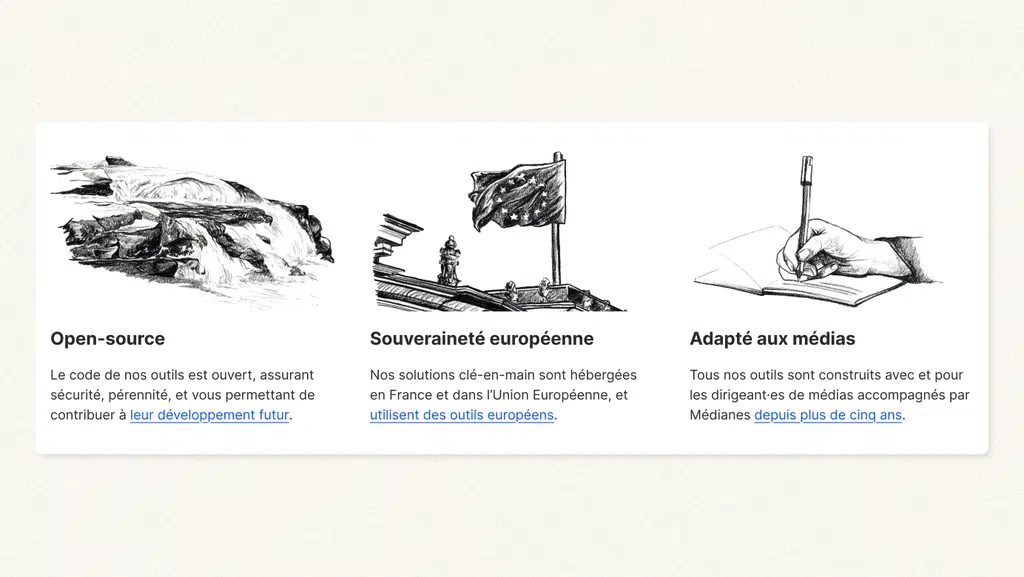
Open-source tools, built to last
We believe that the tools used to design, produce, and distribute media must be open. Open-source code can be verified, improved, and reused by others. The belief that closed-source code offers protection simply because only its creators know it is an illusion—especially now that AI makes it easier to find vulnerabilities and exploit them much more quickly and easily than before. It ensures the security and longevity of the tools, which can thus outlive the organization that created them. Above all, it prevents being locked into a proprietary solution: with open source, a media outlet is never bound hand and foot to its service provider.
Furthermore, open-source code can be made available to everyone: optimized and adopted by a vast network of people rather than by a single entity, its principles of transparency and collaboration strengthen it. Open source has long been a common practice in media and journalism, and its return is possible—and even desirable.
Data Under European Control
We believe that the data of a media outlet and its readers must remain under European control. Sovereignty should not be confused with sovereignism. We advocate for a European, not a nationalist, foundation: not everything that comes from elsewhere is a problem in and of itself—quite the contrary—and open source is proof of the power of breaking down borders. Sovereignty is the ability to identify and limit one’s dependencies, and to act accordingly.
In practical terms, a U.S. company whose servers are located in Europe remains subject to the Cloud Act, which allows U.S. authorities to demand access to data. This is untenable for media organizations that must protect their sources and their readers.
Tools Designed with the Media in Mind
We believe that media tools should be designed by professionals who know the media from the inside, and built in collaboration with them, based on how newsrooms actually use them.
Yet journalists have all too often been kept at arm’s length from these topics, as if these issues did not concern them. It’s a bit like asking them not to look at who owns their media outlet. Involving newsrooms in the design of their tools is essential for them to truly take ownership of them and ensure they align with their editorial vision.
👀 Why are we telling you this? At Médianes, these principles aren’t just theoretical—they’ve given rise to Socle, our suite of open-source, European tools for the media. Discover the suite as we launch Socle Dons, our tool for collecting, managing, and securing donations tailored to media organizations.
Beyond Principles: A Few Convictions
In practical terms, these principles translate into a set of guiding principles that serve as our compass when choosing or switching tools—both for the media outlets we support and for ourselves.
An acceptable dependency is a reversible dependency
Independence isn’t an all-or-nothing concept, but one of degree. The goal isn’t to control everything, but to be able to switch providers without your media platform collapsing. In 2026, thousands of organizations lost all their data stored with Microsoft after a free service was discontinued, with no recourse available: the cloud can go down overnight. The same logic applies to business models: never put all your eggs in one basket. Performing regular backups—separate from the tools or systems being backed up—is a best practice, provided you can restore those backups elsewhere if necessary.
The entire supply chain is affected, and distribution is key
Tech independence is at stake at every stage: production, hosting, payment, audience, distribution, and archiving. But when a platform decides what gets seen, it exerts significant editorial influence—and that’s where dependence weighs heaviest.
Neither technophobes nor technophiles
At [company name]Médianes, we test, compare, and choose our tools based on how we use them, and we’re always ready to make changes. The same is true for AI: the question isn’t whether to adopt or reject it on principle, but rather who owns it and what happens if it’s turned off.
Cooperate and pool resources, without creating a European Google
No media outlet, large or small, will make it on its own. Rather than building a new giant or reinventing the wheel, each in their own corner, let’s build on what already exists at the European level and try to find common solutions. At [name]Médianes, we advocate for a network of open-source actors and tools, collectively maintained, in which we would be just one participant among many.
Skills are part of independence
All too often, the tools offered to media outlets are “black boxes”: we pay to use them without understanding how they work, and every adjustment or price increase comes at a high cost. When a software publisher is acquired, a license can jump overnight from €2,000 to €20,000 per year. Understanding your tools means no longer letting others keep you in the dark. It’s also a way to save money: an open, well-understood tool can be adapted without remaining locked into a single vendor.
In practice, where should you start?
Before changing anything, start by taking stock: make a list of your media tools—from office software to distribution, including payment processing, email marketing, and audience analytics. Then, for each one, take the time to ask yourself five questions.
- What happens if the tap gets turned off tomorrow?
- What do I lose, and what do I gain by making a change?
- What is the cost of change—in terms of money, time, and skills?
- Is it practical for everyday use?
- Is this the right time, and is it a priority compared to everything else?
Good news: the first step is often less expensive than you might think. Turnkey European alternatives (not all of which are open source, by the way) already exist: Infomaniak, La Suite, or Proton for office software; Brevo for email marketing; and Mollie or PayPlug for payments.
💡 Media organizations can regain control of their tools, regardless of their size. Our practical guide provides an overview of the risks and best practices: Regaining Control of Your Digital Tools.
We know this: what most often holds the media back isn’t conviction—it’s money and time. Switching tools requires energy that small teams don’t always have, and independent solutions have long been reserved for those who could afford to hire developers. We created Socle to remove these barriers: open-source tools, hosted in Europe and built in collaboration with the media organizations we support.
What now?
We strive to apply these principles—both for ourselves and for the media organizations we support. Socle, our suite of open-source and European tools, is one such effort among many. We are currently reviewing our management, production, and distribution tools to identify European alternatives—a project that is in full swing.
To ensure that the cobbler isn't always the one with the worst shoes, we're also preparing for our transition internally: moving away from Google Workspace, evaluating our use of Notion and Slack, and already backing them up frequently using dedicated tools on remote servers.
The media industry has succeeded in turning the economic independence of the media into a political issue, debated far beyond the confines of newsrooms. The same may be true for technological independence. For behind the tools used by a media outlet lies a question that also concerns its readers: Who controls the infrastructure on which their news depends? This is especially true for its donors and subscribers, who may appreciate knowing whether their money is—even indirectly—lining the pockets of the tech giants or strengthening the outlet’s independence.
To go further
- Media organizations of all sizes can regain control of their tools. Our practical guide provides an overview of the risks and best practices: Regaining Control of Your Digital Tools.
- From Google to Microsoft, European newsrooms often rely on tools from Silicon Valley, but some are seeking to break free from them: A newsroom’s independence also depends on the tools it uses.
- Discover our selection of open-source and European tools to strengthen media independence at socle.media.
👀 Would you like support with your media outlet’s technological transition? Tell us more about your project.