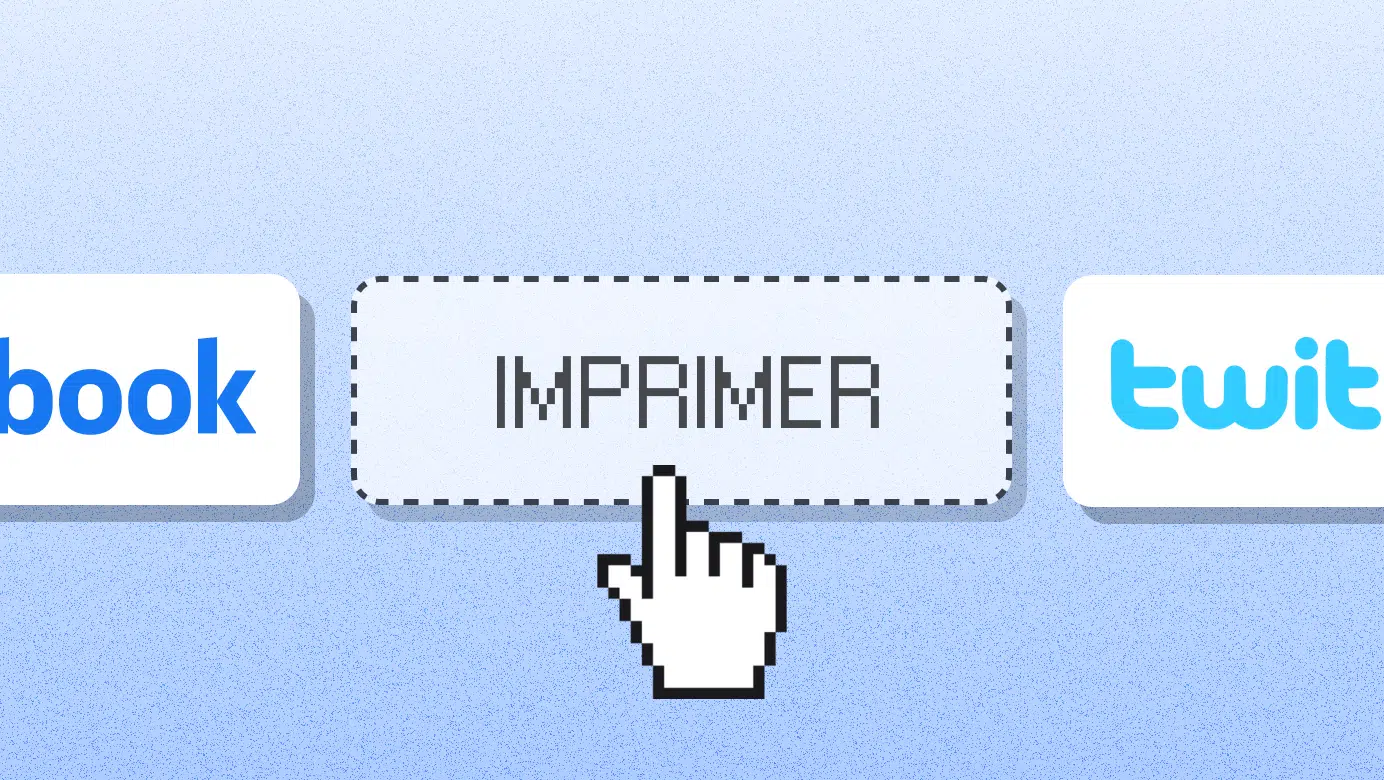
This is the story of a quiet disappearance that I wanted, in these few lines, to bring back to mind: that of the “Print” button. A little over ten years ago, most media outlets gave it a natural place—a small icon tucked at the beginning or end of an article. A single click was all it took to get a printable version of the desired article—often in PDF format—and to enjoy the comfort of paper at home. This option embodied a reassuring connection to this traditional medium for a readership that was gradually venturing onto the Internet to stay informed. Although it once seemed indispensable, the button has gradually given way to other features, such as Facebook and Twitter share buttons, which have themselves lost ground. In the 21st century, printing an article seems like an anachronism.
I admit that telling the story of this disappearance is, in part, a somewhat self-serving endeavor. I’m taking advantage of the fact that our readership includes a few people in leadership positions at prominent media outlets to try to get this heartfelt cry heard. Because I’m not alone. Tired of reading articles all day long on a screen and unconvinced by blue-light-blocking glasses (whose effectiveness remains to be proven), I recently became the owner of an e-reader. This is a common move for many people approaching their thirties for whom “reading more” is a yearly New Year’s resolution. From a purely tech-solutionist perspective, the e-reader seems like an ideal solution for reading more articles without worrying about LED-induced eye strain. In theory, at least. Because, in practice, the whole process is a headache and requires spending a significant amount of time scouring forums for solutions. Dedicated tools change or shut down, articles display poorly, and paywalls persist even when you’re already a subscriber…
A whim? The disappearance of the “Print this article” button actually illustrates a much broader trend that speaks volumes about how the press approaches the distribution of its content on the Web. For various reasons—which I’m not entirely oblivious to—media outlets have gradually refocused reading on their websites and apps. RSS feeds, printing articles, exporting to PDF… all these ways of accessing content and reading it elsewhere than on its original site seem, unfortunately, to conflict with the challenges of our time. Or do they?
A Disappearance
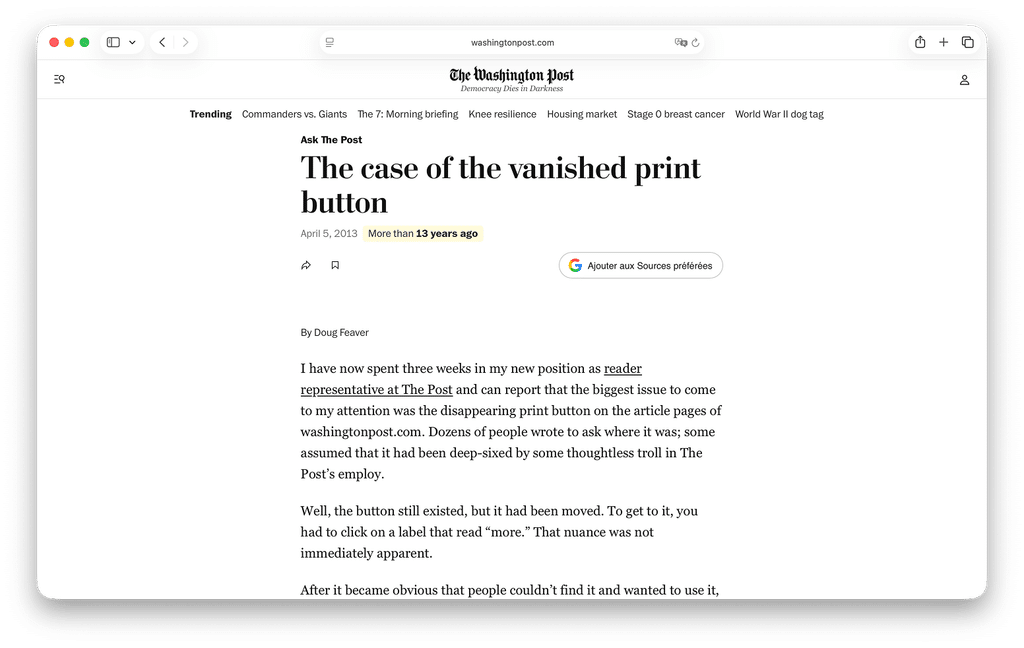
The disappearance of the “Print” button is hard to explain because, in reality, little has been written about it. We have to admit: it didn’t exactly set the world on fire, with a few notable exceptions. While doing some digging, I came across a Washington Post article whose title could have been that of this column if I hadn’t arrived thirteen years too late: “The Case of the Vanished Print Button.” Published in April 2013, it was written by the newspaper’s reader representative—a sort of ombudsman tasked with gathering and responding to readers’ complaints.
The American daily’s website has just undergone a redesign, and among the feedback received, one of the main sources of disappointment is the disappearance of the famous button. In reality, the ombudsman explains, it wasn’t removed. It was moved to a “More” drop-down menu, where it became less visible. End of the story? Faced with protests (from dozens of readers, according to the post—no less), the newspaper finally restored it to its place alongside the social media share buttons. The “Print” button is back among the big leagues.
But this return to favor obviously didn’t last, and the button is now nowhere to be found on The Post’s website. Why? Part of the answer may lie in the broader fate of PDFs. Printing a web page often involves this format, which also allows users to save an article to read later or transfer it to an e-reader. But these three letters aren’t particularly popular and send shivers down the spines of product managers at certain media outlets. The reason: WhatsApp and Telegram groups that specialize in the clandestine distribution of newspapers, for which PDFs are often the main enabler.
In the name of combating fraud, *Le Monde* discontinued the option to download a PDF of its newspaper. In 2021, subscribers learned that this feature would be discontinued, following a similar decision made a few months earlier by *Les Échos*. A devastated reader documented his experience on his blog, along with his attempt—in vain—to convince the newspaper to reverse its decision: “We regret having to make such a decision, but the fight against the free distribution of the work of the 500 journalists on the staff is an imperative for our community,” replied customer service.
I myself have contacted several daily newspapers to which I’ve subscribed in recent years—not as a journalist, but as a disillusioned citizen and customer. The response has always been, more or less, the same: “Thanks for asking, but that’s no longer possible,” along with, as a consolation, an invitation to download the app.
A confirmed death?
The problem with printing web pages is that it has become less and less easy. Not because the option has disappeared—anyone can print any page using a simple keyboard shortcut—but because the pages themselves have become more complex: ads, banners, pop-up windows, subscription walls, videos… News sites proudly pile on all sorts of elements that have caused page sizes to skyrocket. A few months ago, I came across a blog post that measured the file size of a New York Times article: 49 MB, roughly the equivalent of an entire music album. And things don’t seem to be getting any better. Once again, the culprit can be summed up in two letters: AI. In an era where everything is “code-driven,” an idea can become reality in a matter of minutes, whereas in the past it would have required too much human and financial investment to be profitable. From automated summaries to articles read aloud by an artificial voice, the possibilities are multiplying, and features are piling up on news sites—at the risk of slowing them down and complicating simpler tasks, such as printing.
However, even on a page packed with interactive elements, it’s possible to create a print-friendly version that retains only the essentials: the article’s text, stripped of menus, ads, and other elements that might distract the reader. All it takes is defining specific CSS rules for printing: this guide explains how to do it. It’s a relatively simple solution to implement, but it still requires some extra work that few media outlets seem to have deemed worthwhile.
And the ravages of AI don’t stop there. At a time when media outlets are concerned about their content being siphoned off by artificial intelligence systems, facilitating the circulation of articles outside their own platforms may seem to run counter to their interests. I have to admit: in this context, advocating for the return of a feature that makes it easier to print, download, and share articles may seem difficult to justify. Is the “Print” button, then, doomed to join the other relics of an Internet that placed greater trust in its users?
A Return to Favor?
I still believe the game isn't over yet. A few days ago, while looking for arguments to defend this cause, I came across a post on the American tech media outlet Ars Technica. Dated October 6, 2026, it notes that ArsPro subscribers can get a PDF of the articles as well as a full RSS feed. The idea is summarized as follows: “The web isn’t always the best place to read what’s been published on the web.” It helps make reading comfort a strong argument, even in 2026, as evidenced by the dozens of comments praising this initiative. Readers don’t just pay for access to content; they also pay to be able to make it their own and view it on their own terms. And that has value.
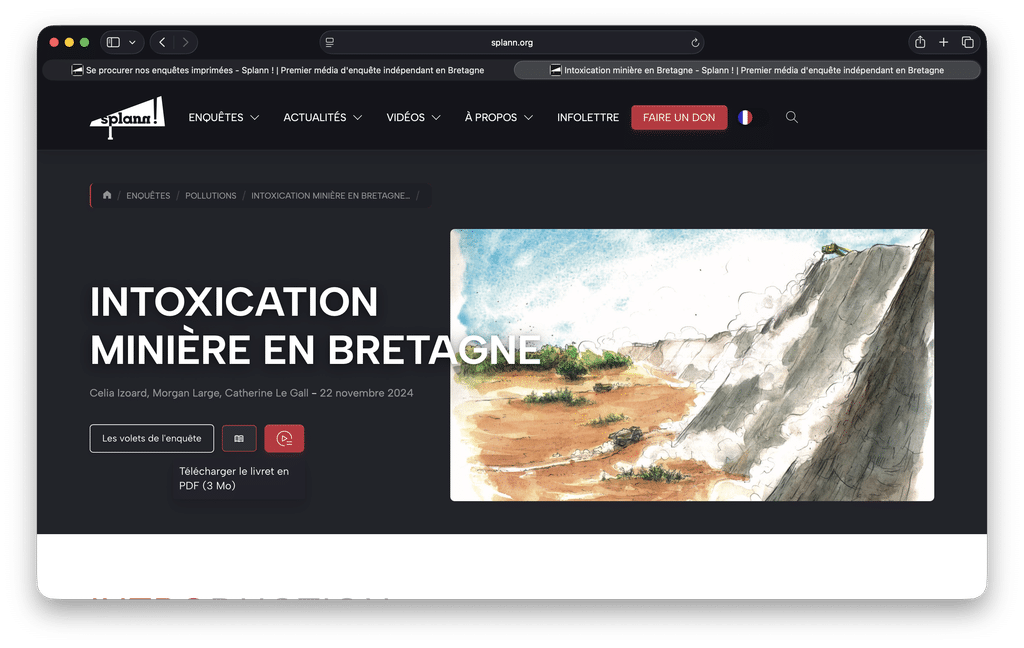
Another example I had the opportunity to document earlier this year: the Breton investigative media outlet Splann!, which took a gamble—one that, at first glance, seemed counterintuitive—to sell its investigative reports in print, in the form of booklets, even though they were available for free online. The initiative stemmed from an observation made by Julie Lallouët-Geffroy, a journalist at the outlet: reading long articles on a screen was too tedious, and exporting them to an e-reader was impractical, she told me at the time. Her attempts to get around the problem—copying and pasting the texts into Word, transferring PDFs to her e-reader, and so on—hadn’t really worked. The site has therefore, in its own way, revived the “Print” button, which allows users to obtain a print-ready PDF for some of its flagship investigative reports. As for the French independent press, I also discovered—while attending a public recording of a show in Toulouse—that Arrêt sur images offers, at certain events, the chance to purchase its investigative reports printed on paper and slipped into large envelopes. “It’s going really well,” the team tells me.
Behind these examples lie two closely related issues: reading comfort and the possibility of distributing content in different ways. Reading without the web in its usual form—without a phone, notifications, or algorithms—fulfills a desire that the media would be wrong to overlook. According to the 2025 edition of CREDOC’s Digital Barometer, four out of ten French people report spending excessive time in front of screens for personal use. For a younger generation that also longs to unwind through a “digital detox,” relying on platforms like TikTok to attract them may no longer be enough. The decisive factor may lie elsewhere: in peace of mind, disconnection, and the freedom to choose how, when, and where to read. This is what prompted the American tech media outlet 404 Media to develop a system allowing its subscribers to read its articles in full directly from their RSS feed reader. One final example to wrap things up: the new media outlet The Atlas, which relies on PDFs to freely distribute its content—particularly via messaging apps like Signal—thereby freeing itself from the algorithms of major platforms as well as the risk of censorship.
If media outlets have so far been able to get away with (over)loading their pages and adding more and more features—which, it must be said, aren’t always user-friendly—it’s also because they faced little competition. AI has significantly reshuffled the deck and could very well make user-friendliness a major issue. A recent study, the results of which we shared with you not long ago, highlighted the importance placed on the ease of use of these tools, even though their shortcomings in terms of reliability are clearly recognized by their users. The challenge, I realize, isn’t so simple: balancing the need to retain an audience on one’s own platforms with the desire to offer a more enjoyable and flexible reading experience—even if that means letting readers choose their own medium. The business model, the presence or absence of a paywall, and the publication schedule are all factors that can hinder the adoption of this practice. I, like the fans of print and e-readers who may have recognized themselves in my story, believe in it.