


Don't want to miss the next one? Sign up for our newsletter.
Editorial and financial independence are no longer enough. As digital tools become vehicles for political pressure, newsrooms must also consider their technological independence. While the decision to use or avoid certain social media platforms—such as Twitter/X—has prompted some media outlets to publicly take a stance, the issue of technological independence actually plays out in what could be considered the hidden part of the iceberg for readers: the digital tools, software, and devices used internally to produce a newsroom’s journalism. The risks are numerous and tangible, to the point that some governments, institutions, and media outlets have begun taking steps to free themselves from them.
This guide provides an overview of these risks, but also highlights best practices already implemented by several European newsrooms, as well as a selection of practical tools to help you get started, regardless of the size of your team.
1. Does this apply to me?
Behind every editorial team lies a technical infrastructure, commonly known as a “tech stack.” This can include tools for collaborative writing, messaging, and video conferencing, as well as your website’s technical structure, hosting, content management system, and analytics tools. The choice of these tools is far from neutral and presents a series of challenges:
Editorial Integrity: By supporting you financially, your community is supporting journalism that it considers valuable and true to the values it believes in. However, the issue of technological dependence—through social media, but not exclusively—is now entering the public debate, and your supporters would be justified in questioning how their funds are being used: “By supporting this media outlet, how much of my money ends up in the coffers of tech giants, even though I may be making a conscious choice to distance myself from them in my personal life? ” The issue is therefore not limited to internal matters: it directly affects your readers, especially when we consider the tools used to collect and process their own personal data.
Political risk: The International Criminal Court recently experienced this firsthand when it announced that it was switching from Microsoft Office to OpenDesk after one of its judges, who had been sanctioned by the United States, found himself cut off from access to a wide range of U.S. digital services. This scenario has prompted governments and international organizations, particularly in Europe, to take similar steps to strengthen their technological independence.
For the planet: Some tools can be too resource-intensive and rely on planned obsolescence, which can accelerate the need to replace your devices (computers, phones, etc.). Lighter alternatives can extend the lifespan of your devices… and reduce costs. This is the case with the French media outlet Reporterre, for example, where the vast majority of computers run Linux rather than Windows. Since Linux uses fewer resources, it helps delay the obsolescence of their devices. Additionally, services that collect less data can help reduce your environmental footprint.
Thinking strategically about technological independence also means seizing an opportunity—not just protecting yourself from a risk. It’s a way to regain control over the tools relevant to your editorial team and to strengthen your readers’ trust by aligning your technical choices with your editorial values, as illustrated by several media outlets later in this guide. Reducing your dependence on the California tech giants is possible—and often less costly and technically challenging than you might think—as long as you don’t jump into it blindly.
A Few Keywords
This guide contains words you don't come across every day. We've listed them here for you to consult as needed while you're reading.
Free software: software whose source code can be freely used, modified, and redistributed. These freedoms are guaranteed by a free license, which prevents any single publisher from retaining exclusive control over the software.
Open source: software whose source code is publicly available and can therefore be viewed, modified, and improved by anyone. Note: Although this is often the case in practice, open-source software is not necessarily free software. Some publishers impose restrictions, particularly regarding redistribution or commercial reuse, and the software is not necessarily free of charge.
Proprietary software: software whose source code is closed and controlled by a company or software publisher. Users generally cannot view, modify, or redistribute the code.
Decentralization: the organization of a service or infrastructure among several independent entities, rather than around a single authority or provider.
Self-hosting: the practice of installing and operating software on one’s own servers, rather than using an external service provider. This approach offers greater control over data and infrastructure, but requires more resources and technical expertise.
2. How
- Start by auditing, not by replacing
Strengthening technological independence cannot be improvised or decreed overnight. The first step is an honest assessment of the current situation: which tools are actually being used, by whom, for what purpose, at what cost, and to what extent they are critical to the media outlet’s day-to-day operations. This audit helps identify easy substitutions (where an open-source alternative is simple and appropriate to adopt) and areas of friction (where the transition will be costly in terms of time or money).
The Good Idea
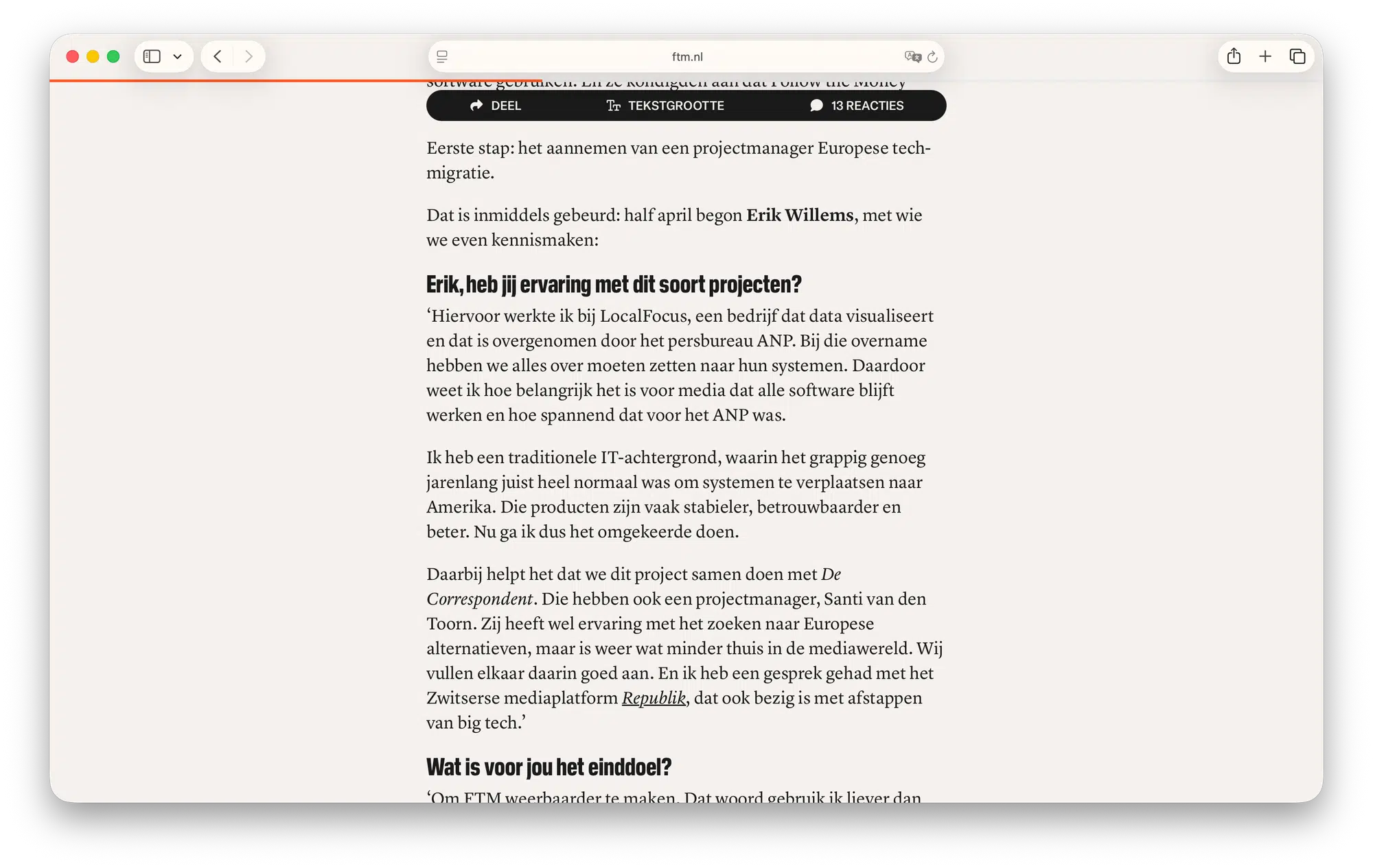
Follow the Money and De Correspondent (Netherlands) have decided to collaborate on a technological transition they deem necessary. The media outlets have published a dedicated page listing all of their digital tools, including those they are still using and have no immediate plans to replace (Slack, 1Password, Shopify, etc.). This is a major project for which they have hired a dedicated project manager.

The Dutch coalition PublicSpaces, composed of about 30 cultural organizations and institutions, has formalized its own framework—dubbed “Digital Powerwash”—based on a series of questions to assess the level of risk associated with a tool. Is the source code reusable? Can users view and export their own data? VPRO, a Dutch public broadcasting group, used it to “clean up” its digital infrastructure and shared its results. This checklist may seem complex and time-consuming if used as is. There’s nothing stopping you from adapting it: a media outlet just starting out can limit itself to 5 or 6 key questions.
In practical terms?
Create a simple table (you can use Digital Powerwash as a template) listing the key criteria and information: tool / importance within the newsroom / cost / who uses it / hosting provider (country) / sensitive data / known alternatives. Have several people on the team fill out this table rather than just one person to ensure a broad and comprehensive audit. You might be surprised to discover how certain tools are being used. Classify the tools into three columns: to be replaced quickly (low friction), to be monitored (medium friction), and to be left alone for now (too critical or costly). Designate a dedicated person within the media organization to oversee this project and the implementation of the various tools.
2. Proceed by gradual substitutions
The goal is not immediate and total purity, but rather the gradual reduction of the riskiest dependencies. Initiating a gradual change—through education via an internal training policy, shared documentation, and tracking of updates—is essential for a change in tools to become a change in internal culture. This is an effective way to give journalists more control so they can take ownership of these tools.
The Good Idea
The Belgian magazine Apache is taking a gradual approach. On its website, the editorial team explains it this way: “Over the past few weeks, we’ve taken stock of all the digital tools we use and will be critically evaluating them. In the coming weeks and months, we’ll work to replace the most problematic ones with alternative solutions. We’re not making this transition all at once, but step by step.” The team, which opted for Google Workspace when it was founded 16 years ago, will phase it out starting this summer using a system based on Nextcloud, an open-source tool.
In practical terms?
Starting with the least critical tools—or those for which alternatives are obvious—may be the right approach. It may be safer to focus on your videoconferencing system, for example, rather than overhauling your CMS, especially to identify a method that works for your team for more significant transitions down the line. Proceed from the periphery toward the core to avoid getting stuck during the publishing process, for example. Take note of what worked and what didn’t work as well during this transition process. Also, set an official switchover date (even if it’s just symbolic) rather than allowing for a vague, never-ending transition.
At the end of this guide, you'll find a list of free and/or open-source tools.
- Estimate the costs and time required
Open source does not mean free. Factoring these costs into budget planning—and not underestimating the amount of time required—is essential to avoid abandoning the project along the way.
How do the media go about it?
Founded as a cooperative, the Belgian media outlet Médor addressed the issue of tools from the very beginning: “How can we produce a Belgian magazine using software from California?” The team concluded that this was not possible—that it was incompatible with its mission and its promise. But relying on free or open-source tools does not mean there are no costs at all. The publication recently spent €55,000 on a major update to Odoo, an open-source tool. On this occasion, the Belgian magazine communicated its approach and organized a crowdfunding campaign to cover the costs of this specific project—a sign that these issues, which may seem limited to internal and technical considerations, can ultimately serve as strong selling points for its community.
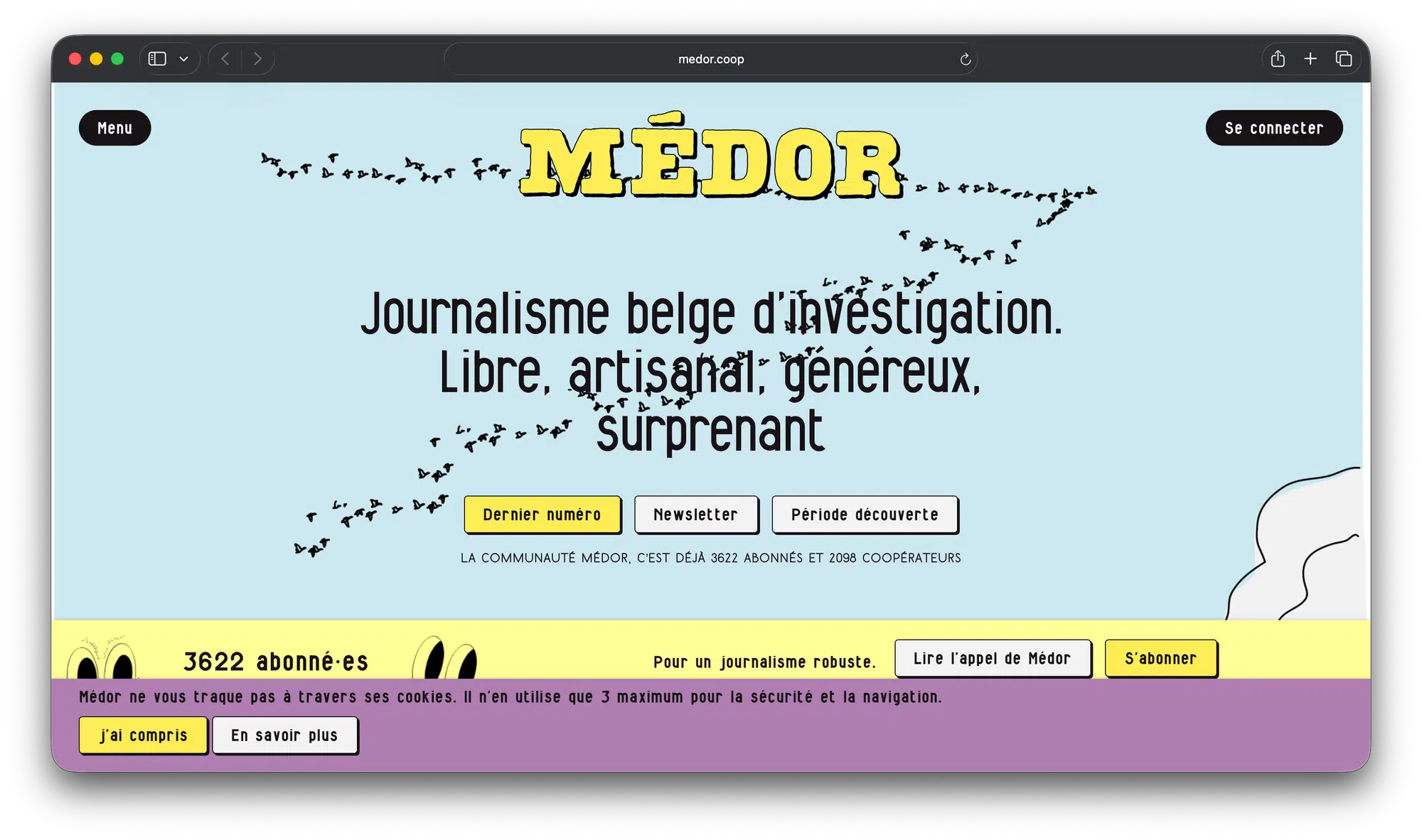
Médor has even incorporated this argument into its cookie banner, which directly states, “Médor does not track you,” immediately highlighting its use of Matomo, an open-source tool considered more privacy-friendly than Google Analytics.
Further Reading: Want to learn more about organizing your fundraising campaigns? How can you turn your readers into a community of donors? We’ve compiled real-world examples and our tips for achieving this in the first guide in this series.
 Owen Huchon
The Markup, an American investigative tech news outlet, has publicly documented how much it costs them to reject all tracking tools—what they call their “privacy tax.” In 2020, the editorial team tracked, hour by hour, every tool they had to rebuild from scratch due to the lack of privacy-friendly alternatives on the market. The cost and time spent on each tool are detailed with complete transparency: a custom video player to replace YouTube (240 hours and $18,000) or a form to replace Google Forms (40 hours and $3,000).
In practical terms?
Work together on this topic rather than separately: that’s the whole point of open source. That’s the choice Follow the Money and De Correspondent have made: “We share the same journalistic mission, use similar technologies, and are comparable in size. This way, we maximize our impact, avoid duplication, and can sometimes afford more cost-effective solutions.” This collaborative effort can even extend to the joint development of tools, as was the case with beabee, a subscriber management tool. Correctiv (Germany), The Bristol Cable (United Kingdom), and The Bureau of Investigative Journalism chose to develop their own open-source solution together rather than each struggling individually with unsuitable and overly expensive tools. The tool is now being adopted by other media outlets, such as Fumaça in Portugal, which did not have to start from scratch.
Further reading: “Basta!” with the Independent Media Portal, La Presse libre… In France, media outlets are building shared infrastructure to regain their independence from technology platforms.
 Marine Doux
- Accept gray areas and be transparent
Compromises are inevitable, especially early in the process. Another important issue is transparency. Among the media outlets mentioned earlier that cover these topics, some have made certain concessions: at Reporterre, two computers still run on Windows, primarily to use software that isn’t compatible with another open-source operating system based on Linux. At Médor, an external proofreader uses an extension available only in Word. These documented exceptions do not invalidate the approach. Explain to your readers that you have adopted this process, and outline the reasons behind it and the steps to come.
 Owen Huchon
The Good Idea
Follow the Money and De Correspondent openly admit that they do not know the total duration of their transition. Transparency focuses on the progress made so far, not just on a goal that is still far off. To publicly document this work, they launched a newsletter to keep their readers informed about the process they have begun. The first issue featured an interview with the person hired to organize this effort.
The French local media outlet Mediacités launched a WhatsApp channel in 2025, drawing criticism for using a tool developed by Meta—and thus owned by a Donald Trump supporter. The outlet did not reach a unanimous decision internally, but chose to stand by this decision for pragmatic reasons: without a mobile app, it is the most effective channel for reaching readers who primarily access its investigative reports on their phones. Mediacités published the reasons behind this decision… while noting that the outlet is considering developing an app. During a recent fundraising campaign, the outlet set a goal of 50,000 euros to make this happen.
- An Update on AI
Beyond the editorial, environmental, managerial, and social issues raised by the use of these tools, there is also a distinct issue of dependence: like office software or CMS platforms, tools based on generative AI often rely on U.S. infrastructure subject to the same geopolitical uncertainties. The U.S. government’s temporary suspension in June 2026 of access to Anthropic’s Claude Fable 5 and Claude Mythos 5 models clearly illustrated this: tools can, overnight, become inaccessible for reasons entirely beyond their users’ control.
Reporterre a banni l’IA générative de l’ensemble de sa production (rédaction, recherche, communication) au nom d’une cohérence avec ses valeurs et ses donateur·ices, qui financent 95,4 % de son budget. Le média a choisi la confiance plutôt que la surveillance : pas de détection automatisée, pas de liste d’outils interdits, mais un principe clair pour sa communauté et ses équipes. Reporterre a bien conscience qu’il ne pourra pas, par exemple, s’assurer que ses pigistes aient respecté ces principes à la lettre. Il s’agit avant tout d’un cap fixé pouvant aiguiller le média dans ses pratiques et qui pourra être révisé à l’avenir. Splann et Bon Pote ont fait des choix similaires, avec la même volonté d’exclure l’IA générative de leur production éditoriale. Bon Pote ajoute par exemple un encart à la fin de chaque article mentionnant explicitement l’absence d’usage d’IA générative pour le produire, valorisant ainsi l’aspect artisanal de leur travail.
 Owen Huchon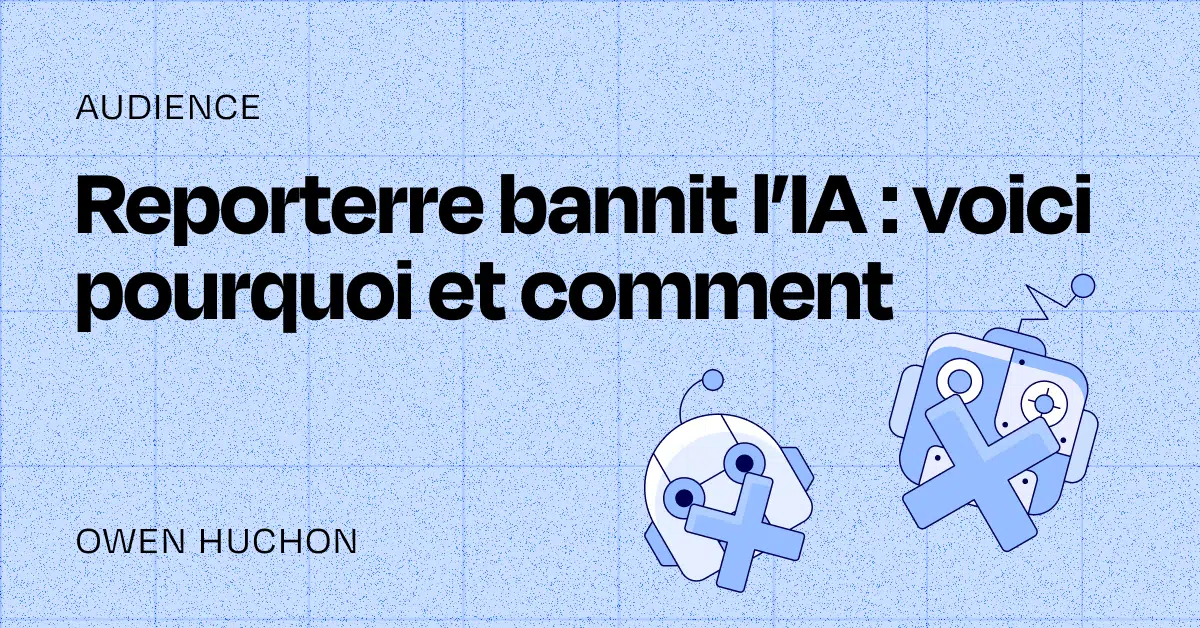
In practical terms?
- Comme Follow the Money et De Correspondent, publier une page « notre stack technique » sur le site, avec les outils utilisés, les raisons des choix, et les exceptions assumées.
- Mettre à jour cette page à échéance régulière, pour mettre en lumière une trajectoire.
- Dans les appels aux dons/abonnements, mentionner explicitement cette démarche. Le sujet de l’indépendance tech gagne progressivement le débat public et peut constituer un argument solide dans vos campagnes.
- Envie de rédiger une charte relative à l’usage de l’intelligence artificielle au sein de votre rédaction ? Veillez à être précis·e dans les termes utilisés. Reporterre a par exemple volontairement opté pour le terme « d’IA générative » plutôt que le terme plus générique « d’IA ». N’hésitez pas à aller au-delà des pratiques éditoriales de vos journalistes : un post sur LinkedIn par exemple pourrait-il être généré par IA ? Soyez précis·e dans les démarches et les méthodes : que veut dire une rédaction « assistée » par l’IA ? Si vous avez besoin d’inspiration, le Nieman Lab a compilé plusieurs chartes.
3. Quelques outils pour commencer
Voici quelques points d’entrée accessibles, qui couvrent les usages les plus courants et que privilégient les rédactions mentionnées plus haut. N’hésitez pas à vous renseigner sur d’autres alternatives disponibles, adaptées à vos besoins et à la taille de votre média.
- CryptPad — édition collaborative, alternative à Google Docs et la suite Microsoft Office
- Nextcloud — stockage en ligne et espace de travail, remplace Google Drive
- Jitsi — visioconférence, remplace Google Meet
- Matomo — analytics web, remplace Google Analytics
- LibreOffice — suite bureautique, remplace Google Workspace / Microsoft Office
- Linux — une alternative libre, open source et gratuite à Windows qui peut prolonger la vie de vos appareils
- Proton Mail / Proton Drive — alternative européenne (suisse) à Gmail et Google Drive
- Framasoft — l’association française propose une série d’outils pour se passer des géants de la tech