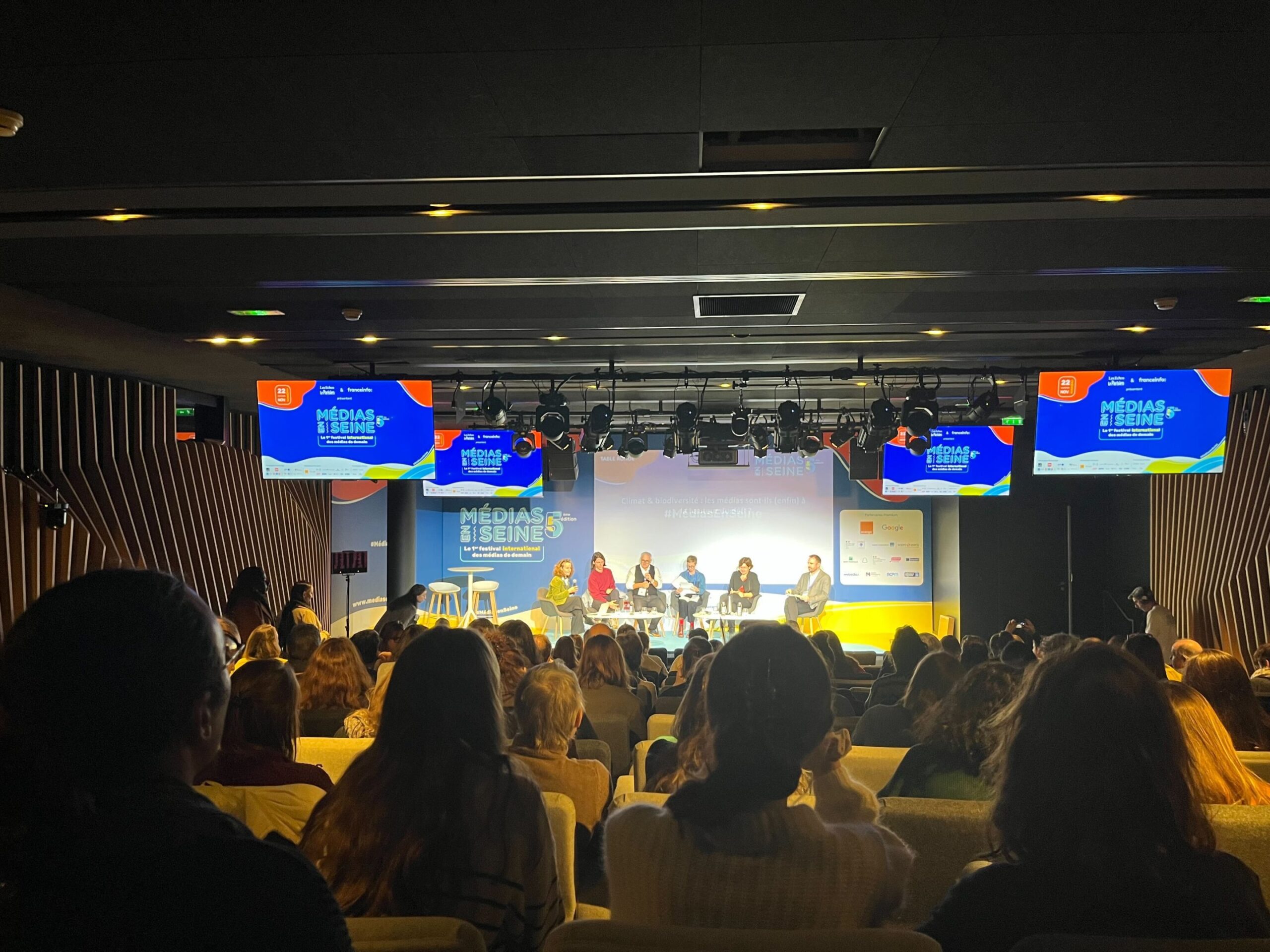
Were you unable to attend the fifth edition of Médias en Seine on Tuesday, November 22? Coverage of the climate crisis, Gen Z’s news consumption habits, newsletter funding models… Here are a few key takeaways from the event.
Explaining the climate crisis without causing panic
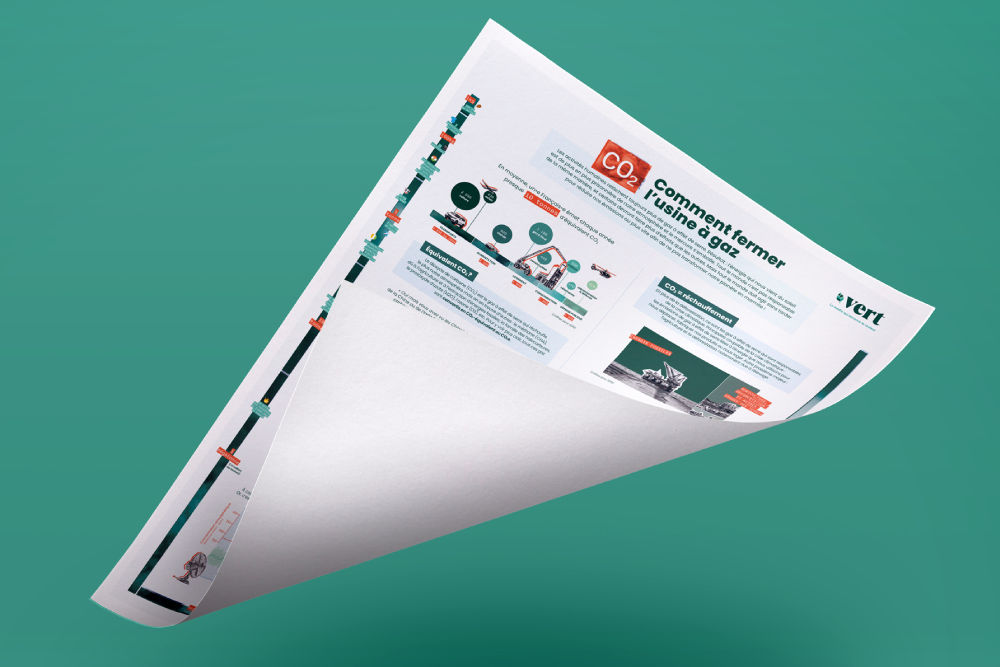
How should we cover anxiety-inducing news in an era of deliberate news avoidance? During a roundtable discussion on covering the climate emergency, Loup Espargilière, co-founder of the independent newsletter Vert (in partnership with Le StudioMédianes, Ed.), addressed several key points of his editorial strategy. Among these, the use of wordplay, a sometimes lighthearted tone, and subtle references stands out—all of which help build a connection with readers while enabling them to stay informed about the climate crisis with clarity, without succumbing to doomsday scenarios. To take things a step further, the publication now offers a set of ten “orders of magnitude” posters to display in bathrooms, offices, or high schools to help people distinguish between a kilowatt and a kilowatt-hour or understand what a kilogram or a metric ton of CO2 represents. It’s a clever way to reach new audiences and raise broader awareness of the challenges posed by the climate crisis.
For her part, Natalie Hanman, head of the environment desk at the British daily *The Guardian*, emphasizes the importance of training journalists to cover climate issues so that the ongoing crisis is reflected in all sections of the newspaper, beyond just the Environment desk. At The Guardian, all journalists are climate journalists. The Fashion section, for example, highlights secondhand fashion, while journalists covering transportation-related topics prioritize stories on carbon-free mobility. The journalism students in attendance used her presentation as an opportunity to urge newsrooms to create positions designed to promote cross-departmental coverage of these issues—much like “gender editors,” who are responsible for ensuring the accurate representation of women in the media.
? Cheffe du service environnement du @guardian, Natalie Hanman émet des réserves quant à la pratique du journalisme de solutions. “J’ai peur que l’on fasse croire aux gens qu’en recyclant, tout ira bien. On a surtout besoin de changements structurels dans nos gouvernements”
— Médianes (@medianes_org) November 22, 2022
Let's Break Free from Our Stereotypes About Gen Z
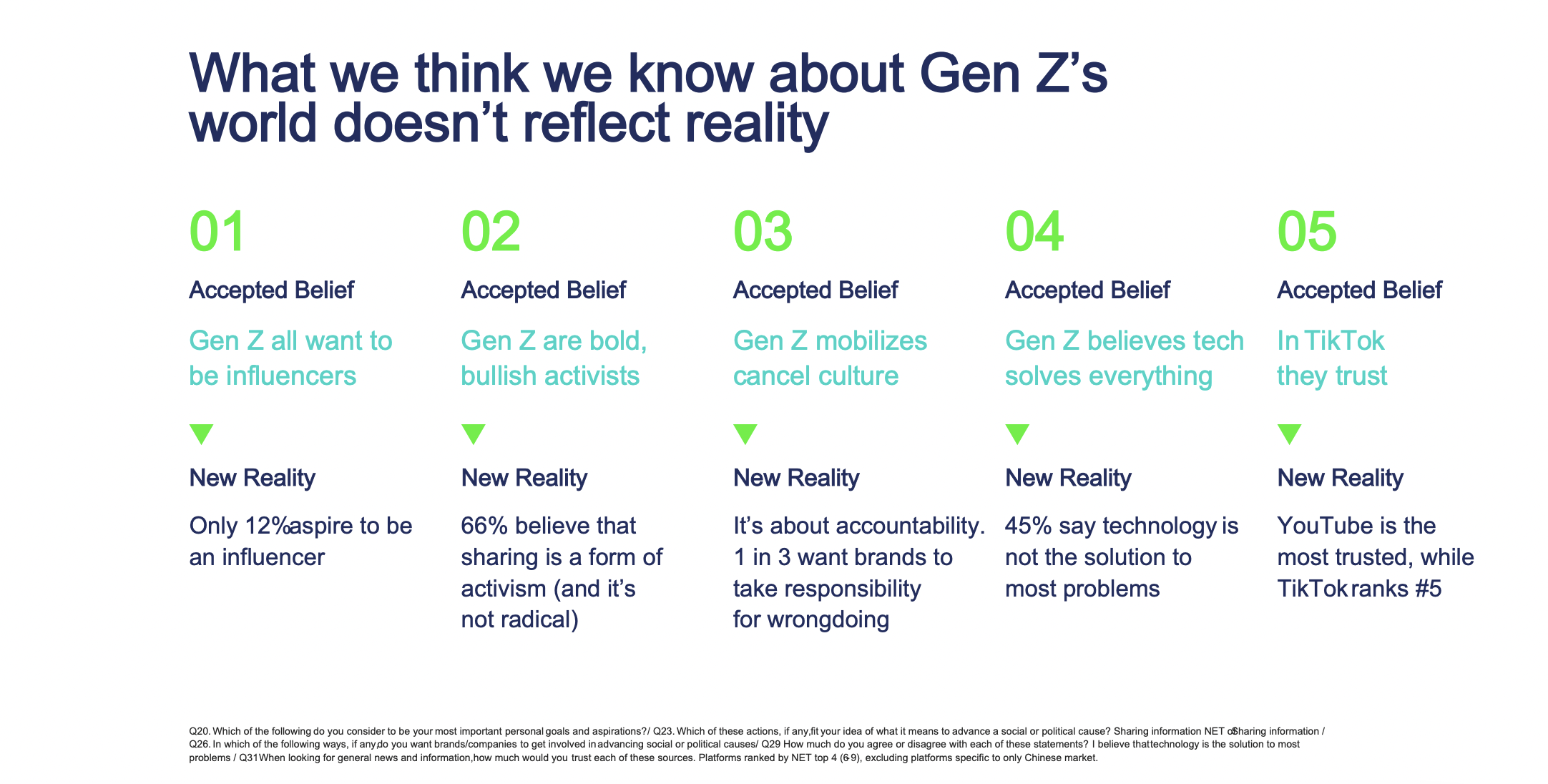
The communications agency Edelman has released the findings of its study on the social media habits of young people aged 14 to 24. Its report covers six markets: China, France, Germany, the United Kingdom, Mexico, and the United States. The main finding? Most of our assumptions about Gen Z are wrong. We assume that young people take the information they receive on TikTok at face value: that’s not true. While TikTok is certainly the app where Gen Z spends the most time (10.5 hours per week), it ranks last among the platforms that young people trust. Does Gen Z not take the time to verify information? That’s also false: 70% of young people fact-check what they hear on social media and unfollow accounts if they believe them to be untrustworthy.
The Ipsos survey conducted for Médias en Seine on how young people aged 16 to 30 engage with the news highlights the fact that they prefer general-interest media to stay informed, both through traditional platforms (television, radio, newspapers) as through social media and mobile apps. Fifty percent of young people consume content produced by television, 22% consume content from radio, and 18% consume content from daily and regional newspapers. Three-quarters of those surveyed say they trust multiple media outlets and journalists. And for 60% of the young people surveyed, misinformation is relatively rare in mainstream media compared to influencers’ accounts on social media.
⚠️ Watch out for clichés! We tend to oversimplify things by assuming that all Gen Zers want to be influencers. That’s not true. They do have influence, of course, but only 12% of them aspire to become influencers.
— Médianes (@medianes_org) November 22, 2022
To better reach young people, the digital-only publisher Konbini doesn’t hesitate to feature manga—a genre often treated “with condescension and contempt” in traditional newsrooms, according to Marie Misset, the publication’s editor-in-chief. For a pop culture media outlet, this cultural connection is essential but risky. Fall behind the latest trend by even a few days, and the consequences are severe. It’s a daily challenge that requires placing trust in the outlet’s young journalists. For his part, Mathieu Marmouget, director of Mouv’ at Radio France, explains that he wants to draw inspiration from the conventions of the Twitch platform by inviting young personalities from the online world and adopting a less standardized writing style that generates enthusiasm and surprises readers.
Advertising isn't automatic
Is it possible to fund a newsletter without advertising? For Climax, Vert, and 2 Jours Pour Vivre, the answer is yes. At Climax, an eco-friendly newsletter from the founders of Tech Trash (supported by Médianes, the studio—Ed.), the focus is first and foremost on diversification. That’s why they launched a quarterly fanzine of the same name to fund the weekly newsletter. People who subscribe to this fanzine do so primarily as a form of support, much like making a donation. Some order it simply to display it on their bookshelf—not to read it, but to show their support for the media project.
The other option is to provide training to companies. That’s what Vert used to do, before backing away from it for ethical reasons. Today, the founders of this newsletter only accept training requests from media outlets and are funded primarily through donations. The Climax team disagrees: “The issues aren’t the same as with advertising. Training sessions for companies are primarily about raising awareness. The question really comes up with brand content.” ” For her part, Amélie Deloffre, founder of the ecotourism newsletter *2 Jours Pour Vivre*, funds her work exclusively through training sessions she conducts for local governments, with the goal of helping to transform her sector by promoting carbon-free mobility and sustainable tourism.