On April 24, Asapp sent an email to its readers: the app is shutting down. In December 2021, Médianes had interviewed Xavier Antoyé, the editor-in-chief of Le Progrès, the media outlet behind the app. He explained the app’s strategy to us, and then we reached out to him again in June to understand what hadn’t worked.
Asapp is an app based in Lyon and Strasbourg, created by the Ebra media group. The outlet focuses on local news through a daily roundup, in-depth analysis, and an events calendar. In December 2021, at the offices of *Le Progrès* in Lyon, Xavier Antoyé—the daily’s editor-in-chief and the person in charge of the Ebra Group’s digital transformation— welcomed us, surrounded by stacks of newspapers. Although located in the heart of the city, it is not city dwellers who are reading print media. “We’ve noticed that there’s a gap in our readership between urban readers and those living in the suburbs, who are more likely to read our print edition,” explains the editor-in-chief.
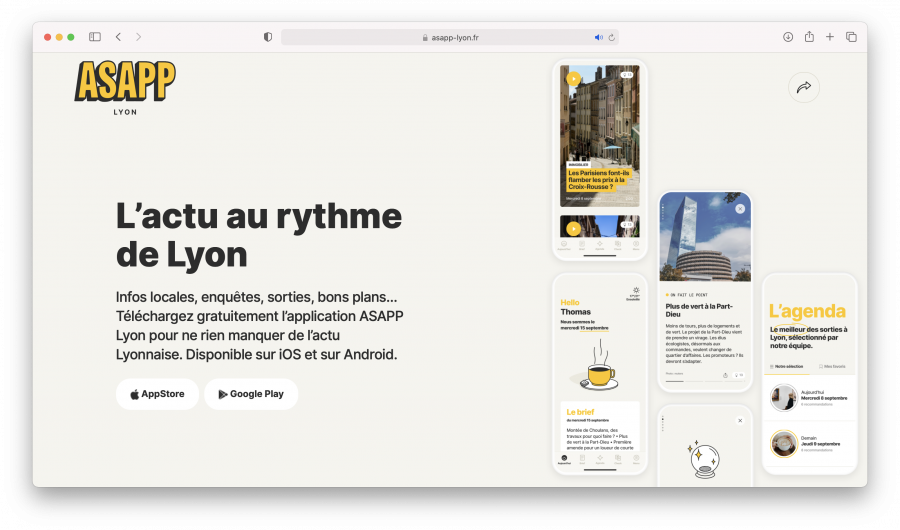
Based on this premise, the media group wanted to target the segment of the audience it wasn’t reaching. So at the Ebra Group, the idea of an app took hold. Its target audience? People aged 35–45 who live in urban areas and are looking for alternative ways to stay informed.
"We had some prerequisites"
Initially, Ebra commissioned the Ipsos Institute to conduct market research: “The first step was to conduct a survey on how urban residents consume media.” Regardless of the survey’s results, Asapp had certain requirements: no paper, only an app and a paid media service.
While the team thought it was providing a gateway to information for people who weren’t typically interested in it and wanted a different take on local news, the survey results revealed a completely different reality. “The audience interested in Asapp is older than we initially thought, and happens to be over-informed. Our editorial approach has therefore been to focus on simplicity in order to delve deeper into the essentials.”
Recruit beta testers
The app was officially launched in September 2021. In December, Xavier Antoyé stated that the team “is still in an experimental phase. Prior to that, the journalists had set up two beta-test versions.” An initial campaign took place in the spring of 2021 and lasted fifteen days. To do so, the group issued a public call via social media to recruit beta testers. 200 people signed up. “We realized that we had designed the first version to mirror Le Progrès in our approach to current events. We needed to find our own identity to set ourselves apart from the print publication and establish a new brand for a different audience.”
A second beta campaign took place in August 2021 over three days with about forty testers, in order to refine the offering. “For example, we thought our audience was tired of reading about politics all day long, so we hardly touched on the subject at all. But the participants asked us for political topics. So we started covering it through the lens of local politics, which makes it more relevant.”
"Putting yourself in real-world conditions"
For Xavier Antoyé, the two beta-testing sessions allowed the team to fine-tune the process and test the topics. “We wanted to publish Monday through Friday, so we couldn’t plan the topics too far in advance; it was perfect for simulating real-world working conditions.” The editor-in-chief emphasizes the importance of simulating these conditions, as it prepares the team.
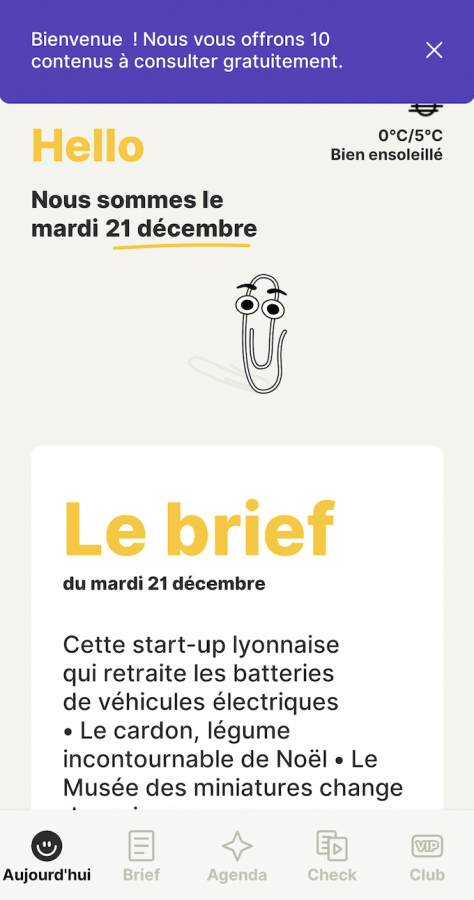
The beta version also allows users to test the app’s layout and design. Asapp partnered with the information design agency Datagif to develop the brand identity. In terms of functionality, the teams drew inspiration from the app *La Matinale du Monde*. “Generally speaking, you shouldn’t worry about making it look good or having the perfect product in the beta version. The goal is precisely to then work toward building a solution that we’ll be able to maintain on a day-to-day basis.”
End of the Project: What Didn't Work
April 2022. After a few months in operation, Asapp Lyon and Strasbourg are shutting down. There weren’t enough readers to sustain the project, despite the testing phases. “Six months after launch, subscriptions weren’t taking off, even though we had invested in marketing,” laments Xavier Antoyé. The issue wasn’t so much the price—set at 5 euros per month—since even if we had lowered it, it wouldn’t have been enough to cover the journalists’ work and the platform’s development. “Despite everything, we’re proud that we didn’t compromise on our pay model.”
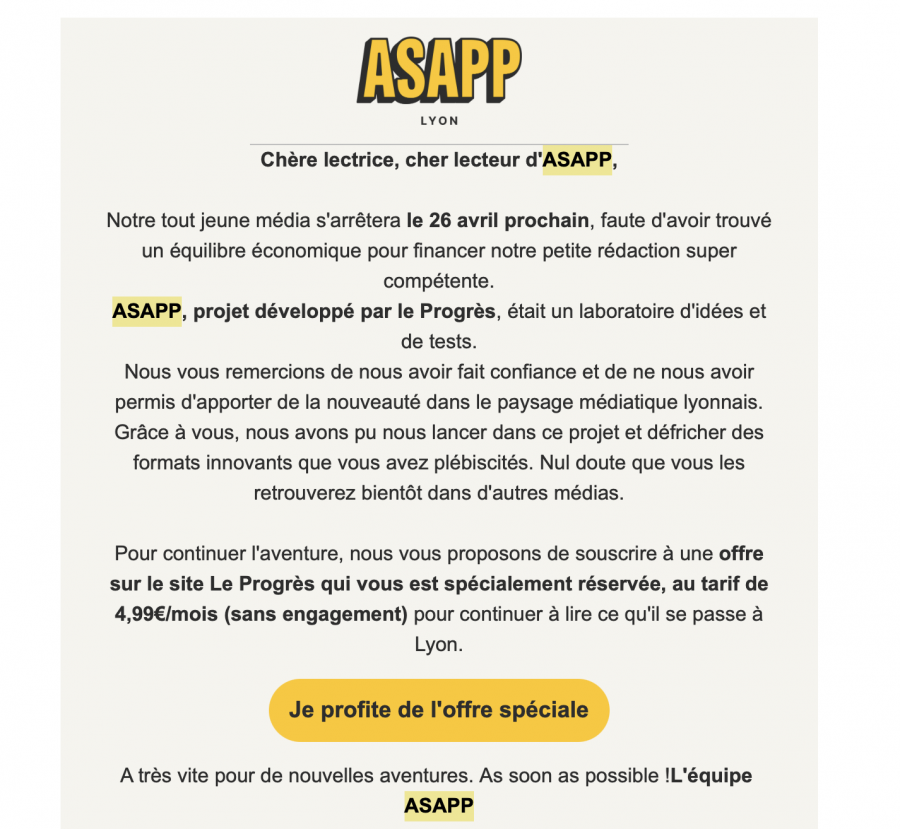
For Xavier Antoyé, the main reason for Asapp’s failure lies in the platform itself: “We encapsulated our media within an app, which may not have been the best idea, since downloading an app is no small matter. Furthermore, this cut us off from Google search results—which would have helped us gain visibility—and from social media outreach. The decision to create an app was perhaps a bit too radical, given the highly competitive news market.”
"This experience has nevertheless been beneficial for the editorial staff of *Le Progrès*," the editor-in-chief assures us. “We’ve embraced other writing formats, and we’re daring to try new things. The editorial staff has gained confidence in these formats, particularly on-camera video segments,” he concludes.
Not all innovations in the media are successful, but the editorial staff intends to build on the lessons learned from this failure. Testing formats, this time within the newspaper itself.
To go further
- This interview is part of our series on testing. Find more tips, including the example of *The Others* and their *Recto-Verso* project, the creation of a pilot issue with Pauline Dupin-Aymard of *Chassez le naturel* magazine, and the example of *Brief.me* with its beta-test campaign.
- To learn how to create your media project step by step, check out our how-to guides.
- How do you announce the end of your media outlet? Check out Asapp’s example on Instagram and Les Croissants’ example.