

👉 Steps, resources, tips… This practical guide was created by the Médianes studio, which has been helping media outlets design and structure their business model since 2020. Want to learn more or need some guidance? Contact us using this form.
How can you fund your project while staying true to your audiences and your values? This guide takes a close look at various existing audience-centered business models. The goal: to define your own!
1. Defining Your Business Model, Step by Step
Targets, competition, needs… Asking the right questions
What would my audiences be willing to pay for? How can I optimize the journey between my paid product and my audiences? To consider funding models for your media outlet and ways to generate revenue, you need to ask yourself a series of preliminary questions. Defining your media outlet’s business model requires that you take all aspects of the project into account. What is your vision? Who is your competition? Who are your target audiences? What are their needs? What is your editorial offering? What platforms will you use? What are your touchpoints? What are your costs and revenues? What benefits will your target audiences gain? Answering these questions will help you define the framework of your media outlet’s business model.
To do this, there’s a method: the Business Model Canvas, which involves mapping out your media outlet’s editorial and business model. The business model must always be consistent with your editorial vision and your target audience. That’s why, first and foremost, you need to have defined your target audience (using the persona method) and your editorial and business models (using the Business Model Canvas method).
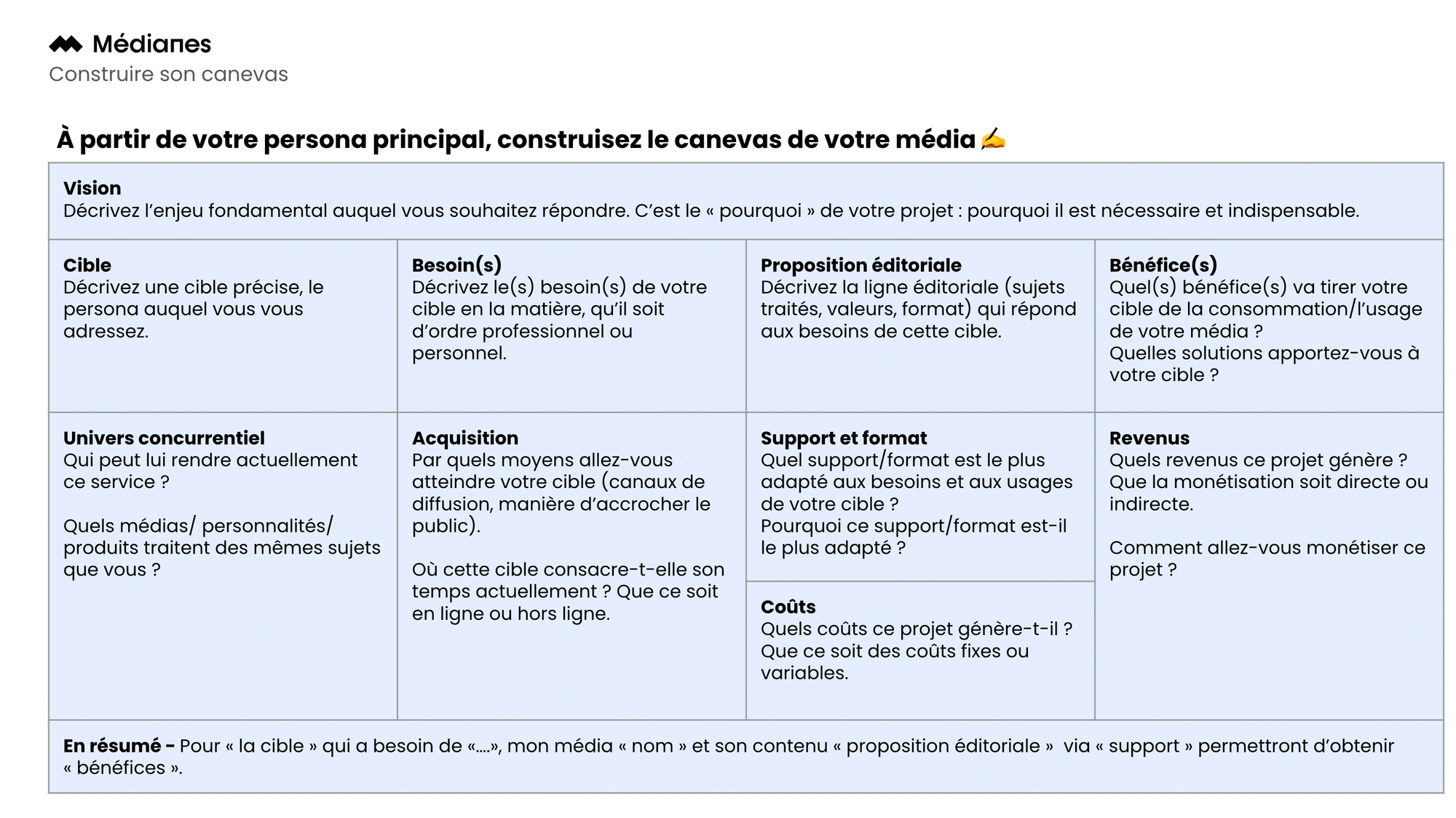
🔗 At Médianes[Company Name], we’ve created two dedicated how-to guides with downloadable educational resources to help you with these projects. ⟶ Building a Framework ⟶ Defining Your Personas
Outline Your Business Plan
Working on the framework allows you to develop your business plan. If your media venture is a project from which you’d like to generate income (and thus make a living), you’ll need to establish assumptions to achieve your sustainability goals.
It is, in fact, necessary to assess the costs your project will generate and the sources of revenue—whether direct or indirect. The cost must be in line with your financial resources and the values of your target audience.
- Revenue: What revenue does this project generate? How do you plan to monetize this project?
- Costs: What costs does this project entail? Whether they are fixed or variable costs (labor, office space, routing, technical solutions, etc.)
In practical terms, you need to strike a balance between revenue (sources of income) and expenses (sources of spending).
Depending on your target audience, the content you want to produce, the format and medium you’ve chosen, as well as your financial and strategic goals, various business models may be feasible. We’ll tell you more about them later in this guide.
🔗 To learn more: Business plans, management, administrative matters… Read the interview with Augustin Naepels, CEO of Les Jours ⟶
Conduct market research
Researching existing models and their effectiveness is the first step in developing your own: this allows you to understand your place within an ecosystem, avoid potential mistakes, and draw inspiration from ideas that align with your project and your target audience. Research media outlets that are structured like yours, target similar audiences, or offer the same formats. Ask yourself the right questions: Do these media outlets tend to monetize their content, implement subscriptions, crowdfunding, donations, paywalls, or sponsorships? In which cases does this work? Conversely, what lessons can be learned from the failures of your peers?
You can browse media websites and see how their offerings are structured. Another way to learn more about their performance is to follow media founders and executives on LinkedIn—many of them share updates about their projects, particularly from a financial perspective. Check out our educational resource at the end of this fact sheet, which will guide you through this process.
Ensure consistency with your editorial promise
A business model is based on a media outlet’s content, editorial direction, audience, and values—in short, on its value proposition.
When defining your business model, be sure to carefully consider your media outlet’s financial viability, editorial independence, and the bond of trust with your readers. It is important that no one pillar stifle the others. In other words, while your media outlet must be able to meet the goals of reach, influence, and financial independence, it must also remain true to its editorial vision. If your media outlet lacks a community aspect, the conditions for implementing a membership model may, for example, be called into question: What project is the audience participating in by becoming a member? Similarly, if your editorial approach isn’t centered around the concept of support, you may not be able to opt for the donation model. We’ll tell you more about these models a little further down.
🔗 Always keep in mind what your media outlet is all about with our handy guide on value propositions ⟶
Put your audience at the heart of your offering
We can’t stress this enough. By choosing to generate revenue from your readers or listeners, you’re acknowledging that you depend on them—or largely on them—to fund your media project. It’s therefore important to always keep in mind their profiles, expectations, and habits. Check out our practical guide on defining personas, which is also linked above.
You should assess your audiences’ financial resources (are they willing to pay? If so, how much? Under what terms? For how long? For what type of service? etc.) Also keep in mind that you’re not alone in the market: ask yourself which media and types of content your target audience is accustomed to paying for (or not!). Furthermore, one essential point to keep in mind is that you’re addressing an audience to whom you’re providing a service.
Messages encouraging contributions should be tailored to different audiences (target audience, paying subscribers, regular readers of the newspaper, online community), both in terms of messaging and distribution channels (social media, newsletters, in-person events, website, flyers, etc.). You need to identify the touchpoints with your target audiences: what platforms do they use, and what are the potential paths between those platforms and your media outlet? This requires you to integrate your audiences into the marketing funnel: acquisition, retention, conversion, and brand awareness. We’ll soon be offering a practical guide dedicated to this topic.
2. Identify the right model
Donations, membership, subscriptions: In the rest of this fact sheet, we’ll take a closer look at business models centered on their audiences.
Note: Keep in mind that defining a primary business model does not mean you can neglect to identify other sources of revenue to fall back on. To ensure financial stability and limit the risk of becoming overly dependent on a single source, it’s essential to review all potential revenue streams for your project in light of your target audience and editorial content. Events, e-commerce, merchandise… To round out your model, don’t hesitate to diversify your revenue streams and take into account any public funding you’re eligible for. At Médianes, we have two resources that can help you.
🔗 Grants, Diversification: A Closer Look at Other Sources of Revenue: ⟶ A practical guide to help you diversify your revenue streams ⟶ The government provides direct and indirect support to the press. Direct aid is provided to promote pluralism and modernization; indirect aid, on the other hand, allows media companies to avoid certain costs. Find key information on aid to the press.
A. Subscription
Rationale for contribution: I pay for a service or a specific editorial product. Contract: Direct or indirect benefit; access to exclusive content. Mechanism: Hard paywall, metered paywall, freemium.
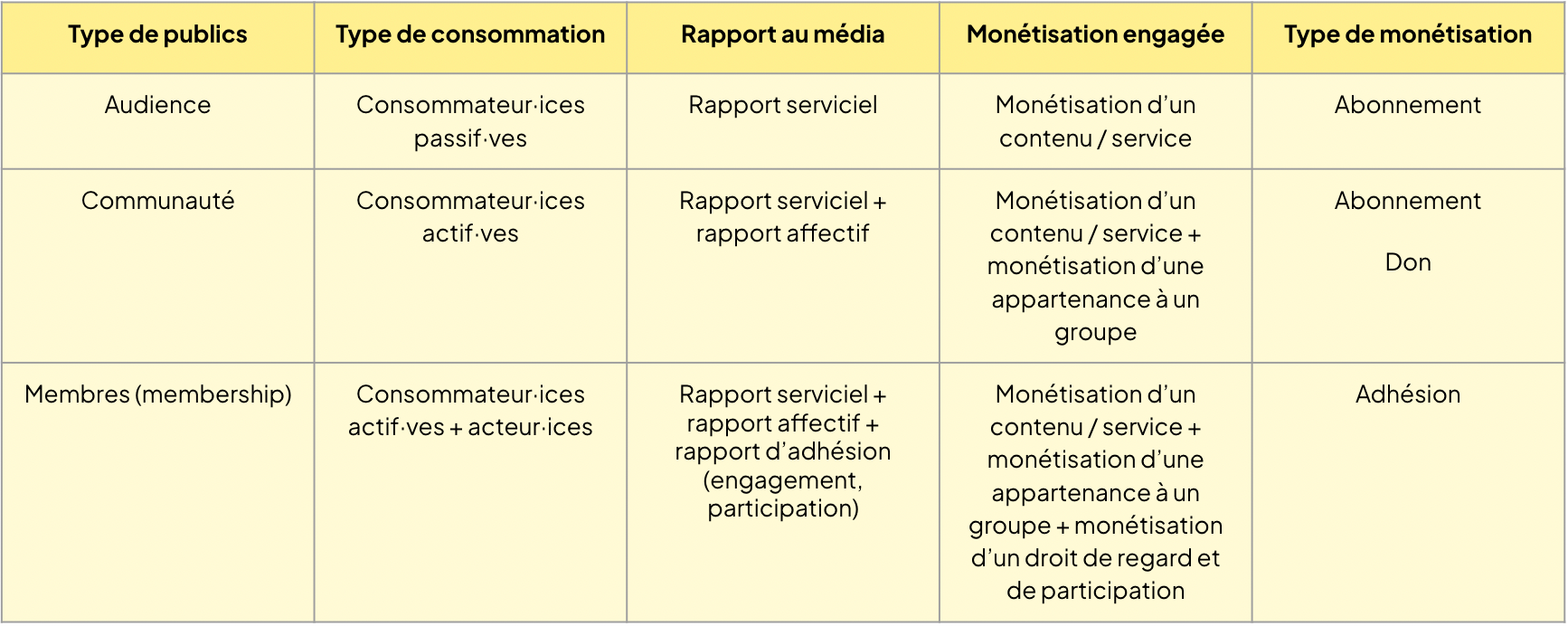
In the case of a subscription, readers pay for a service—a specific editorial product. Unlike donations and memberships, subscriptions rely less on a sense of community and emotional attachment than on a service-based relationship: the financial contribution guarantees exclusive access to content or a product that meets a personal or professional need. Consumers are more passive and less engaged with the media outlet itself than they are with donations and memberships. Several strategies can be employed within the framework of subscription plans. Some media outlets:
- set tiered prices based on readers' profiles (preferential rates);
- adjust their plans and prices based on the content they want to access.
- Content and the user experience can also be monetized (e.g., paywall systems).
Some best practices;
- Create a clear, simple, and concise user journey and subscription process;
- Display a small number of simple options with clear subscription plans;
- Set commitment periods and payment frequencies that are tailored to your business model;
- Payment options tailored to your audience’s profiles (no-commitment or limited-term plans, by credit card, by check via La Poste, etc.);
- Choose payment methods that help build customer loyalty (SEPA direct debit rather than credit card or check);
- Prioritize psychological pricing that aligns with the public’s perceptions of “fair prices.”
Case Study: Arrêt sur images Arrêt sur images offers subscription plans tailored to the economic profiles of its audiences. For example, one plan is designed for audiences with limited financial means (€2), while another is aimed at those able to pay an average rate for news (€10). A gift subscription option is also promoted. Subscription plans are also available for any organization wishing to provide access to Arrêt sur images for various members of a team.
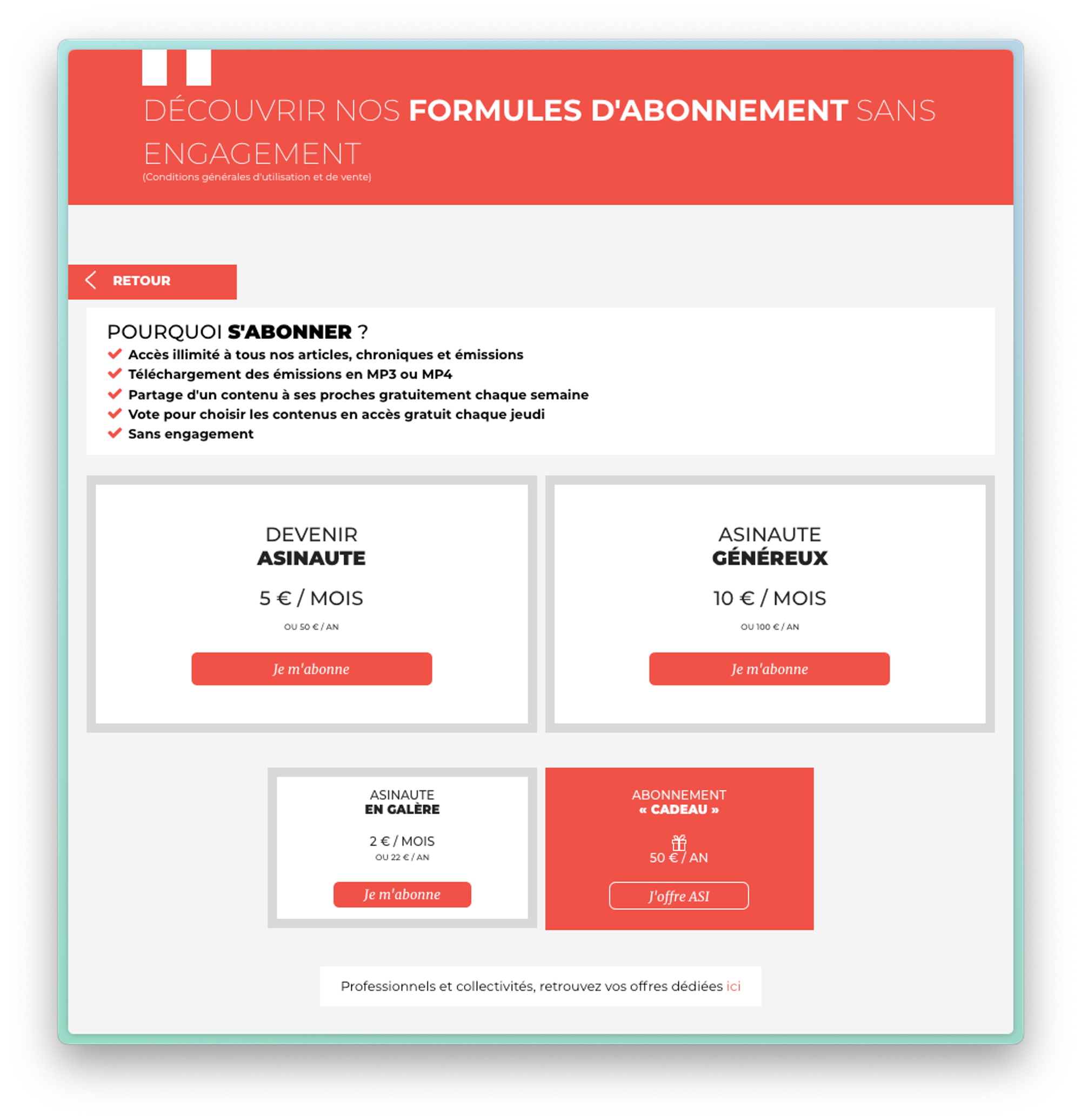
👉 Médianes, the studio, has provided support to Arrêt sur images on marketing and communications issues. It has also been supporting La Déferlante in its strategic and operational development (marketing, design, and tech) since the summer of 2019.
B. The Gift
Reason for contributing: I support a cause or an idea that I believe in. Agreement: A sense of community; no specific consideration in return. Mechanism: One-time, regular, event-based, or ongoing donation.
In the case of media outlets funded by donations, audiences make financial contributions either occasionally or regularly (usually on a monthly basis). The donation model is linked to support for a cause, a vision, an idea, or shared values. Donations stem from a sense of community; no specific reward is offered in exchange. Donations can be encouraged in a low-key, event-based manner—as part of donation campaigns and on an ongoing basis across the media outlet’s various platforms (such as pop-ups on the website or dedicated sections in the newsletter).
When you set up a donation system, it's in your best interest to:
- Ensure that you have a sufficient community base;
- Carefully choose the time when you reach out to your audiences (taking into account the overall schedule, the media calendar, your own outreach efforts, etc.) so that you can reach them when they are available;
- Find effective marketing arguments while remaining as honest as possible;
- Be completely transparent about the amount you need and what the money will be used for;
- Develop a strategy for donation-focused event campaigns and prepare them well in advance (visuals, messages and donation appeals, engagement of the community and Circles 0 and 1, press outreach, etc.).
🔗 For tips and practical examples on crowdfunding campaigns, check out our two guides on the topic: Everything You Need to Know About Crowdfunding and How to Run a Crowdfunding Campaign.
Case Study: StreetPress Launched in 2010, StreetPress is an investigative and urban culture media outlet with a strong, authentic value proposition. It champions a model of engaged, free journalism supported by its readers.
A donation to fund a publication
- As part of the November 2021 launch of FAF, a free newsletter dedicated to monitoring and combating the far right, StreetPress is running a campaign to raise awareness and support, in collaboration with Médianes, le studio. The campaign took off with a key call-to-action: supporting investigative journalism dedicated to combating the far right. The goal was set at €48,000 by December 16. It ultimately raised nearly €75,000 in donations, with a more than 50% increase in the number of monthly donations.
- In late 2023, StreetPress is back at it again, this time launching a collaborative platform focused on the far right. The idea? To allow anyone to report the presence and activities of far-right groups or activists, the events they organize, their meeting places, and so on. As part of this effort, the media outlet—once again partnered with Médianes—has planned two phases: an initial fundraising phase to recruit donors, and a phase dedicated to promoting the platform on a larger scale, while also encouraging donations. The result? More than €185,000 raised against an initial goal of €100,000.
Donations to Support a Pay-What-You-Want Media Outlet In the fall of 2022, we worked with the team on a fundraising campaign, this time focused more on supporting a pay-what-you-want media outlet. The initial goal of €80,000 was reached and exceeded, as StreetPress ultimately raised €100,000 (125% of the goal). Defending against threats from the far-right online sphere, funding lawsuits, protecting journalists from threats, and ensuring the long-term survival of a media outlet that investigates the far right and the police… These points were turned into slogans and served as compelling reasons to contribute.

It’s worth noting that donations are the preferred funding model for community-based media. Like an NGO, StreetPress publishes an annual impact report—a way to engage with its community while being transparent about its budget and strategy.
🔗 To learn more about the StreetPress case: ⟶ Marine Doux’s talk, co-founder of Médianes, at Web2day, in which she discusses the StreetPress case at 24:41. ⟶ Mathieu Molard’s talk, co-editor-in-chief in charge of investigations and head of media development, at the États Généraux de la presse indépendante (1:06) ⟶ Details on the projects carried out by Médianes alongside StreetPress.
C. Membership
Contribution rationale: I am contributing to an editorial and economic project. Contract: A new editorial and economic relationship between the media outlet and its community. Mechanics: Open or limited access; strong or moderate involvement.
The membership model is linked to support for an editorial and business venture. Membership requires turning readers into true members of the community. This points to a model that falls halfway between a subscription and a donation; it formalizes the relationship between the readership and the media outlet on a commercial basis, but also on a participatory and symbolic one.
The media outlet invites its audience to contribute to its existence—that is, to directly fund the outlet and its editorial production in exchange for various rewards, whether symbolic or tangible (special rates, involvement in the editorial process, exclusive meet-and-greets, etc.). Community members do not pay for access to content, but rather to gain a say or a role in the outlet’s editorial direction, economic structure, or overall strategy. These benefits add value to the user experience by granting users greater access, rights, and influence. This is often a participatory model.
🔗 For more information, we invite you to read “Moving from an Audience to a Community,” an article by Maxime Leroy on medianes.org.
The relationship established between the media outlet and its members is a horizontal one based on a sense of belonging and mutual trust. It is a relationship of giving and reciprocity based on transparency in exchange for financial support. To make this membership effective, spaces and mechanisms similar to those used in community management must be established to facilitate dialogue, exchange, and interaction among members, as well as between members and the media outlet. Membership can be promoted through ongoing and/or event-based efforts—as part of membership drives and on an ongoing basis across the media outlet’s various platforms.
Some best practices:
- Align your editorial strategy with your business model to engage your audiences through a project that forms a coherent whole;
- Clearly communicate this editorial and business proposal;
- Clearly define the scope of what you are offering members as part of their membership (your expectations of them; the forms, levels, and limits of their participation);
- Take into account the needs and expectations of your audiences when developing this membership system;
- Create sufficient opportunities for participation to foster a sense of belonging among audiences;
- Choose participation formats that are tailored to your audiences’ availability, habits, and expectations.
Case Study: Tortoise Launched in 2018 through a Kickstarter crowdfunding campaign, Tortoise is a British media outlet that promotes slow journalism. Its primary business model? Membership. Tortoise’s membership page is very well designed, featuring a clear and detailed list of what membership offers its audience (preferred access and rates, exclusive editorial content, etc.). Three years after its launch, Tortoise had 130,000 members, including paying members and those on trial.
This approach wasn't enough to make the media outlet profitable, so it decided to expand into podcasting in addition to articles in order to attract a younger audience. (Today, the average podcast listener is 29 years old, while the average member is 39.)
Tortoise thus turned to the podcast to secure a £10 million investment to expand into the audio sector. A six-part podcast series released following the death of Queen Elizabeth II even reached 100,000 downloads during the mourning period alone. Tortoise requires a financial contribution for access to ad-free podcasts (on its own platforms outside of third-party services). It also funds its offerings through its studio (branded podcasts).
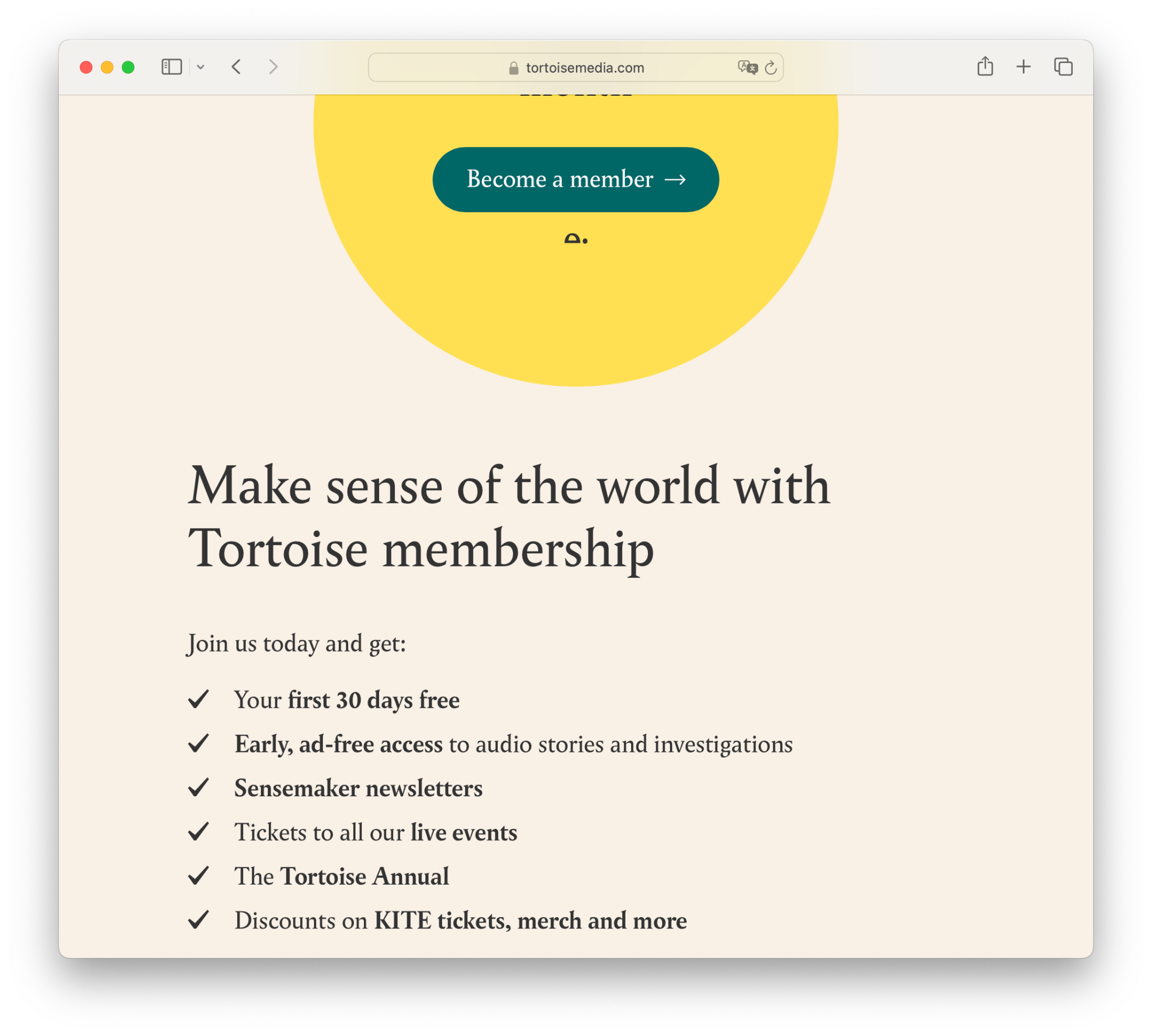
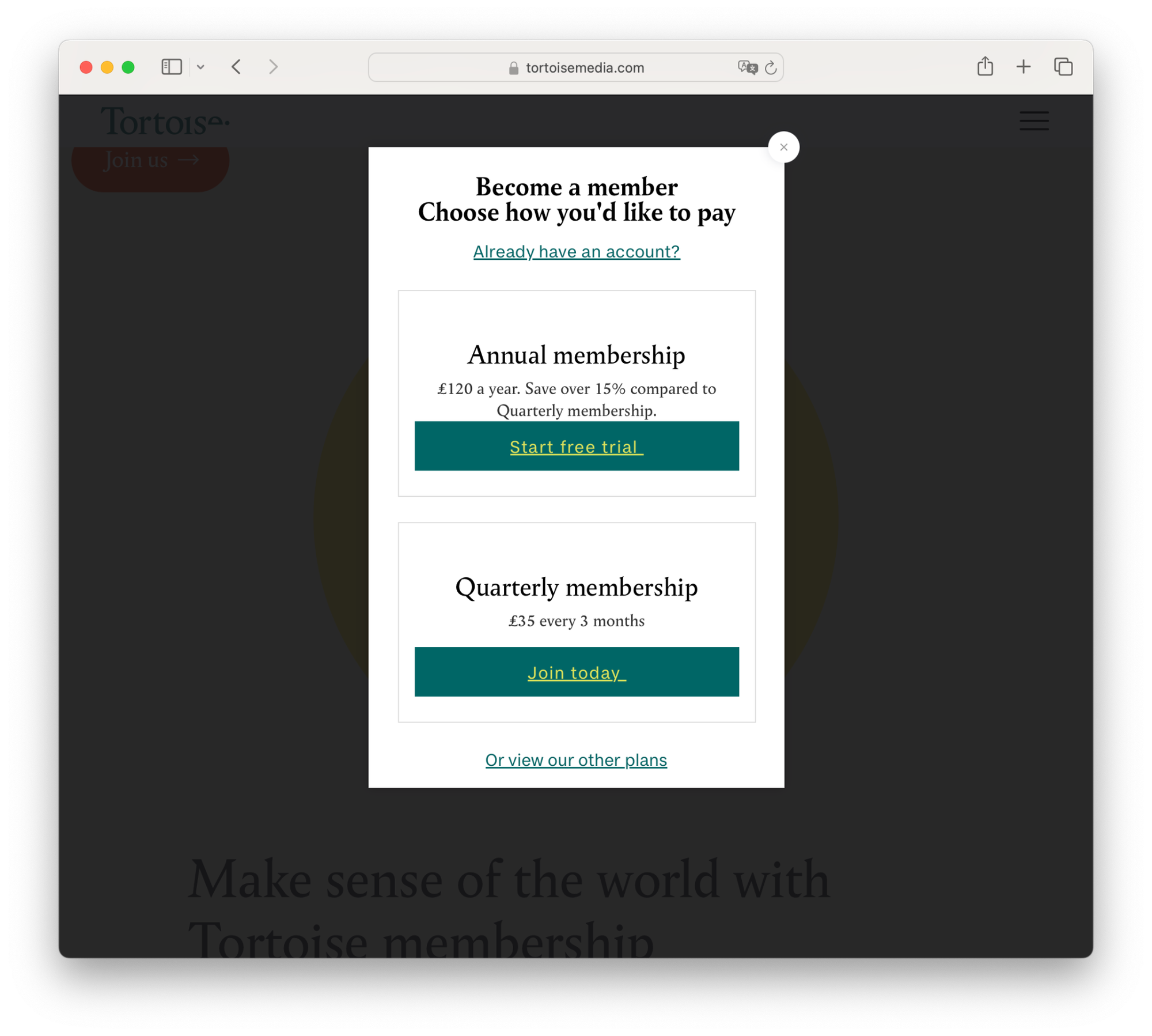

🔗 Pour aller plus loin sur le cas de Tortoise : ⟶ Une analyse de leur passage à l’audio, à lire sur journalism.co.uk ⟶ On vous en dit plus sur les ThinkIn, les formats événementiels de Tortoise, dans l’édition n°15 de notre newsletter.
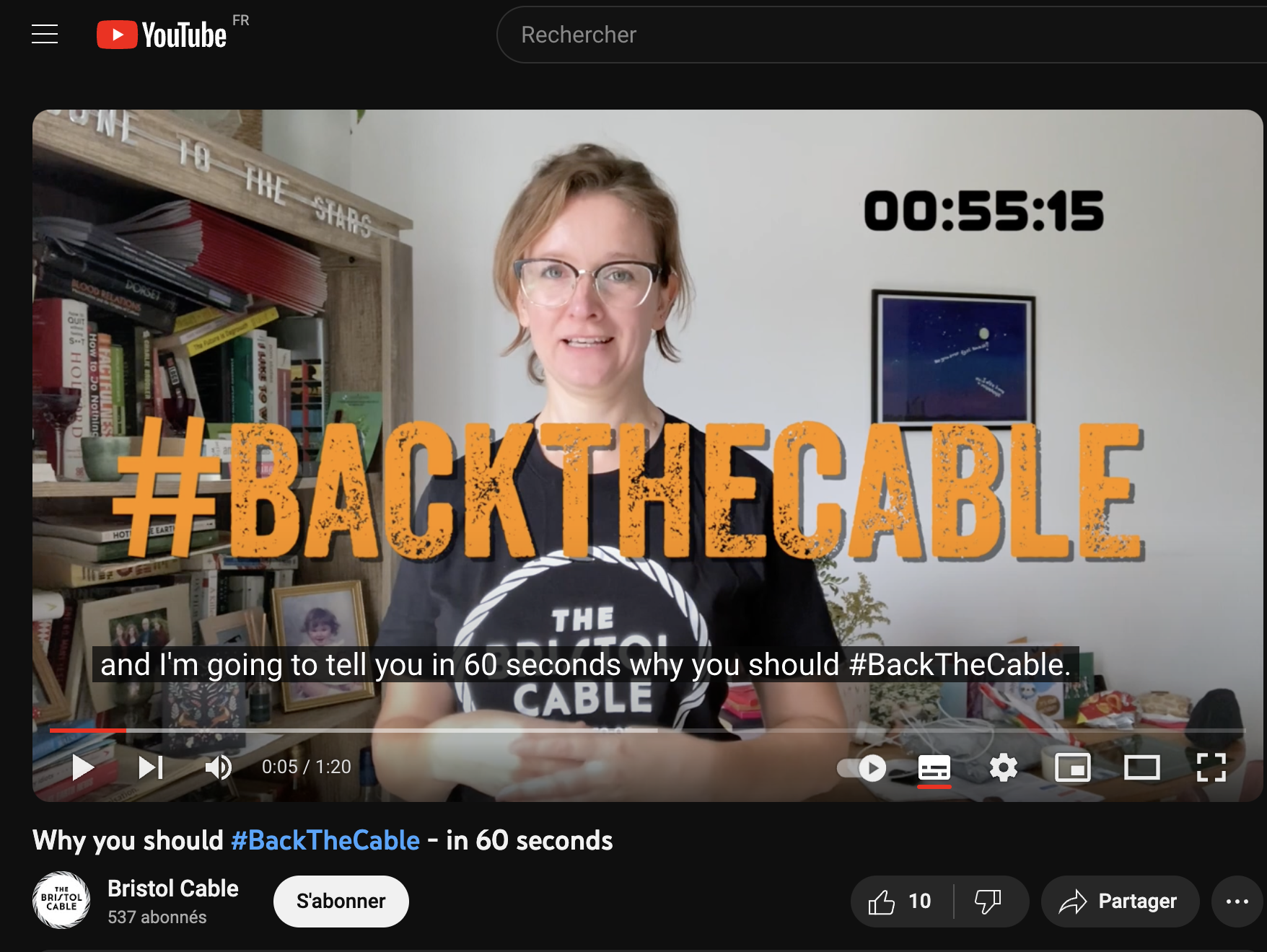
Case Study: The Bristol Cable The Bristol Cable is a free, local investigative news outlet in the UK that is wholly owned by its 2,700 members. Readers can become members by paying a monthly or annual fee. The community contributes to investigations using the Cable Links tool; citizens can share their stories to enrich articles, such as the one on living in skyscrapers. Events, listed in the community calendar, help strengthen local ties.
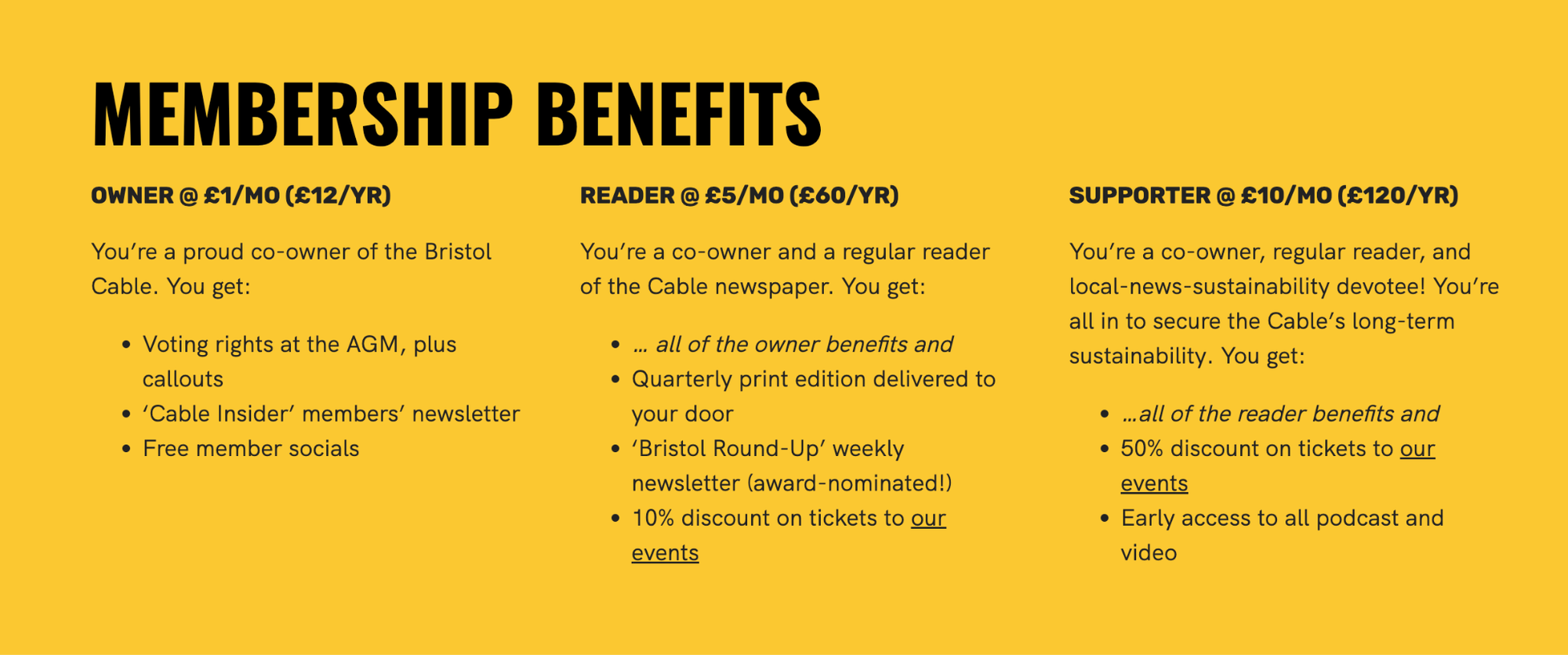
36% of its annual revenue (approximately 375,000 euros) comes from its 2,500 members; the remaining two-thirds come mainly from foundations and grants. To avoid dependence on grants and donors, the media outlet launched a membership drive in late 2023 to increase revenue from its readers by 50%.
D. From Donation to Membership
Properly structuring a donation model makes it possible to transition to a membership model (membership encourages recurring donations). To do this, the media outlet must ensure it has a community base that is sufficiently engaged and willing to make recurring payments.
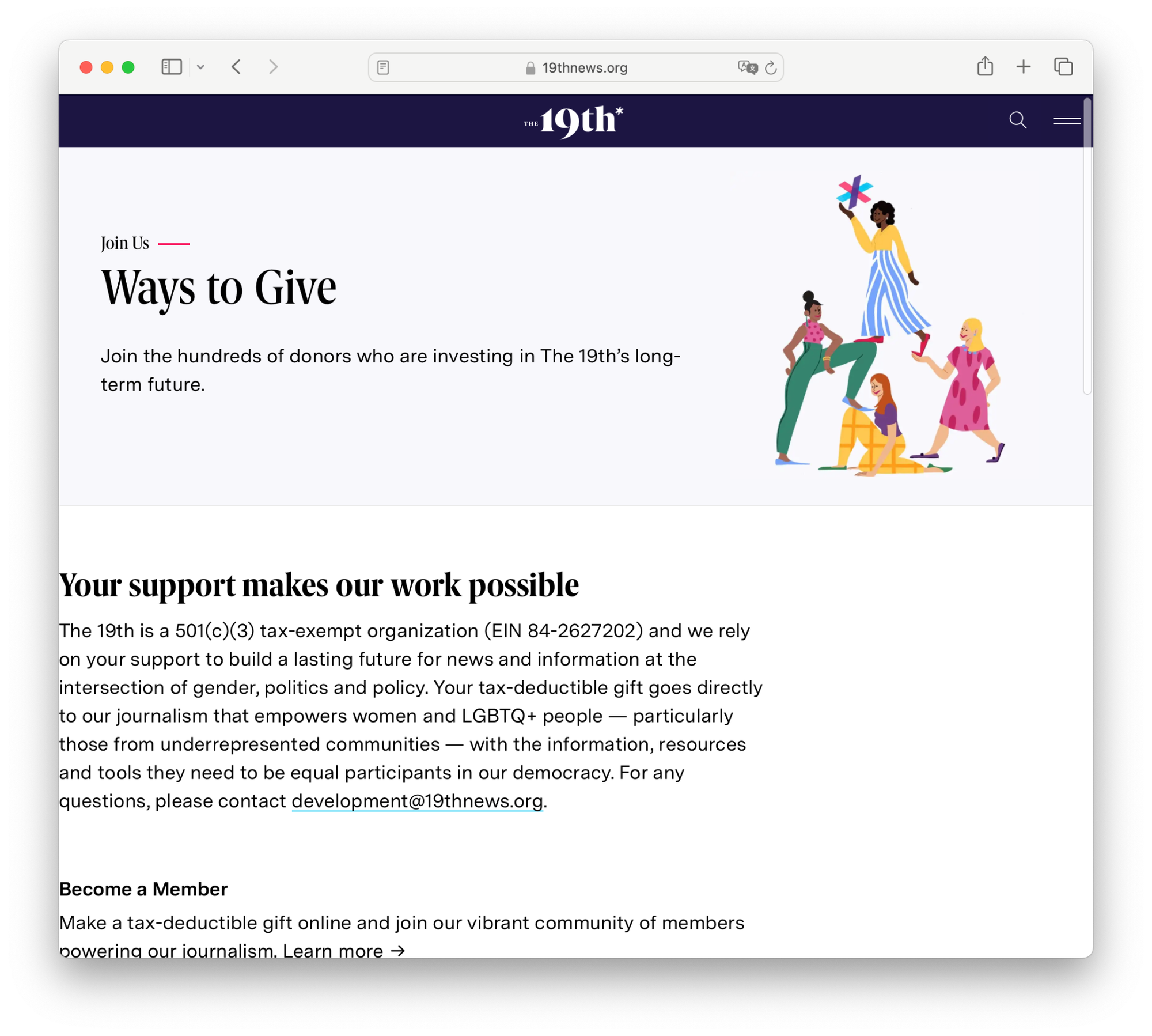
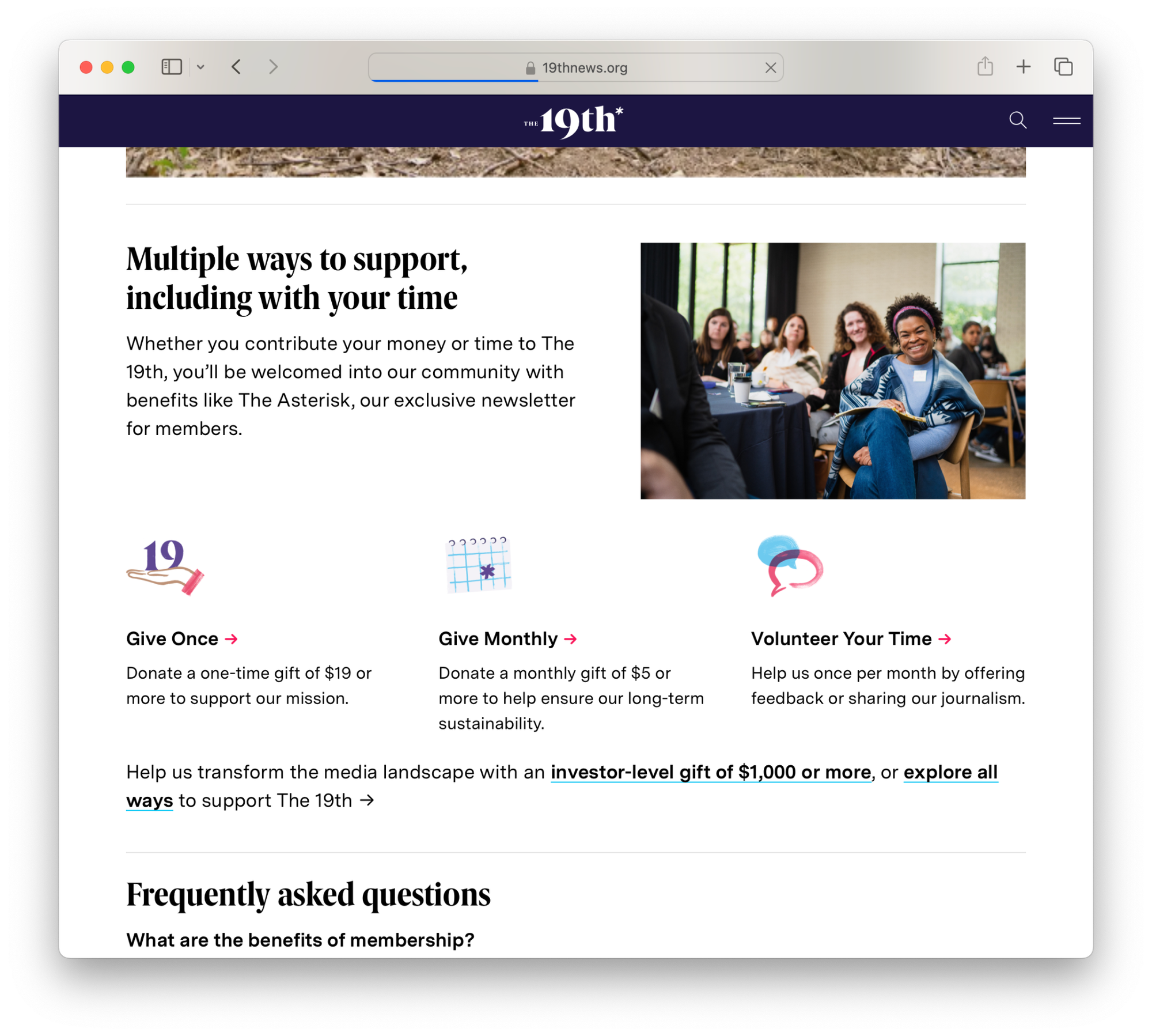
Case Study: The 19th The American feminist media outlet The 19th highlights the importance of its mission from a democratic perspective (feminism): “Our goal is long-term viability to support a sustainable future for journalism and news at the intersection of gender, politics, and public policy.” The 19th launched in 2020 with funding from major donors and relies on the membership and support of its readers. While the proposal is essentially symbolic, it nevertheless grants readers access to the media outlet’s financial operations and strategic decisions. The arguments are as follows:
- Become a Member: Make a tax-deductible donation online and join our vibrant community of members who support our journalism.
- Make a Major Donation: Help us innovate through your ongoing support and enable us to make significant progress toward our mission and long-term growth. Our community of investors supports The 19th with annual donations of $1,000 or more.
- Planned Giving: Dedicate your legacy to independent, nonprofit media and make a lasting impact on our organization.
- Corporate Support: Expand your reach to a diverse, multigenerational community that seeks to make a meaningful contribution to society.
3. Communicate about your business model
In your special relationship with your audiences, you are committed to transparency—all the more so because you are an independent media outlet. Sharing your business model so that readers can understand and accept it—and so that they can get behind it—is a real added value.
Spotlight on StreetPress
StreetPress is stepping up its efforts to help its audiences better understand its business model. This strategy is initially rolled out in a straightforward manner on the “About” page ” page (cleverly renamed “Why StreetPress” in line with the outlet’s value proposition), featuring a “Make a Donation” call-to-action that links to the donation page.
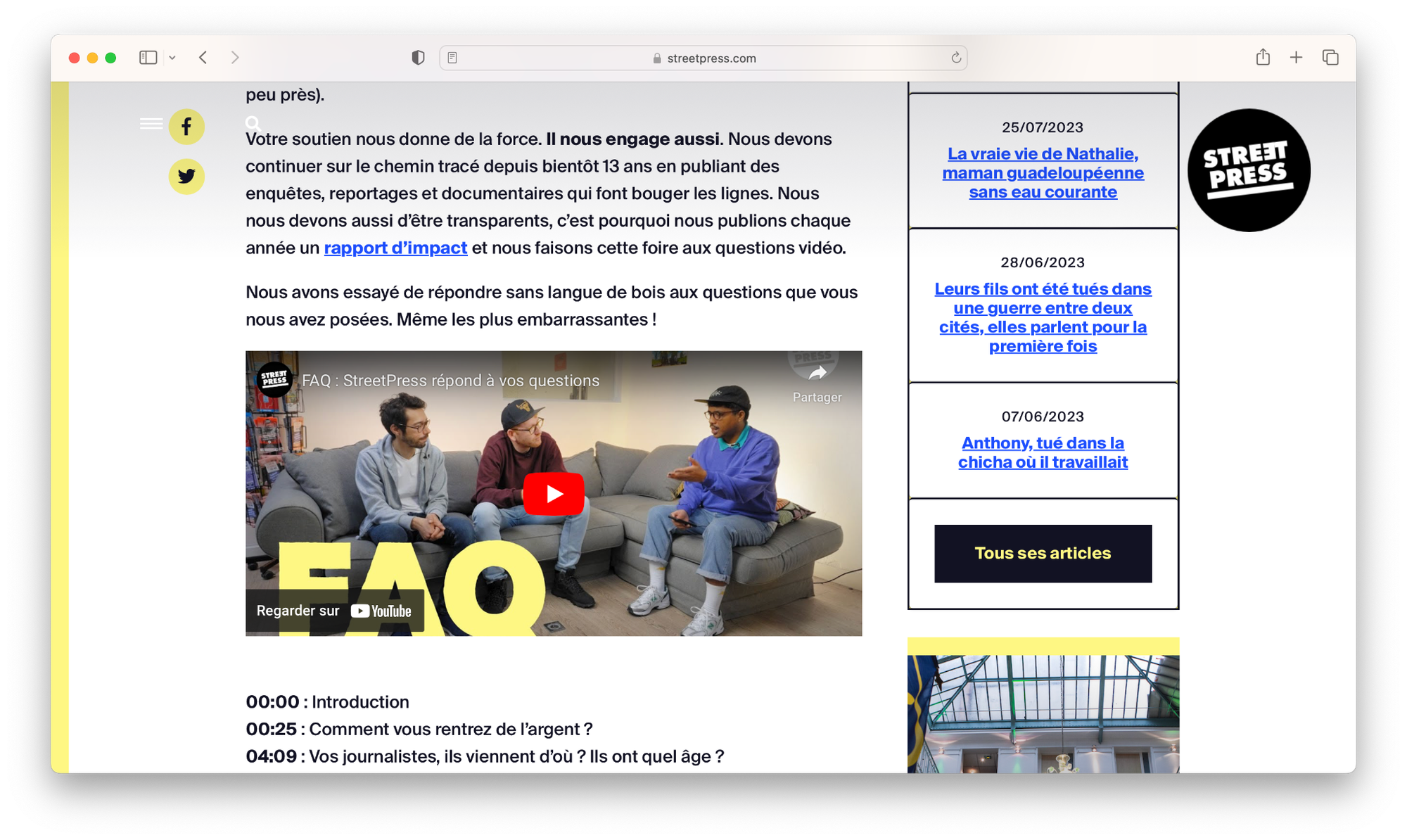
The media outlet also takes advantage of key moments to communicate its mission, the project it is pursuing, and its business model. In November 2022, as part of its fundraising campaign, StreetPress published content (a video FAQ, a manifesto article, a Twitter Space, and an impact report) to explain its approach.
4. Specifically, what are the steps?
A. Start with Your Goals
To provide a cohesive offering and monetize your editorial content, it is essential that you ensure the following:
- Effectively address a specific need of your target audience;
- Offer formats and media tailored to their uses and consumption patterns;
- Offer a price that your customers will perceive as fair for the service provided;
- Offer a pricing structure that is in line with your audiences' financial means.
🔎 Use our practical guides to develop your value proposition, your personas, and your canvas.
B. Identify the level of engagement among audiences
C. Preparing Your Business Plan
In a highly competitive media landscape, the challenge is to show how your product stands out and why it’s useful and interesting enough for people to pay for it. It’s not just about creating a balance between supply and demand, but also about offering good value for the price!
- Start by choosing the appropriate economic model(s), based on your project's objectives;
- Next, outline your business plan;
- List potential sources of revenue, whether direct or indirect;
- List the expenses associated with this strategy;
- Develop a plan to track your income and expenses over the next six months.
5. Our Educational Resources
The Médianes team has prepared two practical resources to help you apply what you’ve learned from this guide to your own project:
- The general form to fill out to help you identify your sources of income;
- This table helps you outline your business plan.
✉️ Have you read and used this guide? We'd love to hear your feedback! Do you have a question or comment? Email us at [email protected]. Thank you for your help, the team at Médianes.