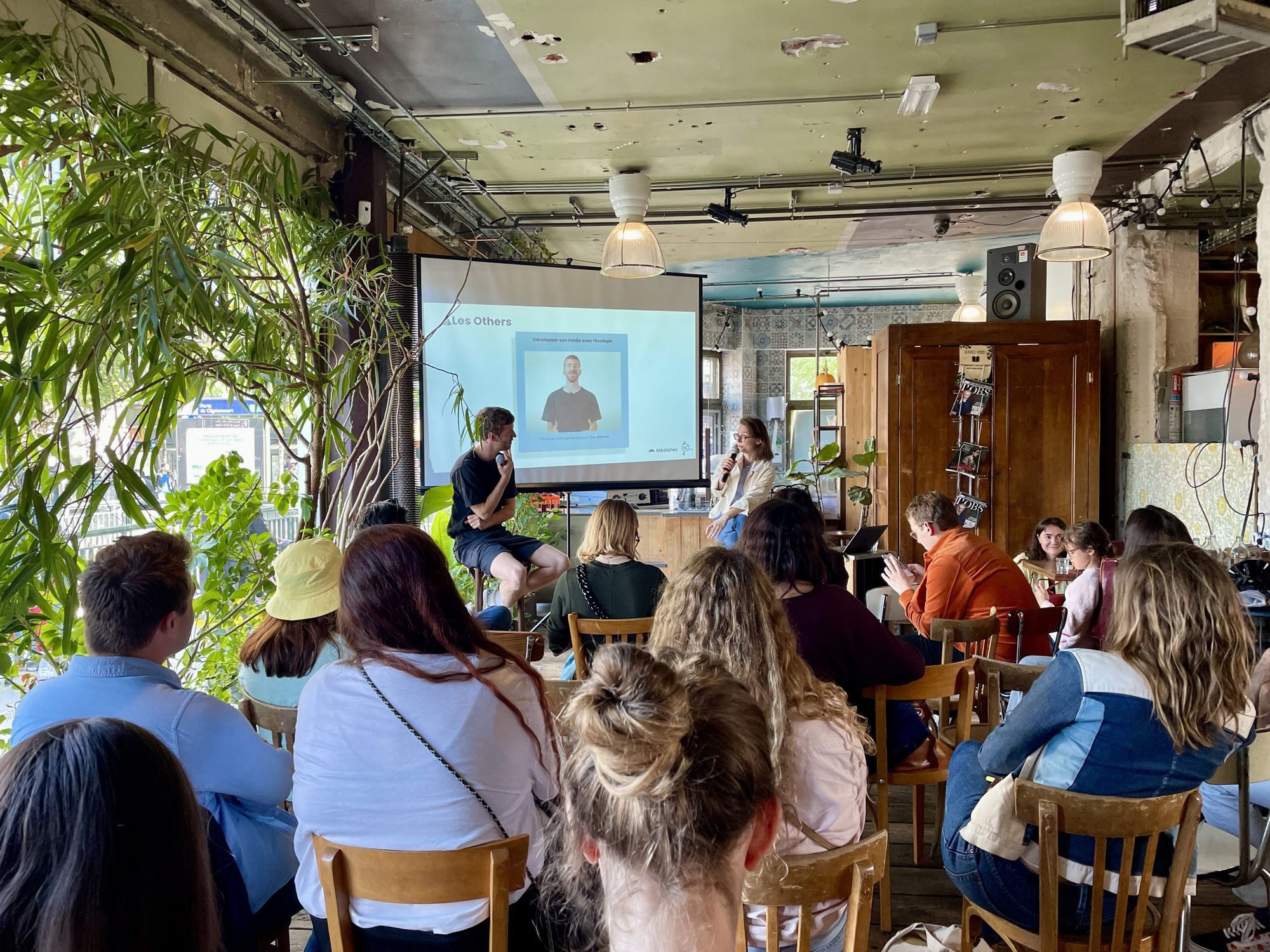
On Saturday, May 28, Médianes organized a roundtable discussion on the topic: “Launching and Developing Your Media Outlet in the Age of the Ecological Emergency.” What factors should be taken into account? We discussed this with Dan Geiselhart and Lauren Boudard from Climax and Thomas Firh from Les Autres. Here’s a recap of our event at La Recyclerie, featuring four ideas you can apply to your media outlet.
Some media outlets cover environmental issues in dedicated sections; others plan to frame their reporting through an ecological lens. This is an important distinction, and for good reason: making environmentalism a theme is not a sufficient commitment for those who view it as an editorial priority. While it is clear that the environment is a vital cause, it must still be addressed from editorial, technical, and strategic perspectives. And that isn’t always easy. Through our discussions with our guests, we’ve identified some tips to follow and tools to implement for launching or developing a media outlet focused on environmental issues.
Climax: Ecology at the Heart of the Editorial Vision
Dan and Lauren are the founders of the *Climax* newsletter, which was launched in 2021 and has more than 2,000 paying subscribers. To set themselves apart, Dan and Lauren chose to set the tone: exposing political inaction on environmental issues through sarcastic humor. We actually discussed this with them in an article from the “Testing Your Project” series. The two journalists already have experience with TechTrash, a tech newsletter with 30,000 subscribers. What’s the connection between the two? “ “The common thread stems from an observation: the dominance of techno-enthusiastic discourse,” explains Lauren. But talking about the climate emergency remains a challenge.

To launch Climax, the journalists asked themselves three questions. The first: How do existing media outlets cover it? It seems that a good starting point would be to draw on our own experience as news consumers. “There’s often a very anxiety-inducing angle and a great deal of complexity, and as readers, we didn’t feel like reading the articles in their entirety.”
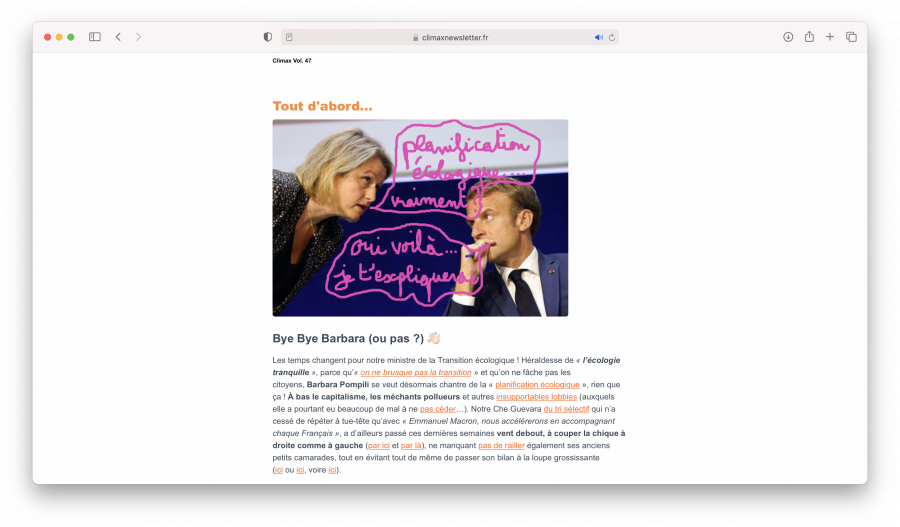
Second question: How can we talk effectively about environmental issues? “There are a thousand ways to talk about environmental issues. Talking about small actions doesn’t resonate with us. Nor does framing it through the lens of heroes and heroines saving the world.” In response, Climax has chosen to address environmental policy with a biting tone—a way to raise awareness differently and call out inaction.
“Sometimes, when it comes to certain topics like climate change, some media outlets use specific imagery to depoliticize the issues ” — Lauren Boudard @Climaxfr @TechTrashFr
— Médianes (@medianes_org) May 28, 2022
Finally: Which channel is the most appropriate? The newsletter format seemed most relevant to them because “it’s a flexible, lightweight format that allows us to break free from the major platforms and create a genuine dialogue with our readers .” The newsletter also helps foster a special connection with its community. For Climax, most readers come from TechTrash without necessarily being aware of environmental issues. Furthermore, the email enables a constructive dialogue between Dan, Lauren, and their community, as readers take the time to provide written feedback.
"We're always getting responses from people who reach out to share information and their reading recommendations with us" — Lauren Boudard @Climaxfr @TechTrashFr
— Médianes (@medianes_org) May 28, 2022
The Others: Taking the Turn, Naturally
Thomas Firh is the co-founder of Les Others, an outdoor-inspired media outlet that covers hiking, biking, rock climbing, and a love of nature. When it launched in 2012, it was a blog. Today, it’s a bi-annual print magazine, online articles, the “Les Baladeurs” podcast, an Instagram account with 185,000 followers, and a creative studio. Most recently, there was the Recto Verso project, which we’ve already told you about: a guide to planning your own trips in France. The crowdfunding campaign that launched Recto Verso was a resounding success: a total of 10,000 pre-orders were sold, even though the initial goal was set at 1,000. In fact, the idea behind Recto Verso was to relieve pressure on natural areas. More broadly, the team at Les Autres is committed to encouraging its community to travel differently—in a more responsible way and with respect for the environment. Thomas Firh has also explained his approach in a manifesto.
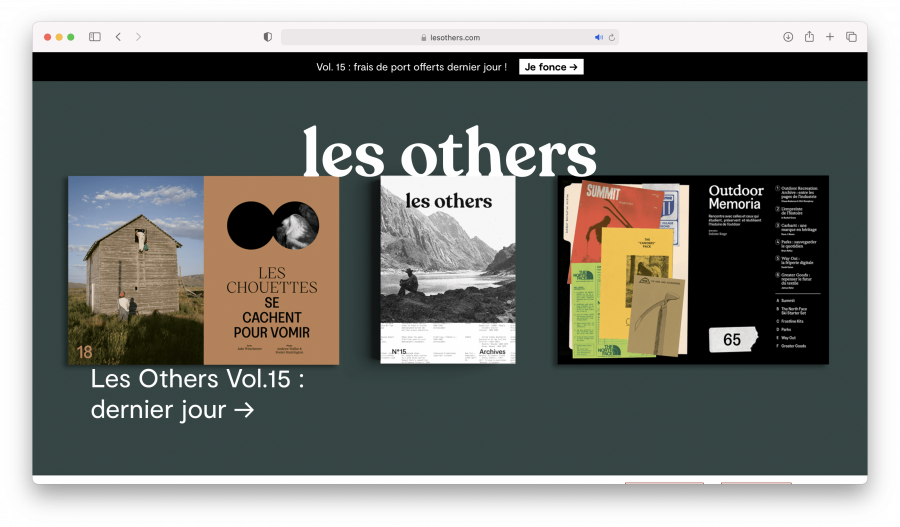
Precisely: the concept of community and sharing is a cornerstone of the media outlet’s editorial vision. Thomas also draws a distinction between the audience and the community: “With an audience, you give them information, and they fit into a top-down model. A community co-creates the project with you.” And for good reason: independent media outlets like Les Autres rely on their readers for funding: listening to them is not an option, and involving them in a concrete way in the editorial process is a brilliant idea.
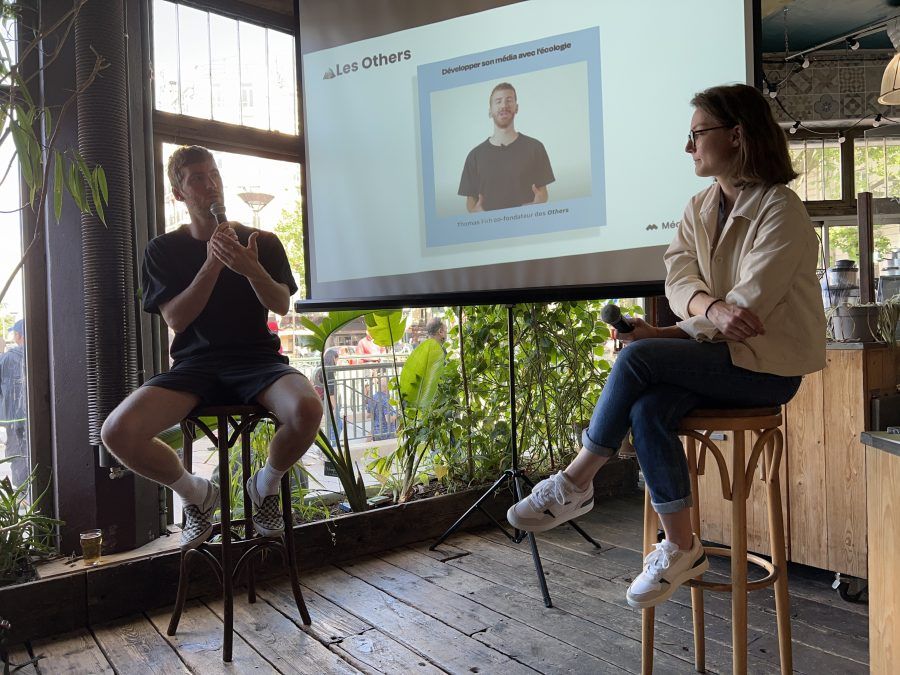
To ensure a certain level of editorial and strategic consistency, Thomas makes it a point of honor to apply the values championed by Les Autres to the day-to-day management of his media outlet: “We’ve chosen to move at a slower pace and to have ambitions other than growth or building a large team. ” And because working on a magazine involves working with raw materials, certain choices must be made to ensure harmony between content and form. “We’ve never thrown a magazine in the trash,” Thomas continues. “We’ve never gone through traditional distribution; we choose paper made in France and sustainable inks, and we’re currently working on a values charter—for ourselves, but one we’ll publish to try to set an example.” Stay tuned, but one thing is certain: we can’t wait.
"Our goal is to keep doing what we do, and to keep getting better at it as we gain experience. And to be able to choose our advertisers more carefully" — @FirhThomas @LesOthers
— Médianes (@medianes_org) May 28, 2022
Four Ways to Launch or Grow Your Media Outlet with a Focus on the Environment
We also included examples from media outlets that were not represented at our roundtable discussion.
Establish or join a charter
The environmental media outlet Vert has partnered with journalists, scientists, and citizens to establish a charter addressing issues related to the environment and media coverage. Loup Espargilière, the founder of Vert, appeared on the “Club indé” segment of “Arrêt sur images” on May 25 and outlined the details of this project. The goal of the charter is “to bring citizens and journalists together around climate information and to ensure better coverage of environmental news ,” Loup explained on the show’s set. This charter aims to reach the mainstream media and those who are not directly involved in environmental issues because “these are eminently cross-cutting topics.”
The charter is presented as 12 principles to be followed. Among these are specifically: addressing climate, biodiversity, and social justice in an integrated manner, placing greater emphasis on education, ensuring transparency regarding the sources used and the experts interviewed, examining the vocabulary and imagery used, exposing the strategies designed to sow doubt in the public’s mind and delay action (greenwashing), provide information on how to address the crisis, and promote journalists’ right to ongoing training throughout their careers. The goal is to establish a document that will stand the test of time. This charter is intended to be signed by numerous media outlets and journalists’ associations “to create a snowball effect and reach larger newsrooms.”
Climax is collaborating on the development of this charter. Joining forces to act on a larger scale is also the idea behind this charter, as Lauren Boudard explained during our roundtable discussion: “We’re currently working with them to create a guide, a charter. The idea is to establish a common foundation that can set out best practices for media organizations to follow. Meetings among smaller media outlets are essential for bringing these issues to the attention of larger ones.”
Select Advertising and Partners
During our roundtable discussion, Climax pointed out that “a climate-focused media outlet can hardly rely on advertising ,” so they decided to make their newsletter a paid service and rely on their community to fund its production.
For their part, Les Others derive one-third of their revenue from their studio’s activities. One of the conditions for maintaining this model is to remain vigilant in the selection of advertisers by refusing any assignments from brands that show little concern for thethe environment. In 2017, Les Others joined the “1% for the Planet” collective, which helps companies make a positive environmental impact. As a result, 1% of Les Autres’ annual revenue is donated to organizations that work to protect the environment.
"Our goal is to keep doing what we do, and to keep getting better at it as we gain experience. And to be able to choose our advertisers more carefully" — @FirhThomas @LesOthers
— Médianes (@medianes_org) May 28, 2022
Print media: Prioritize pre-orders
In June, Climax is launching a 116-page fanzine. What about the environmental impact? To plan ahead and avoid printing more than necessary, Dan and Lauren ran a crowdfunding campaign. The pre-order system allows the Climax team to get a precise idea of how many copies to print. Not distributing the magazine at newsstands also helps prevent unsold copies from being destroyed. Beyond limiting print runs, the pre-order system makes it possible to gauge public interest in a given project.
Les Others also held pre-sales for the Recto Verso project, which was printed in France. For the magazine, despite the rise in paper prices, the team continues to use sustainable inks and paper.
Educate and raise awareness within the community
Les Others shared “The Code of Responsible Adventure,” in which they offer some simple tips to follow for traveling in a way that respects nature. “These are basic steps, but sometimes it’s worth reminding people of them. This means taking an interest in the destination and its residents, researching current regulations, packing the right gear and choosing appropriate transportation, leaving the place exactly as you found it, not disturbing the flora and fauna, offsetting CO2 emissions, and not share exact locations on social media, especially if you have a large following,” Thomas Firh listed during our roundtable discussion.
In its early newsletters, Vert shared homemade recipes for making your own cleaning and beauty products. They also recently published “first aid for the climate,” which consists of simple, everyday tips for citizens to reduce their carbon footprint: stop flying, adopt a plant-based diet and eat locally, or buy secondhand.
Note: We had previously announced that the event would be available on our website in audio format. However, we encountered problems during the recording and are unable to make it available to you. We apologize for this. You can check out our Twitter feed from the event.
Editor’s Note: Médianes, the studio, worked with the Climax team on the launch of its fanzine and with Vert on its fundraising campaign in the spring of 2022, and Les Autres in a fundraising effort in 2021.
______________________________________________________________________________
For further reading:
Details about the event are available on Twitter.
Check out all the episodes of the series “Testing Your Project,” where we interview, among others, the founders of Climax and The Others.
Learn about environmental issues through BBC courses designed for journalists.