Key takeaways: five reasons for caution about Substack
- One more middleman. Substack stands between publishers and their readers, puts its own brand ahead of theirs, and takes 10 percent of every subscription. In the iPhone app, Apple takes its cut too: more than a third of the price can then slip away from the writer.
- A garden that is hard to leave. Leaving Substack means losing your followers, who can’t be exported. And outside the United States, paying subscribers who signed up through the iPhone app only follow you as free readers: their billing stays with Apple, and they have to be persuaded to pay all over again.
- Investors to pay back. Valued at $1.1 billion thanks to venture capital, Substack has to grow fast, and is now turning to advertisers.
- A competitor for newsrooms. It is chasing the same budget they are: the money readers spend on news.
- A neutrality that comes at a price. With minimal moderation and rankings based on sales, the platform also takes its cut from neo-Nazi and conspiracy content.
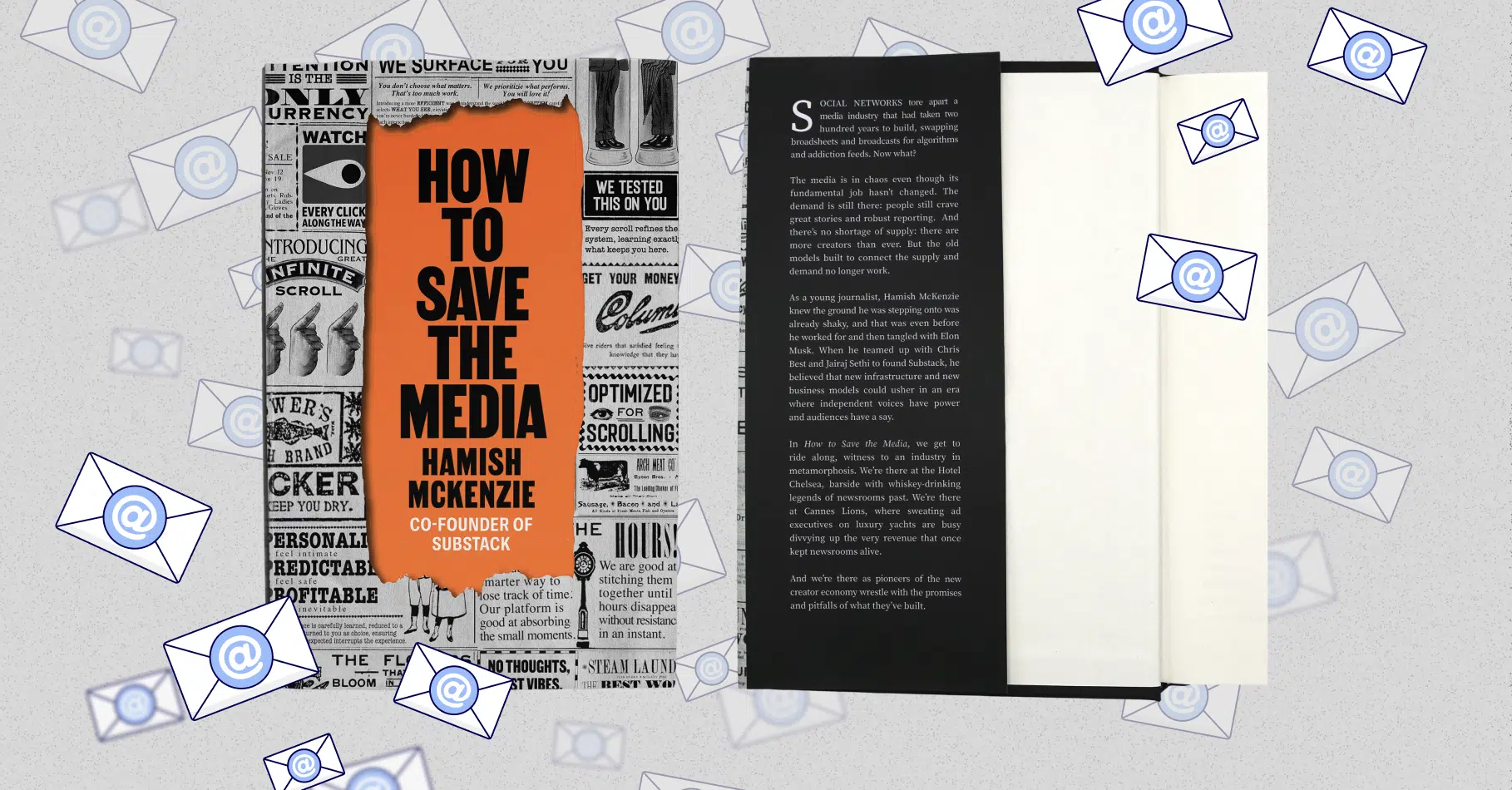
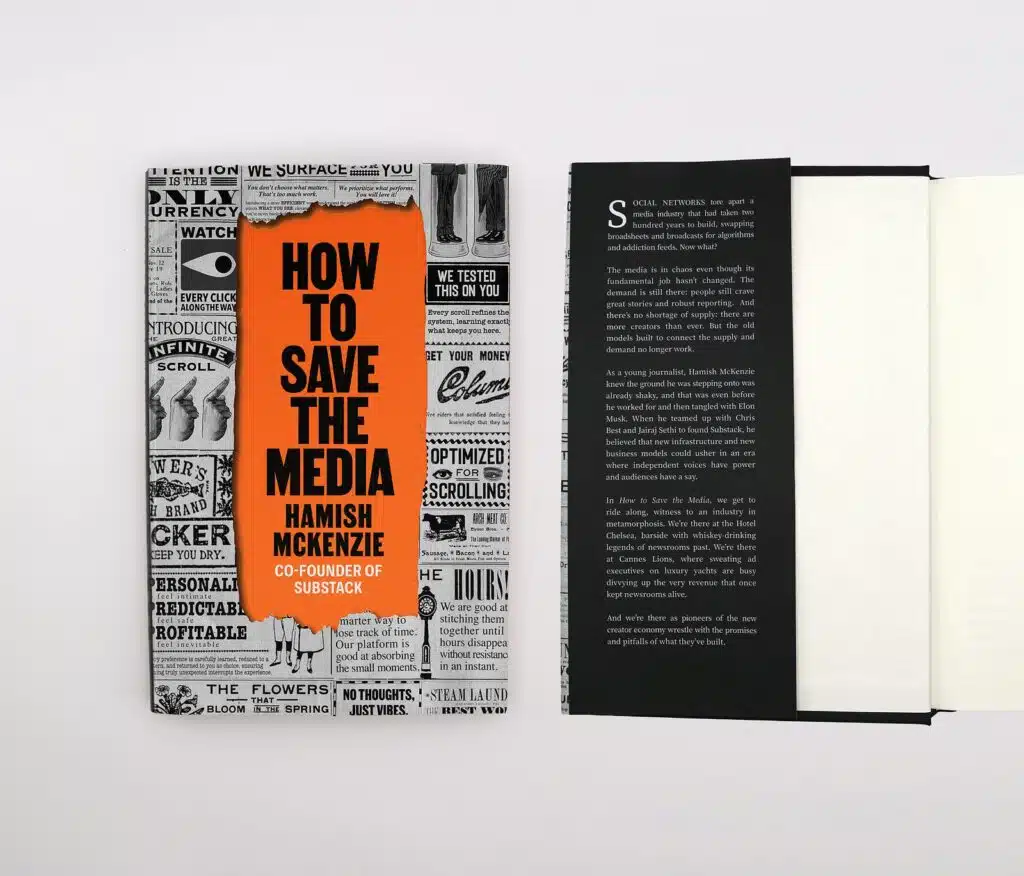
I have just finished reading How to Save the Media, the book by Substack cofounder Hamish McKenzie, and I want to believe it: what if a tech platform, backed by the right business model, were one of the keys to saving the media? Just published in the United States, the book tells the story of how a paid-newsletter platform became a social network, valued at $1.1 billion in 2025 and claiming more than five million paid subscriptions. Its first chapter opens with a dinner at the Chelsea Hotel, the New York landmark where generations of artists and writers have lived. Around the table, Seymour Hersh, who exposed U.S. Army massacres in Vietnam and now publishes on Substack, sits alongside Carl Bernstein, one of the two reporters who brought down Nixon, and other talented writers who have made the platform their home. The narrative is clear: the next Watergate could well be born on Substack, funded by its readers and made possible by the platform. In an America where the president calls the press “the enemy of the people,” the promise resonates. The media, McKenzie asserts, won’t just be saved, but will be “deeper, more diverse, and more valuable than ever.”
On the other side of the Atlantic, Substack has adapted its story. In France, it doesn’t promise the next Watergate, but a place for voices that struggle to find one elsewhere. And here too, I want to believe it. With a handful of conservative billionaires tightening their grip on media outlets and publishing houses, and public broadcasting threatened in its budget and even in its existence, the platform looks like an alternative: a space where writers can write freely, at length, and be paid directly by the people who read them. I find writers I admire there, starting with feminist authors such as Lauren Bastide, Victoire Tuaillon, Judith Duportail and Mona Chollet. And they are not relegated to a corner: several of them rank among the platform’s top-selling French publications. As part of its European push, Substack has recently hired country leads in Italy, Spain, the Netherlands and France, where Renée Kaplan, with whom I spoke at length for this article, was appointed in spring 2026. Her appointment got the French media world talking, and for good reason: she is no tech PR person. A French-American journalist who worked at CNN, France 24 and the Financial Times before running the news division of Arte, and a visiting fellow at the Reuters Institute, she knows the media from the inside, and its crisis better than anyone. It is hard not to be tempted.
So why not believe it? Because we have had this dream before, and McKenzie tells the story himself. In the opening pages of his book, he describes the news outlets that, in the 2010s, sold their souls to Facebook’s News Feed in exchange for audiences and advertisers, until the platform deprioritized news, in 2018, and their traffic collapsed. The media industry had learned a painful lesson, he writes: “The techies were not to be trusted.”
The point is not to say that publishers or creators should stay away from Substack. It is to understand who Substack really serves, and what we risk by entrusting it with our content and our audiences… and by repeating the same dependency we have on Meta today.
One more middleman… just a less toxic one
Substack’s best argument is the comparison with other platforms, starting with Meta. The company has methodically turned its back on news, on the grounds that “people don’t come to Facebook for news and political content.” Reporters Without Borders sees ten years of a “war of attrition” against journalism. In October 2025, Meta’s abrupt halt in Europe of “political, electoral and social issue” ads wiped out thousands of promotions by news outlets, as we documented. A year later, Meta tried to give itself the right to broadly scrape the websites of publishers present on its platforms, with no way to opt out, and faced an outcry.
Publishers are not the only ones growing tired of these platforms. Designed to capture attention, these networks also wear out their users, to the point that the European Commission wants to force Meta to make them less addictive. Many creators and readers say they are joining Substack to take back control of their attention. The French writer Blandine Rinkel, for instance, told the magazine Revue 21 that she wanted to “drastically reduce [her] presence on Instagram,” and to find on Substack “a place to convey the vitality of writing, serenely.”
Substack’s founders make this diagnosis themselves, and rightly so. The problem with platforms, they argue, lies in their business model: paid by advertisers, they have to maximize attention, not quality, and it is this model, McKenzie writes, that determines “what gets amplified and what gets suppressed.” Substack, by contrast, lives off subscriptions: it takes 10 percent of them, on $90 million paid out each year to European writers, according to the platform. It only makes money when they do. Which leaves one question: who funds the platform itself?
A network like any other?
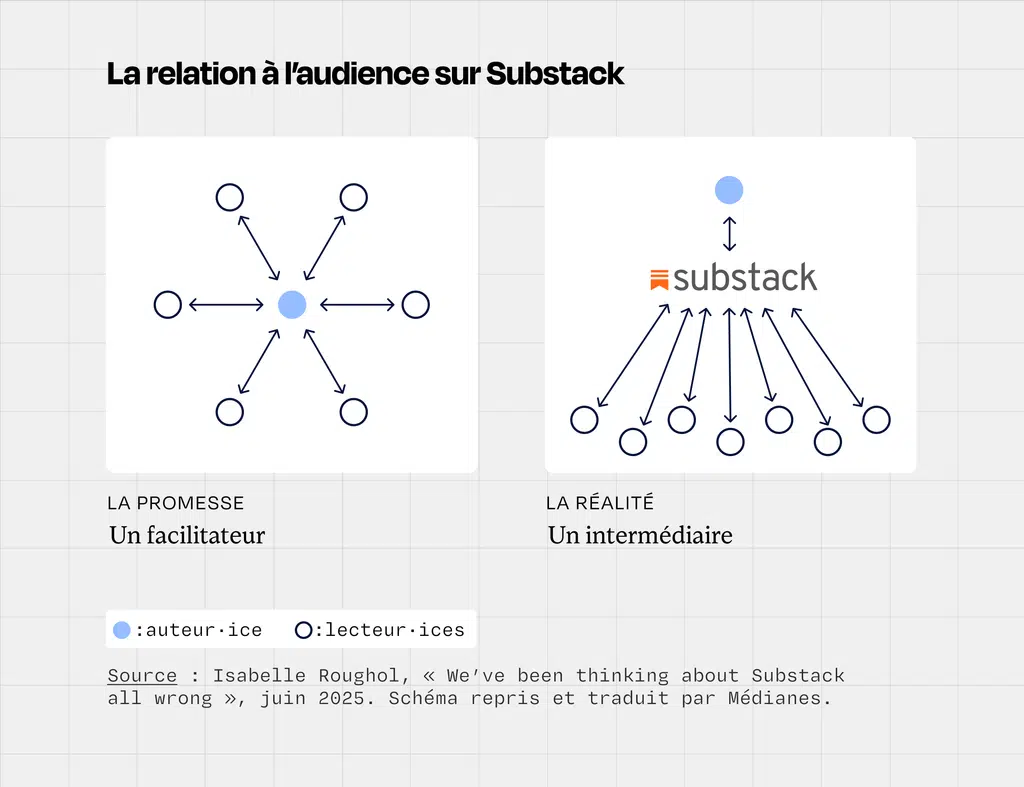
Does Substack escape this logic? Only partly. For media analyst Simon Owens, the platform has become an audience ecosystem comparable to the major social networks, with one difference: it allows publishers to collect their audience’s email addresses and convert them directly into paying subscribers. The least bad of the social networks, in other words, but one that lures publishers with the same promise of audience as Google, Facebook or X.
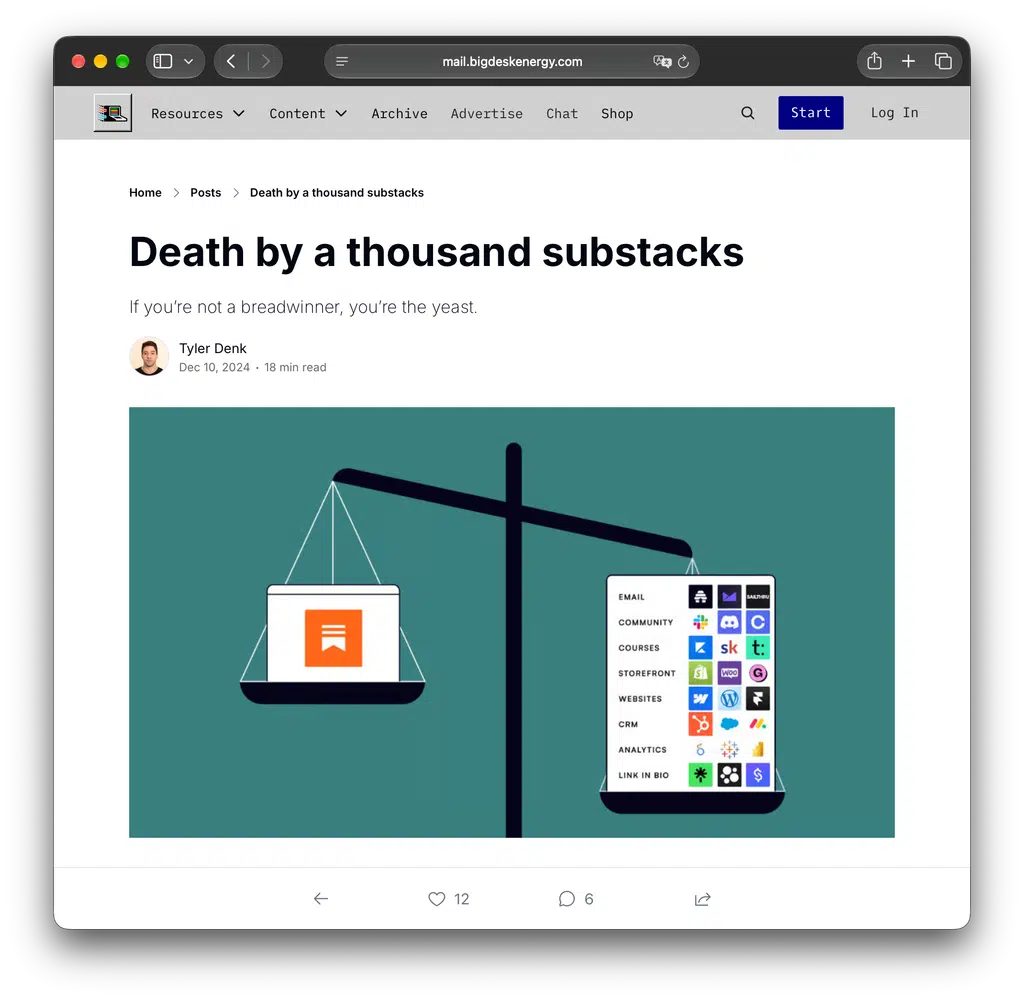
And that audience comes at a price: the visibility of their own brand. Substack could have remained a discreet tool, a “Shopify for news,” infrastructure in the background, serving writers. McKenzie chose instead to build “not just tools but an entire system.” The result, described as early as late 2024 by Tyler Denk, cofounder of Beehiiv, Substack’s main competitor: every publication looks the same and blends into the Substack brand. A “calculated erosion of writers’ brand identities,” to build a social app “on the back of the platform’s top voices.”
This is precisely what Le Monde, France’s leading daily, refuses. Louis Dreyfus, chairman of its management board, says the paper is by far France’s biggest digital-subscription news outlet partly because it has refused intermediaries, from aggregators such as Cafeyn yesterday to Substack today: “We try to get readers to subscribe to our media, not to an intermediary.” He also sees a threat to “the strength of the collective” in newsrooms. Substack rewards bylines rather than teams: as we argued back in May 2025, it redistributes audiences more than it creates them, to the benefit of those who are already visible.
A fertile garden… with high walls
While Substack presents itself as the antidote to the big platforms, its critics argue that it increasingly looks like them: a fertile garden, to be sure, but one whose walls keep getting higher.
In fact, the garden image comes from McKenzie himself. In a post based on his TED talk, he describes the shift from the “temple” of legacy media to the “chaos” of social media, and then to the garden: a distributed system that gives economic autonomy to independent voices, which Substack aims to embody. The opposite, he promises in another post, of the “big, closed garden” built by other social networks, where we own neither our audience nor our relationships, nor even our content. In tech jargon, a “walled garden” (jardin clos) is precisely a closed platform that is hard to leave, like Facebook or the App Store.
Yet from the very beginning, Substack dreamed of being a social network. In 2017, McKenzie recounts in his book, he and his cofounder Chris Best, now Substack’s CEO, wondered what Facebook would have been if it had been built on subscriptions instead of advertising. They already imagined an app with a news feed, profile pages and direct messages, and network effects that would make it more useful as it grew. A “venture-scale” idea, McKenzie writes: one built to attract venture capital. What they rejected in Facebook back then was its dependence on advertising, not the logic of the network.
Substack has built that network piece by piece, year after year: an app, cross-recommendations between publications, Notes (a feed of short posts similar to X), a button to “follow” without subscribing, then video. And it delivers. According to Substack, its network (recommendations, the Notes feed, the app) brings in around 30 percent of paid subscriptions and, Renée Kaplan adds, up to half of free subscriptions. Do writers need to play the social network game, post Notes, and recommend their peers? Nothing is mandatory, she insists. Still, the more growth comes from the network, the more costly it becomes to do without it.
Leaving, but at what cost?
In theory, leaving Substack takes a few clicks. McKenzie keeps saying so: “No walled garden would let you export your mailing list, content, and even payment relationships at any moment.” But followers, the audience the platform now pushes writers to build first, can’t be exported, as The Verge notes.
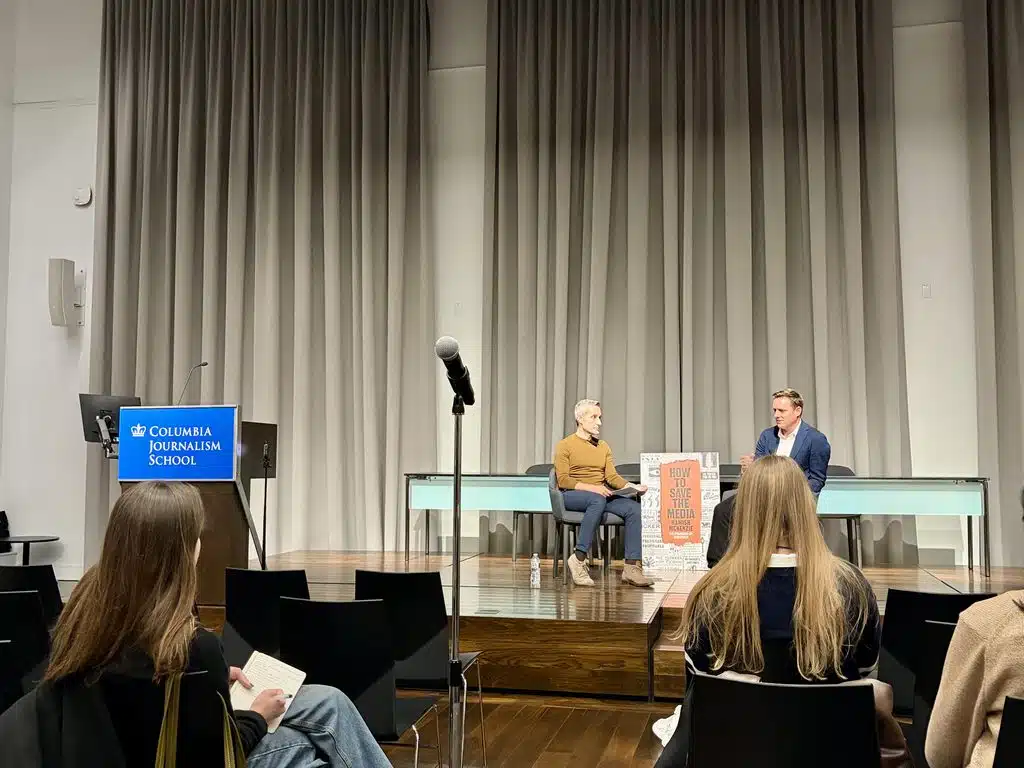
On November 18, at an event at Columbia Journalism School in New York, I told him what holds me back when I advise publishers on whether to join Substack: followers can’t be exported. Is that likely to change? He answered by explaining why followers exist: they were introduced because writers asked for them, so that readers could, as he put it, “date before they got married,” getting to know a writer before subscribing. He acknowledged a “trade-off”: it can create “an impression that Substack is trying to trap some of your audience, which is not what we’re trying to do.” He gave no indication, however, that followers might one day become exportable.
And not all payment relationships can be exported either. Outside the United States, readers who subscribe through the iOS app have no choice but to pay through Apple, which takes its commission and may pay out only up to 45 days after the end of each month.
For a writer or a publisher, the stakes are very concrete. Take a €10 monthly subscription, excluding taxes. On the web, Substack keeps €1 and the payment processor, Stripe, around 50 cents, leaving roughly €8.50. In the app, Apple takes 26 percent in the first year in the European Union, on top of Substack’s €1, leaving just €6.40. To make up for it, Substack recommends raising the price for those readers, who would then pay around €13. “One option is terrible for us, the other is terrible for our readers,” a British newsletter editor told Journalism UK. The money also arrives later, which strains cash flow. Above all, billing for these subscriptions stays with Apple. The day a writer leaves Substack, these paying subscribers don’t follow: they become free readers again, who have to be persuaded to pay all over again. For journalist Isabelle Roughol, LinkedIn’s former international editorial director, who has written extensively about Substack, “this is the end of subscriber portability.”
Faced with these criticisms, Substack points to Apple’s rules. Yet in the European Union, under pressure from the Digital Markets Act, Apple now allows alternative payment options, with a lower commission but other costs, and billing that would no longer go through Apple. Substack knows this but doesn’t offer them, citing the fees involved: “We will update you if we decide to support it in the future.” Asked about this, a Substack spokesperson said the platform is “continuing to evaluate” these options to understand whether they “would offer meaningful benefits to publishers,” with no changes to announce at this time.
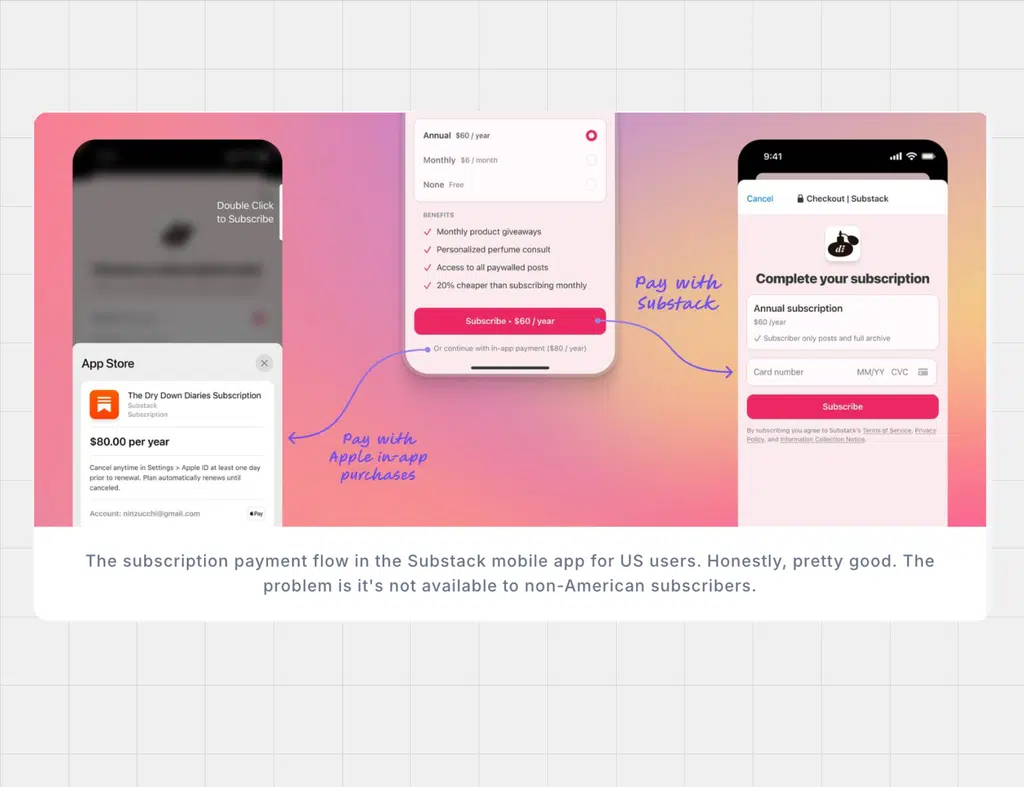
The promise that you can leave at any time, central to McKenzie’s pitch, is thus becoming increasingly theoretical. The garden has no walls, he insists, but it has doors, and they are getting narrower.
Who funds the garden… and to what end?
In Europe, and especially in France, who owns the media has become a central public debate. The same question applies to the platforms that claim to save them. Substack is neither a media outlet nor a journalists’ cooperative: it is a venture-backed Silicon Valley start-up. That Hamish McKenzie was a journalist before joining Tesla’s communications team changes nothing. Like any company of its kind, Substack answers first to its investors.
The problem is not that Substack wants to be profitable: a media outlet must be profitable too in order to stay free. The problem is that we have seen this movie before. “What Substack is selling us today is exactly what Facebook sold us yesterday,” journalist Lucie Ronfaut told Méta-Media. Google and Meta long presented themselves as allies of journalism, complete with funding programs and progressive rhetoric. Then Donald Trump returned to power, and their leaders lined up in the front row of his inauguration, alongside the other tech barons. When their interests were at stake, lofty principles did not count for much.
The lesson applies to Substack: editorial independence cannot simply be declared. It goes hand in hand with financial independence and technological independence. A media outlet may be free to publish what it wants; if it depends on a platform to be read and paid, it also depends on whoever owns that platform.
Substack’s investors are not neutral toward the press, either. Its earliest major backer, Andreessen Horowitz, is the firm of Marc Andreessen, who has sat on Meta’s board of directors since 2008. McKenzie himself acknowledges that Andreessen, a vocal critic of the media, encouraged start-up founders to go through social media to get around the press’s filter.
Above all, a venture capital fund doesn’t back a cause: it bets on rapid growth, in order to later sell its stake for far more. In 2025, Substack raised $100 million at a $1.1 billion valuation. Three years earlier, in 2022, it had abandoned plans to raise money at that level and laid off 14 percent of its staff. It now has to justify that price: according to The New York Times, Substack is more interested in taking on YouTube than Mailchimp.
Subscriptions alone won’t get it there. Even in countries where paid subscriptions are common, only 17 percent of people surveyed by the Reuters Institute pay for online news, and just 12 percent in France. That ceiling hasn’t moved in years. One of Substack’s investors, Mike Kerns, therefore considers it “inevitable” that advertising will play a bigger role. McKenzie once called that model “busted”. He now speaks of “a recognition of new possibilities.” In late 2025, Substack began courting brands to match them with its writers, before launching a sponsorship program in June 2026 with partners such as Balenciaga and Uber. It initially took no commission, but according to City AM, that was likely to change if the scheme worked.
For independent publishers, competition now plays out on every front. Subscriptions and donations, long presented as the path to a press freed from advertising, draw on the same budget: the money readers set aside to support journalism. Substack competes with newsrooms for it, and takes its cut along the way. It is setting up shop where the media’s money flows.
Yet none of this was inevitable, especially for a platform that claims to want to save the media, or at least to help it. Other players have made a different choice: Ghost, one of its competitors, is structured as a nonprofit foundation so that it never has to serve shareholders rather than its users. In Europe, newsrooms are already breaking free of Silicon Valley tools, thanks to open-source alternatives or homegrown tools. Substack, for its part, chose venture capital. Knowing who owns it is therefore no small detail: it tells you who it works for, and to what end.
A neutrality that isn’t neutral
Substack presents itself as neutral toward the writers it hosts, including the most extreme ones. But a platform with no editorial line, which ranks its writers by revenue and must grow to pay back its investors, does more than redistribute money. It decides, without saying so, which voices have the means to exist.
Social networks have long been accused of serving as echo chambers for extremist speech. Substack goes further: it lets that speech be funded. In late 2023, The Atlantic revealed the presence of neo-Nazi publications on the platform. Writers signed an open letter. Yet the leadership refused to demonetize those publications: “The more we pushed ourselves on every point,” McKenzie writes in his book, “the more certain we were that we shouldn’t change our position.” It merely banned a few reported accounts. Several writers left, including Casey Newton with Platformer, one of its flagship newsletters.
McKenzie does acknowledge “egregious errors”: in July 2025, Substack sent hundreds of thousands of app users a push notification promoting a publication that displayed a swastika. A “humiliating incident,” which led the company to fix a bug and review its recommendation rules. Not its doctrine. In February 2026, a new investigation by The Guardian showed that the platform was still taking its commission on newsletters glorifying Hitler or denying the Holocaust, sold for up to $150 a year. Substack did not respond to the newspaper.
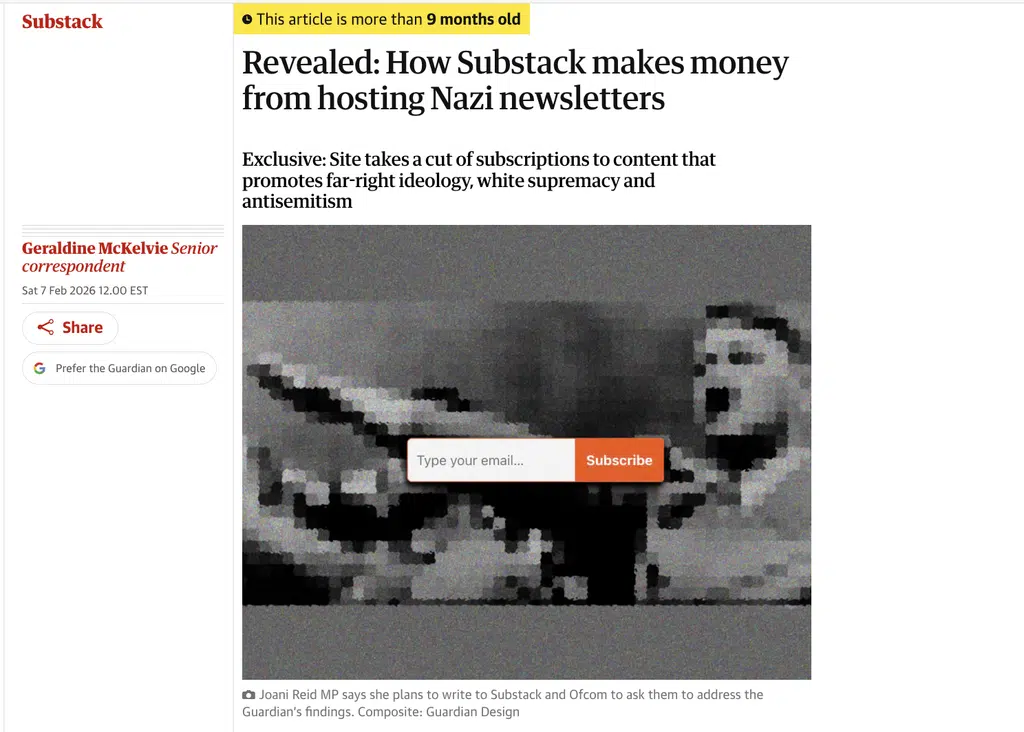
To many Europeans, this doctrine is surprising. It stems from the American conception of free speech, which protects nearly all speech short of direct incitement to violence, whereas many European countries, including France, strictly regulate incitement to hatred and Holocaust denial.
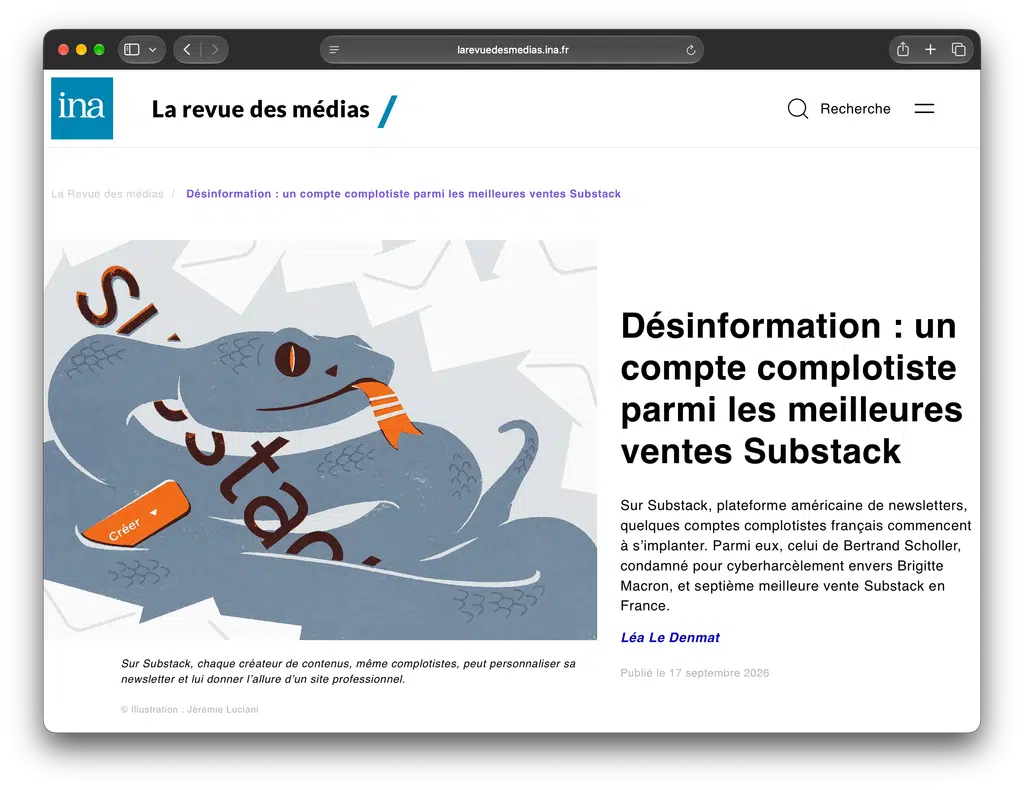
In France, this fall put the doctrine to the test on different ground: not Nazism, but conspiracy theories. In September 2026, La Revue des médias revealed that Bertrand Scholler, convicted at first instance of cyberbullying French first lady Brigitte Macron and banned from using his social media accounts for six months, had been able to carry on on Substack, which is not considered a social network. His newsletters are paid, up to €25 a month, of which Substack takes 10 percent, and he then ranked seventh among the platform’s top-selling French publications.
Asked about adapting to the European context, Renée Kaplan speaks less of adaptation than of a “recommitment to a clear message.” Substack acts “in full compliance with local laws,” steps in when content is reported, and above all encourages each writer to moderate their own publication. Bertrand Scholler, she stresses, “was clearly within the bounds of the law.” And defending his freedom of expression “in no way” means endorsing his ideas: all points of view, even those with which one is in “fervent disagreement,” “have the right to exist.” Perhaps. But a bestseller list is not neutral. Substack publishes, by country and by category, a ranking of the publications that earn the most paid subscribers. Being on it means being showcased to people discovering the platform, and presented as a success. The ranking draws new subscribers to those voices, and helps fund them.
Join? Yes, but with eyes open
At the end of our interview, I asked Renée Kaplan what guaranteed that Substack would not change course, as Facebook and Google did before it. Her answer: every change to the platform remains “fully consistent with its mission and core values.” It is a fine promise, but unfortunately not a guarantee.
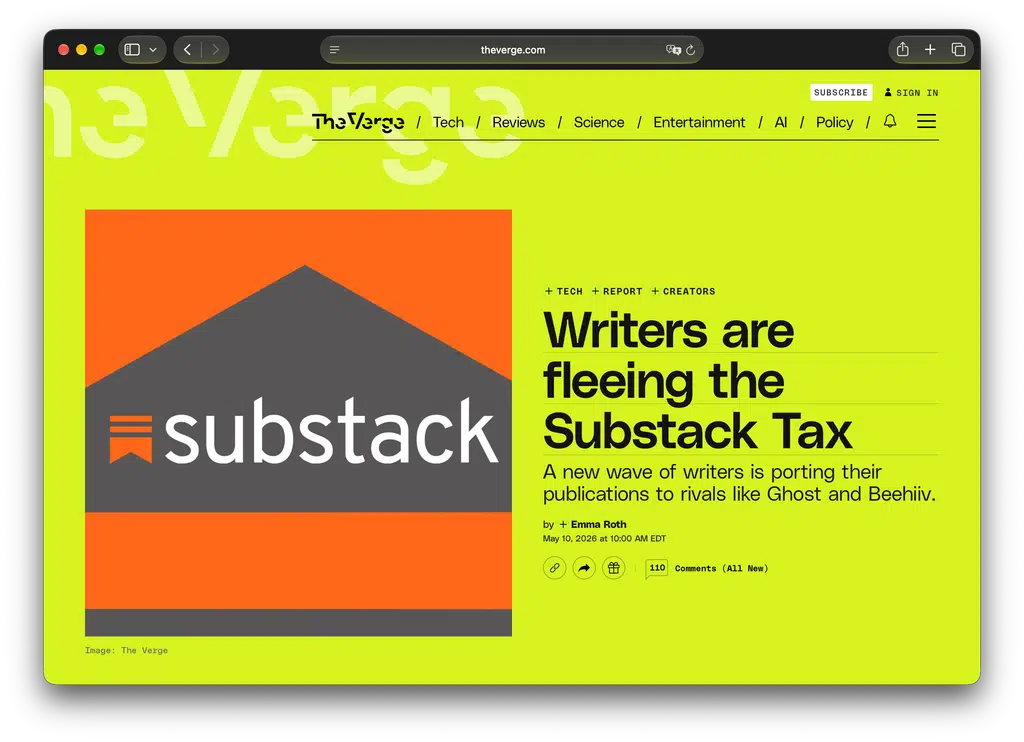
Substack serves first those who already have a community, provided they keep control of their audience. And even for them, the math ends up being expensive. In the United States, a new wave of departures picked up last spring, documented by The Verge. This time, it is not neo-Nazi newsletters driving writers away, but what many call the “Substack tax”: the bigger a publication grows, the heavier the 10 percent commission weighs, while competitors charge a flat fee. The Ankler, one of the platform’s most popular publications, has left, and other major titles are considering following. In the end, Substack mostly serves its investors, with every subscription and perhaps, tomorrow, with every sponsorship. It serves newsrooms, writers without an audience and media pluralism far less.
Nothing stops anyone from joining. But with eyes open: use the network without handing it your payment relationships, your brand or your advertisers; for newsrooms, set rules for their journalists’ Substacks rather than ignoring them; and for everyone, look at who funds the platform, not just at what it promises. Other tools exist, from Ghost to Beehiiv, which is also venture-backed but says it wants to remain a tool, in the manner of Shopify, rather than become a system.
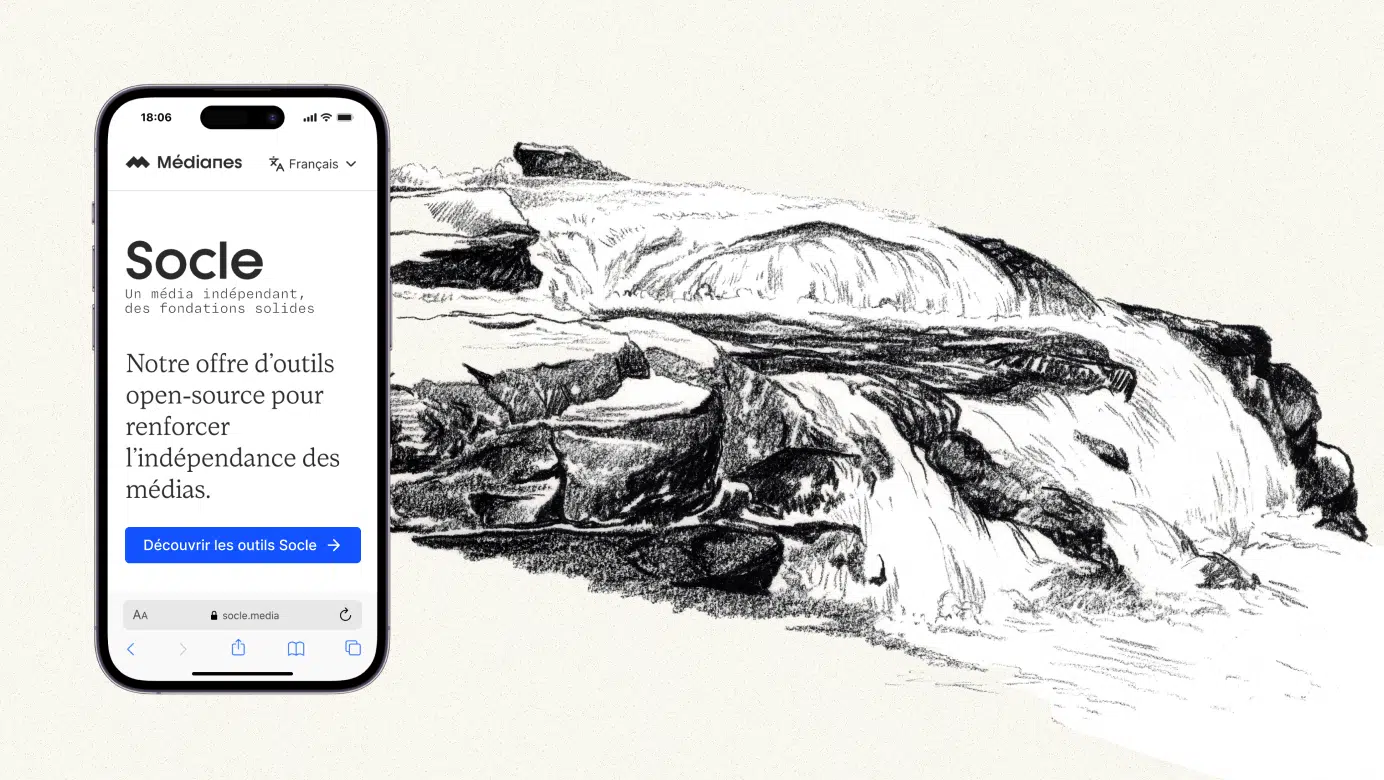
At Médianes, that is also why we created Socle, a set of open-source tools for independent media: because the financial temptation is strong as soon as a tool stops aiming to remain just a tool, and because media independence is also technological. McKenzie has already drawn the lesson from Facebook: “The techies were not to be trusted.” At Columbia, I asked him why we should believe that Substack won’t become the platform he criticizes in his book. On that point, he did not answer. In my view, the lesson applies to his own platform too.
To go further
- As early as May 2025, we explained why Substack reproduces the imbalances of the media system rather than correcting them: “Substack, or the illusion of independence.”
- From courtship to withdrawal, twenty years of Facebook’s U-turns on the press: “Facebook and the media: 20 years of a dangerous relationship.”
- Open source, European sovereignty, tools designed with newsrooms: our principles, in “Media independence is also technological.”
- Before choosing a newsletter platform, the editorial, economic and technical questions to ask: “Newsletters: the questions to ask when choosing a platform.”
- How independent media are reducing their dependence on Big Tech tools: “Taking back control of your digital tools.”

Written by Marine Doux
Marine is the president, co-founder, and editorial director of Médianes. She supports media organizations in their growth and ensures that our activities have an impact. She is currently a visiting scholar at Columbia University’s Tow Center for Digital Journalism.