
💡 The fifth episode of our case study series, which each month explores the practices and strategies of the independent European press, along with our advice on how to implement them: technological independence, business models, diversification of content… This series is produced as part of our European media network, Sphera, and is aimed at media executives and content creators across Europe. Don’t want to miss the next one? Sign up for our newsletter.
Technological independence isn’t just about internal processes—the tools used to produce journalism. It also comes into play downstream: in how that journalism reaches the public. And in this area, dependence on major platforms is just as real. This guide takes stock of these risks, highlights practices used by European newsrooms to break free from this dependence, and offers concrete first steps, regardless of the size of your team.
For many newsrooms, social media isn’t a luxury they can do without: it’s often a key channel for reaching audiences—and sometimes even the only one. However, it’s certainly worth considering a more modest and pragmatic approach—perhaps scaling back a bit on these platforms and reinvesting that time in spaces you have more control over. The examples cited in this case study are intended to introduce you to a wide range of approaches, with varying levels of investment that can be adapted to your needs and business models.
1. Does this apply to me?
Your audience doesn't belong to you as long as it goes through platforms that set their own rules—and change them without warning. In recent years, there have been more and more examples of this.
X. The most notable example—which sparked a real awareness of the media’s dependence on these platforms—is Twitter’s transition to X under Elon Musk’s leadership. Several news organizations have seen a drop in their traffic: according to the Reuters Institute, visits from X to news sites have dropped by 46% worldwide since May 2023, and by 22% over the past year in Europe. Not to mention the fact that the platform is used for political purposes and exposes its users to misinformation.
Meta. Since August 1, 2023, news content has been blocked on Facebook and Instagram in Canada in response to a law requiring tech giants to pay media outlets. The company has also changed its policy on the visibility of content deemed “political” several times. Several media outlets have also reported declines in traffic. In Europe, since October 2025, Meta has banned ads related to “politics, elections, and social issues”—a category that is as broad as it is vague, causing concern among the press.
Google. Social media isn’t the only factor at play: changes to Google’s algorithms have already upended entire business models. With AI Overviews—summaries generated by artificial intelligence that appear directly on the results page—media outlets fear the advent of “Google Zero”: a collapse in search traffic because readers no longer need to click. Google search traffic to publishers has fallen by one-third worldwide in one year, and media executives surveyed expect an average decline of 43% within three years, according to the Reuters Institute.
But breaking free doesn’t mean leaving everything behind. There’s no need to close your social media accounts overnight, nor to launch a print magazine if that doesn’t fit your business model. There are many ways to venture beyond these platforms, on a wide range of scales and with very different budgets—even for a 100% online media outlet. This guide presents several of them, which you can adapt to your resources. This effort can also be seen as an opportunity rather than a cost: your reach may be smaller, but it’s a chance to build a more direct connection with your community—and perhaps even reach a new one.
Doing a favor for oneself—and for one’s readers. Some members of the public are fed up with screens and social media. Distributing journalism in a different way means responding to this desire for comfort and freedom in how people stay informed: reading off-screen, free from algorithms, at one’s own pace, and engaging with information beyond the channels offered by the media. It also means going against the grain of the race for innovation, to return to simpler things. Freeing yourself from the (often obscure) rules and criteria of platforms is a service to your journalism: it allows you to do the work you want to do, without having to bow to their demands.
2. How to Change Your Online Habits
2.a. Expand its direct channels (RSS, PDF, newsletter)
The web hasn’t always been dominated by huge corporations, and information hasn’t always circulated through social media. Returning to older, low-cost, and still-relevant practices can meet today’s needs. The most common example is the newsletter, which for years has been the preferred format for breaking free from algorithmic distribution. But this golden age may be threatened by the “AI-fication” of email inboxes. In January 2026, Google announced the arrival of Gemini in Gmail: automatic conversation summaries, writing assistance, and a “AI Inbox” currently in testing that sorts messages on the user’s behalf. AI could then come between you and your readers, just as social media algorithms have done. That doesn’t mean you should give up on newsletters, but other similar practices do exist.
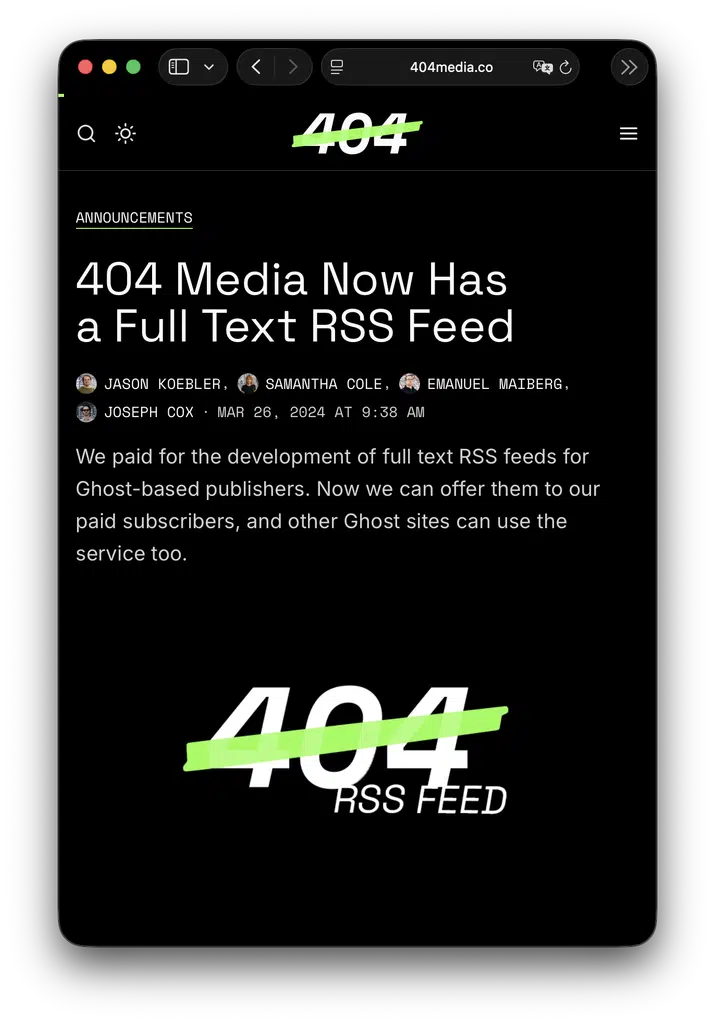
A Good Idea: The American media outlet 404 Media, which is owned by its journalists, noticed that a number of subscribers were asking for the option to access the full article—rather than just the headline—via an RSS feed reader. Its content management system (CMS), Ghost, didn’t allow for this, so the editorial team funded the development of a system enabling subscribers to read articles in full. Their reasoning: to be able to reach their readers directly, without relying solely on a search engine in decline or on social media algorithms that penalize outbound links. This feature is now among the benefits highlighted to convince readers to subscribe.
Another U.S. tech media outlet, Ars Technica, offers a similar initiative: full-text RSS feeds and even the option to download PDF versions of articles. “Support Ars and enjoy a better reading experience,” the outlet explains in a post detailing how these features work.
Does PDF seem outdated to you? Yet some media outlets are taking a renewed interest in it, seeing it as a way to circumvent algorithms—and censorship as well. Take *The Atlas*, for example—a weekly publication distributed as a PDF via WhatsApp and Signal: a file that’s passed from phone to phone and, most importantly, bypasses algorithms.
In practical terms
- Explain why you need your readers’ email addresses. Rather than treating the newsletter as just a way to read your content, emphasize the importance of the issue and the need to maintain a lasting connection. That’s what 404 Media did to justify implementing a sign-up wall to access its content.
- Make your RSS feed visible—with an icon in the footer or a “Follow Us” page—and explain it in one sentence. For example, Reporterre has a page that explains to its readers how to use RSS feeds to follow its publications, along with recommendations for tools.
2.b. Decentralize your online presence (Fediverse, Bluesky, Ghost)
You may have heard of “decentralization.” As the media sought alternatives to X, platforms like Bluesky and Mastodon emerged as potential options. Their advantage: a decentralized system. What does that mean? Just like with email, you can switch providers without losing your contacts. Just like with podcasts, you don’t have to post separately on each platform—your content automatically appears on multiple platforms at once. Decentralization isn’t limited to social media. In 2024, the Ghost CMS announced its integration of ActivityPub, the protocol that enables communication with the “fediverse”: articles published on a site can then be followed and read on Mastodon, for example. If you use WordPress, an official plugin allows you to do the same. Several media outlets, including The Verge and 404 Media, have expressed interest in this type of system.
However, these practices are still relatively new and evolving: before diving in headfirst, start by experimenting little by little. Find out how media outlets like Ouest-France, Les Jours, and L’Informé have launched on Bluesky, Threads, and Mastodon.
The Bristol Cable, a British cooperative media outlet, has taken it a step further by launching a mobile app that combines its journalism with the Fediverse. Developed in collaboration with the Newsmast Foundation—an organization that helps other groups use and develop “decentralized” tools—the app is available exclusively to subscribers. Subscribers can read the outlet’s articles and publish posts, which are also visible on Mastodon and other federated platforms.
2.c. Building Your Own Platforms
When no existing platform is suitable, some independent media outlets choose to join forces to build their own. This is the most ambitious approach, but it’s also the one that best illustrates what collaboration makes possible: what one newsroom cannot do alone, several can accomplish together.
In Canada, Meta’s blocking of news content served as the catalyst. In November 2023, twenty independent media outlets launched Unrigged.ca, a collective, nonprofit platform that aggregates and highlights their content, allowing them to continue reaching their audiences despite the block. At the time, its founders claimed a combined audience of over one million readers.
In France, collective efforts take other forms. Since 2015, Basta! has maintained its “Free Media Portal”—more recently renamed the Independent Media Portal—designed as an alternative to Google News: a hand-curated selection by journalists of hundreds of French and foreign media outlets. Another example is La Presse Libre, which follows a similar approach through a bundled subscription system: ten independent media outlets, a shared portal, and a single subscription to access them all. On the website, users can read content from multiple media outlets within a single space.
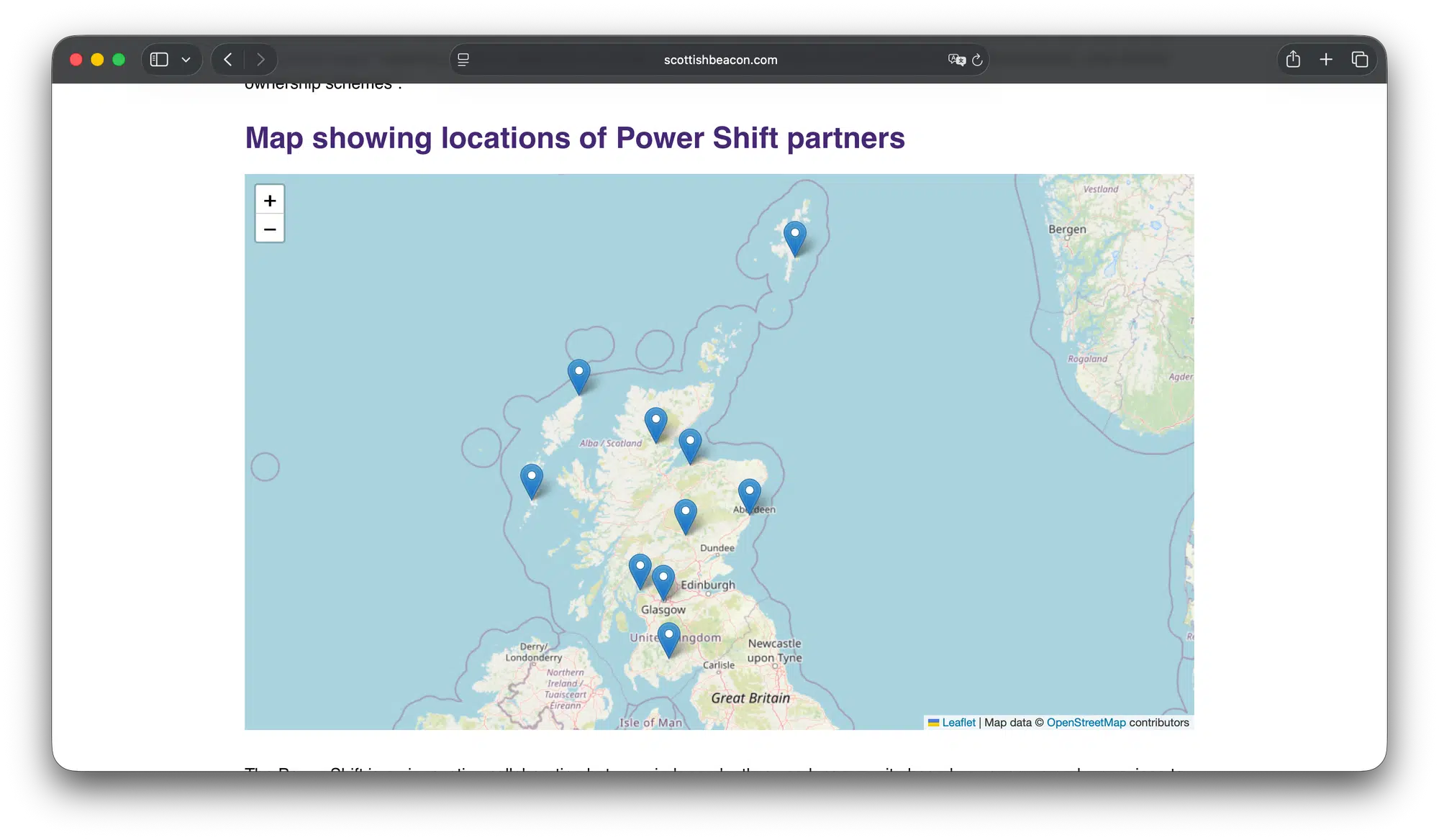
This approach is also proving effective for local media. In Scotland, about 20 local newsrooms have joined forces under the Scottish Beacon. For Power Shift, a collaborative investigative project on the energy transition in Scotland, the network’s website aggregates articles produced by about ten newsrooms, which then republish them on their own sites with a sidebar and an image linking back to the project. The network has also negotiated a reprint agreement with The Herald, a national newspaper, and recently produced a print magazine.
A Great Idea: That’s the vision behind Urbania, a media outlet founded in Canada in 2003 and established in France since 2020, with its Micromag: a 100% digital publication that incorporates magazine elements (covers, photos, interviews) into vertical slides—similar to Instagram Stories—and blends video, motion design, and interactive features. Rather than publishing it on Instagram or TikTok, the outlet hosts it on its own website to limit its dependence on the platforms’ algorithms and moderation rules. No app to install—a simple link is all it takes. Access is free, but readers must provide their email address or phone number while reading: this allows the publication to build its own subscriber base. Issues are then distributed via newsletter and text message. To learn more, check out our interview with the Urbania team.
3. Explore new channels beyond the web
3.a Getting Off the Internet: Paper
Print is a medium without algorithms—it’s read off-screen and passed from hand to hand. Printing, storing, and distributing it can require time, a budget, and logistics that some newsrooms simply can’t afford. The good news is that exploring print doesn’t mean launching a magazine. It’s possible to start small—with a folded sheet of paper, a zine, a poster, or a booklet featuring previously published content.
Think about the simplest and most effective format to distribute on paper. Start by thinking about what you want to convey—even if that means limiting yourself to a single A4 sheet: this will force you to identify the essentials (your values, key information, a manifesto, etc.). Next, consider the locations where you’d like to distribute it.
Think about what you’d like to include in it, limiting yourself to one A4 sheet if necessary: this will help you identify what matters most (your values, information, a manifesto, etc.). Next, consider where you’d like to distribute this material.
Médor, a Belgian cooperative magazine, published its “Call for Robust Journalism” in late 2023 in the form of a folded poster, which was included in issue No. 33 and then distributed to cultural venues, bars, and shops. The appeal can also be printed from their website. The American media outlet WIRED also released a zine titled “How to Win a Fight?” based on past publications. Beyond being an interesting way to give new life to previously published content, this format is designed as a practical tool for wide distribution, featuring advice on how to protest safely.
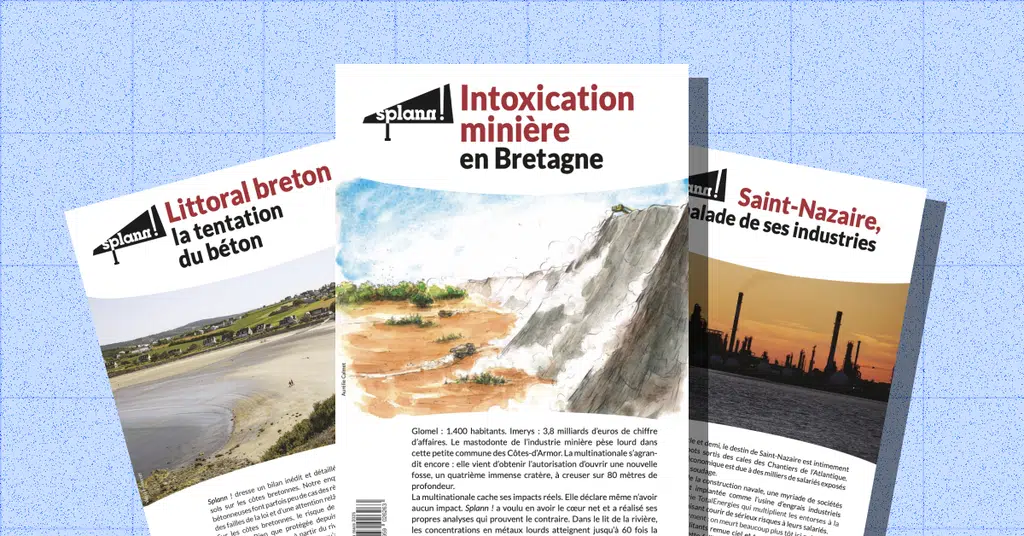
La bonne idée Splann, a nonprofit investigative media outlet based in Brittany, publishes its investigations for free online but also offers them in print. Its major reports are printed as bilingual booklets, distributed primarily through bookstores, and nearly 700 booklets were ordered during its first online sales campaign. In the spring of 2026, a new campaign offered two additional booklets—on the public hospital and agricultural high schools—for 11 euros each, including shipping. Print also serves as a field tool for the organization: in 2022, one of its investigations into a mega-pig farm was distributed in print form in mailboxes by local residents. To learn more about how Splann designs and distributes its booklets, check out our report and our interviews with the media team.
3.b Existing in physical space
A purely online media outlet can also exist on the street, on stage, or at a café counter. Physical space does not replace digital distribution—it creates points of contact that no one can cut off. But how do you go about it? With simple, low-cost methods.
In Augsburg (Germany), the Augsburger Allgemeine placed QR codes throughout the city that linked to articles explaining the political parties’ proposals on specific local issues (daycare, transportation, urban planning). This was a way to illustrate the connection between the information and its tangible impact on the public’s daily lives. Be careful, however, not to rely entirely on QR codes. In 2024, the Texas Tribune distributed printed guides and stickers to help Texans unfamiliar with the voting process, each featuring a QR code linking to its online resources. Few people used it: only 108 scans out of 2,000 stickers distributed. The editorial team learned a lesson from this: print essential information (such as key election dates) directly on the material, rather than hiding it behind a QR code. The Texas Tribune also tested in-person distribution for an investigation into air quality near Houston: 500 flyers and 1,000 postcards, in English and Spanish, were distributed door-to-door and at high-traffic locations (school exits, churches, supermarkets, and laundromats), featuring links to local organizations and a QR code for more information.
Live journalism has also established itself as an effective way to reconnect with your audience and deliver your journalism with greater impact. If you’re interested in this practice, you can refer to our previous case study on the subject.
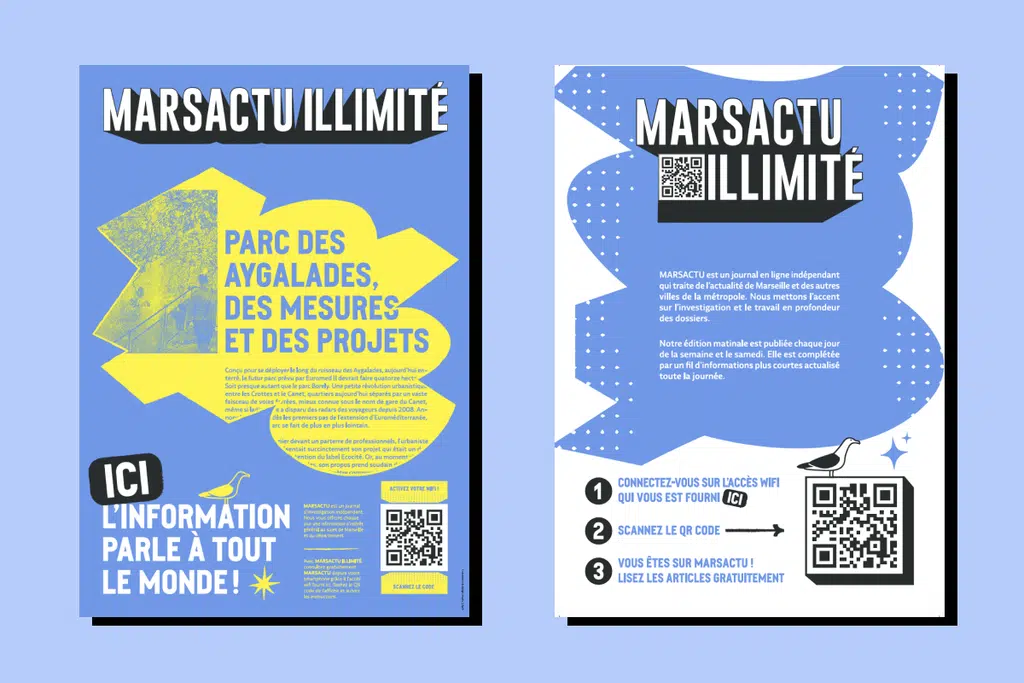
A Great Idea: Marsactu, an investigative media outlet based in Marseille, launched “Marsactu Illimité” to reach residents it has struggled to connect with: its subscribers are concentrated in the city center and the south, with far fewer in the outskirts—including among those most directly affected by some of its stories. At partner cafés and community centers, all you have to do is connect to the venue’s Wi-Fi to read all the articles, without a subscription or account. Flyers and posters featuring QR codes explain how the system works to people visiting these locations. For the media outlet, this is a way to reach an audience beyond its usual circles. To learn more about their experience, read our interview with Marsactu’s president, Julien Vinzent.
4. Accept gray areas and stay clear-headed
Breaking free from social media platforms is still a relatively new practice on this scale, and it remains difficult to provide a one-size-fits-all guide for each platform. The safest approach is to test things out and proceed cautiously, without trying to change everything at once. Each experiment should be monitored: measure the actual impact of each channel before moving forward, to determine what really works, what requires too much effort, and what’s best to abandon. It’s also an opportunity to learn, as several of the media outlets mentioned above have done, adjusting their approach based on feedback. Don’t keep these trials and errors to yourself: embracing this element of experimentation and sharing it with your readers—who are often receptive to these topics—may even lead them to support you.